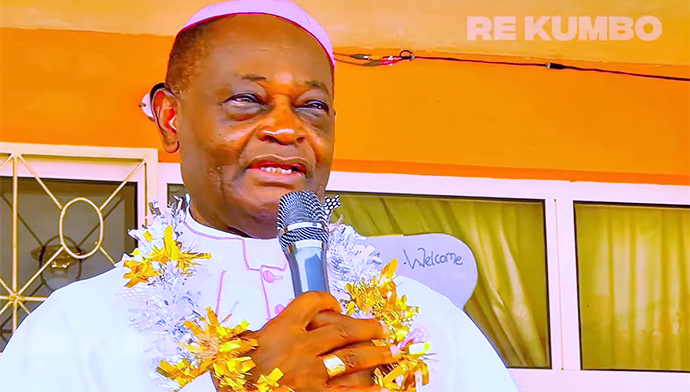
Amidst ongoing preparations for the arrival of Pope Leo XVI in Cameroon, the Bishop of Kumbo Diocese has offered a chilling appraisal of the ten-year separatist conflict that has devastated Cameroon’s English-speaking regions.
The Holy Father’s three-day visit to Cameroon, April 15-18, will include a significant stopover in Bamenda, the capital of the war-torn Northwest region, highlighting the Vatican’s commitment to a crisis that has claimed the lives of at least 6,500 individuals and displaced more than a million others.
Conflict and the country’s colonial past
A decade ago, Cameroon’s long-simmering Anglophone problem erupted into a full-blown crisis. The roots of the conflict lie in the nation’s colonial past, when the British Southern Cameroons (today’s Northwest and Southwest regions that were colonized by Britain) unified with the French-speaking Republic of Cameroon in 1961.
Many in the Northwest and Southwest regions, collectively known as Ambazonia by separatists, felt their distinct legal system and educational traditions inherited from colonial Britain were being systematically eroded by the predominantly Francophone central government.
The immediate flashpoint came in 2016, when lawyers and teachers in the two regions launched peaceful protests against the imposition of French in their courts and schools.
The government’s heavy-handed response, which included mass arrests and lethal force, shattered any hope for dialogue. Instead, it radicalized a segment of the population, giving rise to armed separatist groups who have since been fighting to establish an independent nation called Ambazonia.
While the devastation is visible across both regions, it is most acute in Kumbo, a flashpoint of the separatist violence.
Bishop George Nkuo reflects on violence and crisis
In comments to CWR, Bishop George Nkuo said his diocese has “endured ten painful years of conflict, fear, displacement, uncertainty, and deep sorrow.”
“In all parts of the diocese, our communities have suffered deeply. Young and old, Christians and non-Christians, Catholics and non-Catholics. Farmers, teachers, Catechists, traders, pupils, mothers and fathers. We have witnessed killings, kidnappings, disappearances, burning of homes, looting, sexual violations, extortion, and constant fear. Entire villages have lived in anxiety. Schools have closed, farms have been abandoned. Youth have fled,” the prelate said.
He highlighted a pattern of escalating violence, citing the recent massacre in Mbat in his diocese, where at least 16 people (mostly women and children) were killed. The Mbat attack is a chilling echo of the Ngarbuh massacre of February 14, 2020, when government soldiers marched into the community in the dead of the night and killed 21 people, including 13 children and a pregnant woman.
“These are not simple incidents to be overlooked. Rather, they are human tragedies that shatter families and interrupt dreams that have already been distorted,” Bishop Nkuo said.
“What grieves us deeply is that violence risks becoming normalized. We are at risk of getting used to what should never be normal,” the cleric warned, before asserting, “Our diocese is not a battleground. It is not a slaughter slab where human beings are butchered, nor is it a training ground where soldiers train for war and by doing so get normal to the sounds of guns and missiles and explosives.”
Bishop George Nkuo knows well what he is talking about. He has been kidnapped several times by separatist fighters who have frequently misconstrued his pastoral messages and his aversion to the violation of the rights of children in the midst of the conflict.
But one incident in which the bishop was kidnapped stands out.
“This particular time, I was traveling from Bamenda to Kumbo,” he recounts. “I suspected something might happen, so I asked a priest from Jakiri to accompany me, hoping his presence might deter any trouble. He knew many of the separatists. Unfortunately, as we approached a certain point, they stopped our convoy. There were guns, they were shooting, and they ordered everyone out of the car. It became clear they were looking only for me. One of them struck me with his gun. I realized I had to go with them to ensure the safety of the others in the convoy.
“They took me on a long, circuitous route through the villages, trying to find a path to their camp. Eventually, we arrived, and they brought me before a makeshift tribunal. The ‘judges’ were there, and as their evidence, they played a video of me preaching in the cathedral on the Feast of the Assumption. My crime, they said, was daring to suggest that schools should resume. ‘Who are you to say that?’ they demanded. ‘How can you call for schools to open? You are collaborating with the government, with the enemies.”
The cleric then asked that the video be played in its entirety, understanding that his words had been taken out of context. He said his homily had focused on the exploitation of children as a result of them not going to school.
“Our children are not in school, and as a consequence, people come from towns like Yaoundé and Douala and take them along with the pretense of going to help them. Many end up in slavery; others are trafficked across borders. That is what I had preached.”
He said that even as he tried to explain the thrust of his preaching to the obstinate separatists, pressure was mounting for his immediate release.
“Christians, Muslims, and those who don’t identify with any religious entity all came out demanding the release of the Bishop,” Bishop Nkuo told CWR.
“The kidnappers did not like the sight of a crowd coming to demand a bishop’s release. Suddenly, the tide turned. They said, ‘Oh, Bishop, you are not our prisoner. You are here on a pastoral visit.’
They then offered him a rooster as a gift, to convince the gathering crowd that Bishop Nkuo had gone to the camp on his own accord.
“They took a picture of me with the rooster. That was their proof that I was on a friendly visit. Then they said, ‘Bishop, you must bless our boys.’ These young men, holding their guns, gathered around, and of course, I had no choice but to pray and bless them,” the bishop told CWR.
“The two pictures that went out were of the bishop receiving a gift and the bishop praying over the gunmen. In their narrative, it was no longer a kidnapping; it was a pastoral visit. They even brought out a celebratory crate of beer and said, ‘Bishop, when you visit, you must celebrate with us.”
Pope’s visit “a God-guided crack of light.”
Pope Leo’s impending visit to Cameroon has raised hopes that a solution to the problem could be found. And some of that hope is coming even from the most unlikely quarters.
Abdulkarim Ali, a Muslim scholar and activist now serving a life term at the Kondengui Maximum prison in Yaoundé, wrote an open letter to Archbishop Andrew Nkea of the Bamenda archdiocese making the case for the Pope’s intervention in the crisis.
Referring to the archbishop as his “brother,” Abdulkarim states, “our land has become desolation. Thousands dead, and the numbers add with the ticking of the clock. Families scattered as refugees in Nigeria, forests filled with internally displaced people who sleep without roofs, prisons swelling with people whose crime is longing for justice. You have walked those empty parishes; you know the “pathetic” conditions firsthand.”
He then said the Holy Father “can end this war on his first day in Yaoundé,” describing the Pope’s visit as “a God-guided crack of light.”
“I got so overwhelmed when God revealed to the Pope that Southern Cameroon and La Republique du Cameroun [the other eight French-speaking regions] are in need of salvation; hence, his coming to Bamenda in particular. As Peter was given the keys and charged to feed the sheep, so the Pope’s voice and determination today can move what armies, money, power and tyranny cannot.”
He said it was “the last opportunity” that God has given Cameroon to end the slaughter.
“The Church holds leverage no army or assembly can match,” he insisted, pointing to its peacemaking role in global conflicts. For instance, he noted, the Vatican averted war between Argentina and Chile through direct mediation. A lay Catholic association, the Community of Sant’Egidio, successfully brokered the Rome General Peace Accords to end Mozambique’s sixteen-year civil war. More recently, the Holy See was instrumental in the diplomatic rapprochement that helped relations between the United States and Cuba.
Abdulkarim even dared the Biya regime to reject the Pope’s call for an end to the conflict.
“I dare the regime to reject a candid and direct request from the Pope—to cease fire, release prisoners of conscience, and engage in meaningful mediated dialogue and negotiations as a means to end this bloody conflict. “
“Do not let the Holy Father’s visit be remembered only for song and vestments while the people continue to bleed. Use his presence to demand those concrete steps, so the “grass” stops suffering because the “elephants” are finally moved to peace in justice,” he wrote to the archbishop.
While such hope is taking root across the country, Bishop Nkuo urges caution, explaining that things can change only if the people of Cameroon listen to the Pope.
“As I’ve said, the Pope will preach the Gospel—a Gospel of truth, justice, love, and reconciliation,” he told CWR.
“The unfortunate thing is that this same Gospel is preached to all of us. The real question is: are we ready for conversion?”
“The Pope will do his job,” Bishop Nkuo says. “He will deliver a clear message of peace, consolation, and truth. He will not miss that opportunity. But the Pope cannot walk into people’s hearts. We must ask the people to listen to what he says, take it to heart, and be ready to repent and believe the Good News.”
“My hope is that the Pope’s visit will not be without fruit. I am convinced it will touch some hearts, and that those people will be ready to repent and change. That is what we pray for,” says Bishop Nkuo.
If you value the news and views Catholic World Report provides, please consider donating to support our efforts. Your contribution will help us continue to make CWR available to all readers worldwide for free, without a subscription. Thank you for your generosity!
Click here for more information on donating to CWR. Click here to sign up for our newsletter.