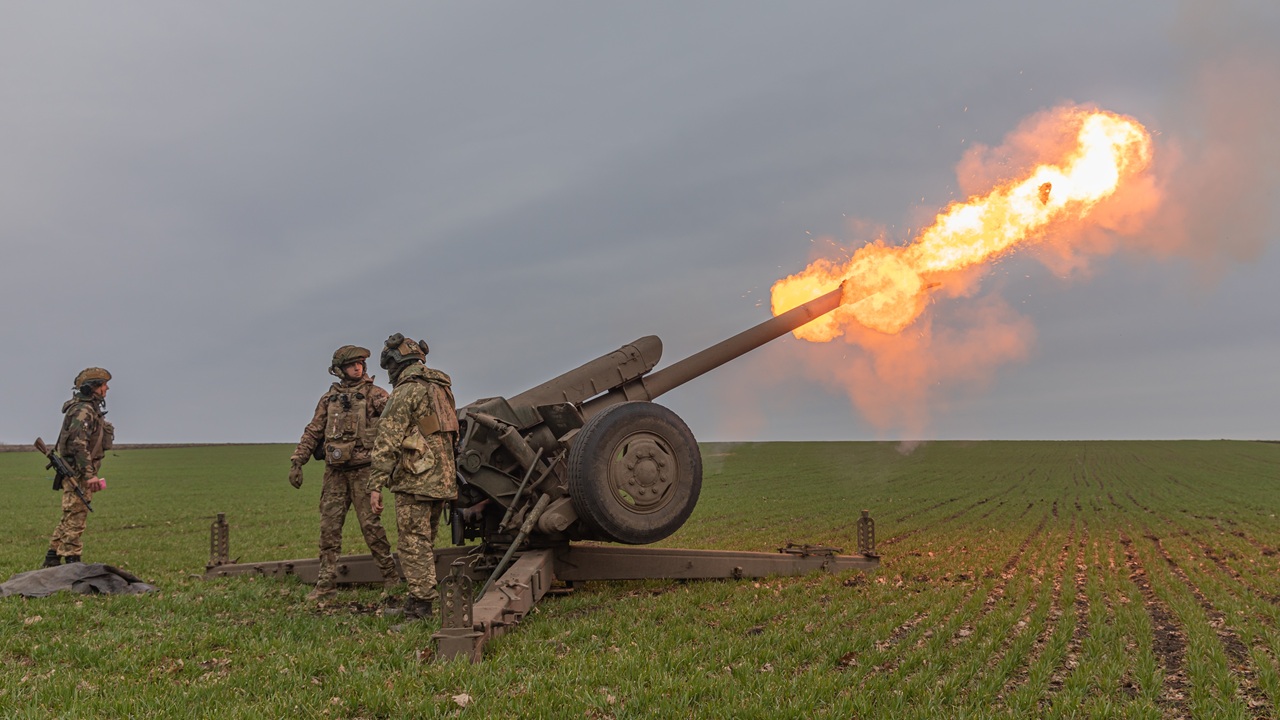
Ukraine has adapted age-old tactics—notably the “creeping barrage” of World War I fame—to the modern battlefield against Russia.
While war rages in the Middle East, the Ukrainian military continues to take advantage of the tactical and operational situation to continue with its counteroffensive.
In the past few weeks of fighting, the Ukrainians have liberated more than 400 square kilometers (154 square miles) of territory in the south and east, undermining Russia’s anticipated spring offensive before it even begins.
Ukraine Is on the Counterattack in Donbas
The Ukrainian counterattack began in the closing days of January. Kyiv took advantage of Elon Musk’s decision to shut down unauthorized Starlink terminals operating in Ukraine.
The Ukrainian counteroffensive is unfolding in several parts of the battlefield—most notably in the Donbas, Ukraine’s hotly contested easternmost region, which has served as the epicenter of the Russo-Ukrainian conflict since 2014.
“Ukrainian forces advanced 10 to 12 kilometers (6.2–7.4 miles) deep in two separate drives in Dnipropetrovsk Oblast that have reportedly liberated more than 400 square kilometers since late January 2026,” the Institute for the Study of War assessed in a recent operational update about the Ukrainian counteroffensive in the Donbas.
Beyond the direct objective of liberating Ukrainian territory from the Russian forces, the Ukrainian counteroffensive aims at upsetting Moscow’s upcoming spring offensive. Despite the ongoing Ukrainian gains, Russia maintains the strategic initiative. And soon, once the ground has dried up from the melting snow and mud no longer covers the battlefield, the Russian forces will once again go on the offensive. The ongoing Ukrainian counteroffensive anticipates a Russian attack and aims to lessen its impact by diverting Russian resources.
This is not the first time the Ukrainians have adopted an offensive defense approach. In August 2024, Ukraine launched a foray inside Russia’s Kursk Oblast, capturing dozens of villages and creating a large foothold inside Russia proper. It took the Russian forces months and hundreds of thousands of troops to push back the Ukrainians, giving Kyiv important breathing space in Ukraine.
How Drones Are Fueling Ukraine’s Forward Push
To set the conditions for tactical gains, the Ukrainians are using one-way attack unmanned aerial systems, also known as kamikaze drones or loitering munitions, to soften up Russian positions in depth.
For example, Ukrainian kamikaze drone operators supporting infantry battalions will target Russian positions and vehicles at depths of 6 to 10 miles behind the frontline. Logistics for both combatants are unconventional. Russian units, for instance, rely on motorcycles, quad bikes, and minibuses to get troops and supplies to the frontlines. The goal is to create a rolling screen for the infantry to advance, denying the Russians the ability to reinforce positions under attack.
In many ways, the Ukrainian practice resembles the rolling, or creeping, artillery barrage—a century-old tactic that was first introduced by the British Army during the Second Boer War in South Africa, but became popular during the trench warfare of World War I.
Moreover, the Ukrainian forces are taking advantage of poor weather conditions to support their advances.
The lack of Starlink connectivity is causing serious disruptions to Russian offensive and defensive operations. First-person drones like the ones used in Ukraine are linked with their operators. They rely on this connection for guidance to the target. The lack of connectivity means that Russian one-way attack unmanned aerial systems cannot operate on the battlefield. This respite from the constant overhead threat allows Ukrainian infantry to operate more freely.
About the Author: Stavros Atlamazoglou
Stavros Atlamazoglou is a seasoned defense journalist specializing in special operations and a Hellenic Army veteran (national service with the 575th Marine Battalion and Army HQ). He holds a BA from the Johns Hopkins University and an MA from the Johns Hopkins’ School of Advanced International Studies (SAIS). His work has been featured in Business Insider, Sandboxx, and SOFREP.