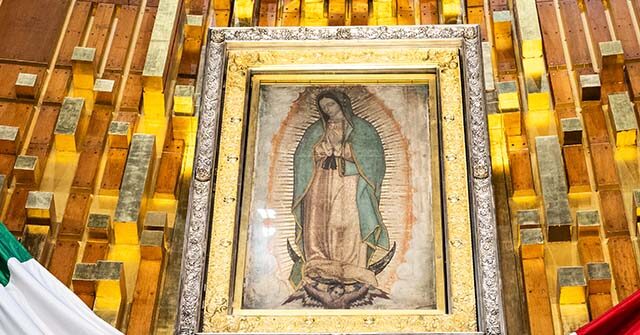
Scientists are shocked after finding a “miracle” imprint on a 16th-century cactus-fiber cloak bearing an image of the Virgin Mary that reveals a hidden detail they are unable to explain.
While examining the Tilma of Guadalupe — a the 500-year-old cloak that many Christians believe bears a miraculous image of the Virgin Mary — researchers say they discovered at least 13 small human figures embedded in the eyes.
“The image of Our Lady of Guadalupe has been the subject of numerous technical studies since 1751 and extensive scientific investigations in recent years,” the researchers wrote in their report, “Miraculous Image of Our Lady of Guadalupe,” published by St. Michael the Archangel Catholic Church.
According to the group, the figures hidden in the eyes of the Virgin Mary image “bear a kind of instant picture of what actually occurred at the moment the image was unveiled in front of the bishop and other witnesses on December 9, 1531.”
The researchers, however, say that none of the findings “offered any sound scientific explanation which, up to this very day, defies science and all human reasoning as it continuous to baffle scientists and even skeptics” — despite extensive scientific investigations.
They explained that the figures are so small, they were “digitally enlarged 1,000 times than the actual size to be able to see what is reflected in his eyes,” adding that the image is actually a quarter of a micron, which is one fourth of a millionth of a millimeter.
“There is no explanation offered by NASA scientists on how the image was imprinted on the Tilma. There are no brush strokes, or sketch marks on it,” the scientists said.
“The image also seems to increase in size and change colors owing to an unknown property of the surface and substance of which it is made,” they added. “The colors actually float above the surface of the Tilma at a distance of 3/10th of a millimeter — without touching it.”
When examined less than ten inches of the image, one can only see the maguey cloth, and the colors totally disappear, researchers noted.
According to Catholic tradition, the image of Our Lady of Guadalupe miraculously appeared on Juan Diego’s tilma, a simple cloak, when he unveiled the fabric before the Bishop Juan de Zumárraga in 1531.
The cloak, made from coarse fibers of the maguey cactus, is known for being fragile and typically decays within a few decades.
The tilma, however, has endured nearly 500 years with little deterioration, even after centuries of exposure to candle smoke, humidity, dust, and handling by pilgrims.
The cloak appears to be unusually resistant to insects, dust accumulation, and fading — remaining vibrant despite not having a protective covering, according to historical accounts.
The tilma consists of two separate pieces of fabric sewn together with a seam running through the middle of the image.
This added to what the researchers concluded, which is that sections of the face, hands, robe, and mantle appear to have been laid down all at once, in one seamless pass, with no trace of preliminary sketches, corrections, or multiple brush strokes.
The scientists ultimately determined that the process for creating the image defies straightforward explanation through any established 16th-century painting techniques.
View the researchers’ findings here.
Alana Mastrangelo is a reporter for Breitbart News. You can follow her on Facebook and X at @ARmastrangelo, and on Instagram.