Iran pursued its strategy of economic warfare on Thursday, attacking two oil tankers in the Persian Gulf and repeating its threats to cut off oil shipments through the vital trade route.
Iran also launched a coordinated attack on Israel with its Lebanese proxy Hezbollah, while the Israeli military reported strikes on a “critical” nuclear site near the Iranian capital of Tehran.
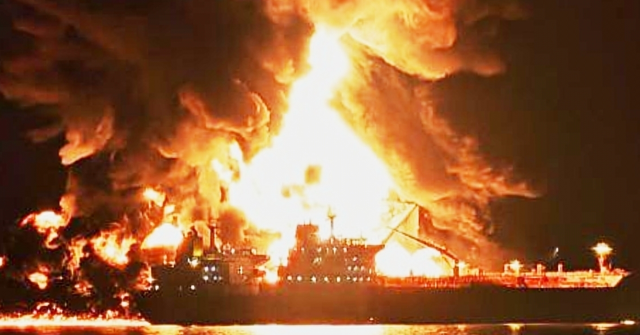
The two oil tankers struck off the Iraqi coast in the Persian Gulf overnight were more severely damaged than previous Iranian targets, with massive fires burning on both ships, and at least one fatality reported:
The Times of Israel (TOI) reported that Iran took responsibility for one tanker attack, but has not yet mentioned the other. The government of Iraq believes Iran perpetrated both acts of “sabotage” and expressed “deep concern” about further risks to oil tankers in the Gulf.
Senior Iraqi officials told the left-wing outlet the New York Times (NYT) that both ships were employed by Iraq to transport its oil products. The ship Iran admitted to attacking was U.S.-owned but flagged under the Marshall Islands.
Iran’s terrorist Islamic Revolutionary Guard Corps (IRGC) said the ship was attacked because it “disobeyed and ignored our warnings.” The IRGC said it would target any ship linked to the United States, Israel, or any of their “partners” (which Iran currently defines as any Middle Eastern nation that allows American troops on its soil), with the objective of driving oil prices above $200 per barrel.
Oil prices rose above $100 on news of the tanker attacks before receding back below that threshold later on Thursday.
Iraq has temporarily suspended operations at its oil terminals following the tanker attacks, and one of Oman’s oil ports was also hit by Iranian drones.
Iran might have perpetrated a third attack on a commercial vessel on Thursday, as a container ship off the coast of the United Arab Emirates (UAE) was struck by an unknown projectile and suffered a small fire. According to the United Kingdom Maritime Trade Operations (UKMTO) center, there were no injuries from the incident.
Iran launched more missiles against Israel on Wednesday night and Thursday, as part of what Israeli media described as an “integrated Hezbollah and Iran joint attack.”
“The IDF is operating with determination against the Hezbollah terrorist organization following its deliberate decision to attack Israel on behalf of the Iranian regime. The IDF will not tolerate any harm to Israeli civilians and will forcibly respond against any threat posed to the State of Israel,” the Israel Defense Forces (IDF) said on Thursday.
Hezbollah dubbed the operation “Eaten Straw,” a name drawn from a verse in the Quran that discusses how to completely destroy an enemy.
“I think that Hezbollah is trying to scare Israel from launching further operations and I truly hope that we will not be afraid, and our government will do what it has to do,” Israel Alma Research and Education Center security expert Sarit Zehavi told Fox News.
Israel responded with powerful attacks on Hezbollah positions south of Lebanon, prompting the Lebanese government to plead with U.S. and European leaders to broker a ceasefire. Israeli officials reportedly refused Lebanon’s ceasefire proposal because it did not do enough to disarm Hezbollah as Lebanon was supposed to do last year under the Gaza War ceasefire agreement.
Israeli Defense Minister Israel Katz on Thursday warned Lebanese President Joseph Aoun that if he does not halt Hezbollah’s attacks, “we will take the territory and do it ourselves.”
Katz said he and Prime Minister Benjamin Netanyahu have instructed the IDF to “prepare for an expansion of IDF activity in Lebanon and to restore calm and security to the northern communities.”
The IDF said on Thursday that it struck a facility near Tehran that was working on “critical capabilities in the development of nuclear weapons.”
The site is a compound called Taleghan located within the Parchin military complex that was also struck by the IDF in October 2024, after Iran launched a missile attack against Israel. Israeli military officials said a new attack was necessary because Iran has “taken steps to rehabilitate the compound” and “continued efforts to advance and develop capabilities required for the development of a nuclear weapon.”
The Jerusalem Post reported that Iran made efforts in February to conceal construction activity at Taleghan from satellites. The site has been used in the past to test explosives that could be used in the construction of a nuclear warhead.