In an ancient Greek legend, Alexander the Great famously solved the challenge of untying the Gordian knot by bypassing that seemingly impossible task entirely and instead chose, simply and directly, to slice through it with his sword. The moral of that legend seems to be that sometimes the best solution to a problem resistant to resolution is to reject its defining premises as false. After all, the goal in the example of the Gordian knot was not the undoing of the knot as such, but the unmooring of the rope from an oxcart.
In other words, Alexander saw that the “challenge” of the knot was an illusion grounded in a confusion about ends and was thereby able to solve the problem quite easily.
Communio theology and Thomism
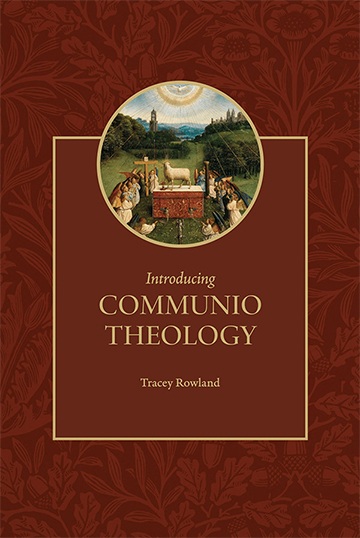
I thought of this legend as I read the new book published by Word on Fire, written by the Australian theologian and Ratzinger Prize winner, Dr. Tracey Rowland. Introducing Communio Theology is a very readable, insightful, and timely exposition of Communio theology. What follows is not a review of the book; rather, I want to focus on those aspects of the text that help us to untie the Gordian knot of these contemporary and seemingly intractable ecclesial conflicts.
I say that the book is “timely” because what Rowland does so well is to demonstrate how Communio theologians have, more than any other modern Catholic school of thought, made the defining characteristic of their movement a robust embracing of the uniquely Catholic principle of the “both-and”. This allows it to be the preeminent theological approach for untying the many Gordian knots of modern Catholicism. This requires an ancillary commitment to the critically important Thomistic principle of analogy.
This point about Thomistic principles is important because, as Rowland shows, the common mistake of pitting Communio theology against Thomists is something that needs to be refuted. As she showed in her previous book Catholic Theology (Bloomsbury, 2017), there have been no fewer than 17 different versions of Thomism in the 20th century, and ressourcement/Communio is one of them. The reality is that Communio theology is in many key ways a version of Thomistic thought.
The book is essential reading for anyone interested in the various heated debates in the Church today and who believes, as I do, that the debates will be intractable so long as the many false binaries that undergird them remain unchallenged. I will examine one example of these apparently unresolvable debates in order to highlight the approach of the Communio theologians Rowland mentions. An example most pertinent today, because of the challenge posed by the SSPX to the Church, is the impasse between “progressive” Catholics and the so-called “traditionalist” Catholics on the topic of the development of doctrine.
Divine Revelation and disputed teachings
On the one hand, the traditionalist claim is that the major doctrines of the Church, even if non-infallible, are in fact infallible. Such traditionalists engage in what Msgr. Thomas Guarino, in The Disputed Teachings of Vatican II, has called “infallibility bloat,” wherein doctrines that do not meet the strict criteria for being considered infallible are still treated as such because to admit that they might contain errors calls into question the indefectibility of the Church. There is also a not-so-subtle conflating of the related but distinct issues of infallibility and indefectibility.
As a result, the epistemic focus now shifts from Revelation as an unveiling of a deep and dramatic covenantal encounter with Christ–an encounter of which she is the sacrament for the world—to a set of epistemically “certain” propositions deduced from Scripture and Tradition as so many little truth nuggets and “God factoids” that must now be defended at all costs. Furthermore, Scripture and Tradition are treated as two independent streams of truth about God and Christ.
In theory, it is still affirmed that the Church can sometimes err, but in practice, this is effectively denied. Revelation thus comes to be identified, not with Christ as such, but instead with the detached “truth content” of a set of propositions that state things “about Christ” and “about the Trinity”.
This is, of course, a bit simplistic for the sake of brevity. But the full expression of this exaggerated reduction of Revelation to a set of propositions can be seen in the theology of the scholastic epigones of Francisco Suárez. This had an outsized influence on the theology of Revelation that we find in the Baroque era.
But the upshot of all of this is that for the staunch traditionalists of our time, the doctrines of the Church cannot change in any way. And since Vatican II and the post-conciliar popes did develop doctrines in ways that seem, on the surface, to contradict previous doctrines, then they must be in error. And many insist they must be rejected. From there, it is now a simple matter of gauging where traditionalists fall in their reaction to such alleged errors, ranging from “recognize and resist” types such as the SSPX to the full-blown sedevacantists who splintered off them.
By contrast, progressive Catholics, like their antecedents in the modernist movement of the early 20th century, reject the notion that Revelation is to be viewed in these largely propositional categories. Propositions are, say progressives, second and third-level reflections on Revelation and are in fact little more than the culturally conditioned mythopoetic projections of the subjective religious consciousness of the human mind. God might ultimately be behind our “God consciousness”, but only as an ineffable mystery that must be approached apophatically.
What this approach leads to, with a brutal internal logic (brutal because it cannot be softened in any way), is the spectacle of the anthropological tail wagging the Christological dog. We see this constantly among progressive Catholics. In their view, the primary Revelation from God takes place most primordially in the subjectivity of all human beings everywhere and in an inchoate and “unthematized” way. But they assert that God’s Revelation in Christ must now be read through the lens of this more primordial revelation, effectively relativizing Christ as merely one “exemplar” of the primordial and inchoate Revelation. Christ is thus reduced to “an exemplar of an en-graced and elevated human being” who certainly did not found a Church, was mistaken about the imminent end of the world, and did not “die for our sins”. He was an exemplar of moral and spiritual living and nothing more.
Obviously, for Catholics who think like this, doctrines not only can “develop” but even morph into their opposite. Doctrines can change and even flatly contradict previous doctrines on the same topic. And this would also include dogmas, since nothing propositional is off limits. In their view, all doctrines and dogmas are culturally conditioned and are to be situated in their historical context. Therefore, as that context and those cultural conditions change, so too can the doctrines.
False premises about Divine Revelation
So where does this leave us? The debate between traditionalists and progressives is caused at its root because they both share false premises about the nature of Revelation and the relationship of Revelation to the doctrines and dogmas of the Church, which express its central truths in propositional form. And that false premise was the detaching of the “content” of Revelation from Jesus Christ.
The traditionalists identify, in a way, Revelation with Christ—but then exaggerate its propositional nature to such an extent that the doctrines of the Church become the central focus of the theology of Revelation. Theology shifts to focus on tradition itself as the primary object of theological reflection on the nature of Revelation because it is viewed as the epistemically certain exposition of Revelation. And then Revelation recedes into the background as the originating event, which must now be interpreted through the lens of later doctrines.
Progressives, insofar as they affirm that a normative Revelation from God has in some way been given through Christ, nevertheless divorce Christ from the later doctrinal tradition. He then fades into the mist of time as a relic of first-century Jewish apocalypticism. They then move to reconstruct, anachronistically, the historical Jesus as the supporter of modern, leftist political causes. Christ as the unique bearer of Revelation is therefore so covered over with modern political ideology and Marxist deconstruction of all forms of hierarchy, as to become virtually invisible as anything truly meaningful in a religious sense.
The retired theologian Fr. Robert Imbelli has written extensively on what he has called the “decapitation” of the Church, which has resulted from this separation of Christ from the content of Revelation. A ressourcement/Communio theologian himself, Fr. Imbelli, who was in seminary in Rome during the Council, identifies the dogmatic constitution Dei Verbum as the most important conciliar text. The great breakthrough of Dei Verbum is its assertion, in line with the Church Fathers, that Divine Revelation is to be identified first with Christ himself and then secondarily with the scriptural witness and the doctrinal tradition.
Scripture and tradition are not two separate and independent “streams of information about Revelation” but are intertwined participations in Revelation, which is nothing more than Christ himself. Christ is Revelation. Period. Full stop. Thus, all later doctrines within the Church represent a normative ecclesial meditation upon that Revelation. Dei Verbum must be read as affirming both the identification of Christ himself without qualification as Revelation, and the ongoing development of doctrine in the Church as a normative participation in that primordial Revelation.
False pr
This both-and approach of Dei Verbum cuts off at its legs the theology of the traditionalists and the progressives. It affirms, contra the progressives, that the Revelation of God in Christ is the most primordial and therefore constitutive anthropological truth about humanity, and not some putative “universal revelation” of God in every soul. And note well, it is not the universal presence of grace that Dei Verbum is rejecting, but its alleged prioritization as the more primary Revelation of God due to it being (again, allegedly) the more “universal” revelation. The view of the universal among progressive Catholics is thus exposed as simply the Enlightenment’s pursuit of religion within the boundaries of secular reason. It is Locke and Kant in religious drag.
But Dei Verbum also undercuts the hyper-propositionalism of the traditionalists and, by extension, their penchant for infallibility bloat. There are different types of traditionalists and of course all Catholics must be in some sense traditionalists. But here I am referring to those modern “Trads” who, in my view, have become an ideological movement within the Church more than a truly theological one. Wedded to an overly propositional view of Revelation and a concomitant embracing of an infallibility bloat for the entirety of the ordinary magisterium pre-1962, they have been unable to grasp the fact that Vatican II did in fact change some doctrines in the form of a development of the tradition to be more in line with the truths of Revelation as they are grounded in Christ. They cannot embrace the notion that the magisterium can, and in fact has, corrected itself on numerous occasions, and long before Vatican II.
Theirs is, therefore, more of an either-or epistemological ideology of an elusive certainty, rather than a truly Catholic both-and which embraces both the conceptual content of doctrines as true and the fact that their truth is relative to the primordial truth of Christ the Lord and can be adjusted by the magisterium accordingly.
Returning then to Rowland, one sees in the entirety of her new book a serious attempt to situate the Communio theologians as the best hope for reconciling false ecclesial binaries, and for giving us the best hermeneutic for retrieving Vatican II and for understanding what is involved with the contentious issue of the development of doctrine.
Here, I will refer directly to her extremely important chapter on Communio theology and Vatican II. Space precludes a full analysis of her text on this point, but suffice it to say that she both affirms the profound importance of the Council and our ongoing need to correctly interpret it, and the need to look honestly at the conciliar flaws. Once again, we see that Communio theologians such as Ratzinger, Balthasar, and de Lubac were profound critics of the post-conciliar developments.
In particular, what Rowland notes is that many Communio theologians have been willing to criticize the Council itself for at least catalyzing the later mayhem by not providing the Church with an explicit hermeneutic for its interpretation. They note that while it is true that like all councils Vatican II must be read in the light of the entire tradition, and while it is also true that the Council is clearly favoring a deep Christocentrism as its key theological fulcrum (e.g. Gaudium et Spes 22), and while it is true that much of the post-conciliar mischief is just a vulgar and stupid display of cultural accommodation gone mad, nevertheless the Council left enough theological hanging chads that required a more explicit exposition of a conciliar hermeneutic that it was inevitable that misuse would happen. Especially because such misuses were intentional.
Finally, and this is key, Rowland, leaning on the analysis of Guarino, points out that the Council decided to pursue a more irenic approach to modernity and eschewed the dialectics of rejection and condemnation in favor of looking for analogical points of contact and agreement. This analogical rather than dialectical approach had its strengths, but once again, absent an explicit hermeneutic, it also had inevitable flaws, as the analogical approach could be abused to baptize modernity as a kind of closeted Christianity.
Finally, on the twin issues of Revelation and Vatican II’s interpretation, the way forward cannot be a rejection of the Council and a return to a restorationism of Baroque era thinking, nor can it be the progressive reduction of the Church to a bureaucratized NGO. Revelation is both relational and conceptual, and the doctrinal concepts it spawns are both epistemically stable and capable of development, but only in a Christological way that is grounded in the originating event. Vatican II is a profound council that has ongoing significance, but only insofar as it overcomes its own deficit of hermeneutical clarity.
Therein lies the deep significance of Communio theology as an ongoing project in conjunction (though more generally) with the revival in Thomistic theology. And nobody has made this more evident and with more careful clarity than Rowland.
If you value the news and views Catholic World Report provides, please consider donating to support our efforts. Your contribution will help us continue to make CWR available to all readers worldwide for free, without a subscription. Thank you for your generosity!
Click here for more information on donating to CWR. Click here to sign up for our newsletter.