Finnish law has historically prohibited the importation or deployment of a nuclear weapon anywhere on its territory—but this is expected to change soon.
Finland could become the next NATO country to host nuclear weapons.
The Scandinavian country recently announced its intention to amend its anti-nuclear weapons legislation, opening the way for hosting NATO nukes in its territory.
Finland Is Legalizing Nuclear Weapons at Its Bases
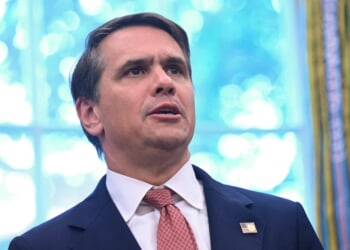
Finnish Defence Minister Antti Häkkänen announced last week that his government would seek to amend current Finnish legislation to allow nuclear weapons in the Nordic country.
Under the country’s Nuclear Energy Act of 1987, the import, manufacture, possession, and detonation of nuclear explosives is prohibited on Finnish territory, regardless of whether there is peace or war.
Under the current proposal advancement by the Finnish government, the legislation would change to making it possible “[to] bring a nuclear weapon into Finland, or to transport, deliver or possess one in Finland, if it is connected to the military defence of Finland,” according to Häkkänen.
The Finnish defense minister cited the changing security environment in Finland and Europe to explain the decision to amend Finnish law and allow the transport and presence of nuclear weapons on Finnish soil.
The situation has “fundamentally and significantly changed” since Russian President Vladimir Putin ordered the full-scale invasion of Ukraine more than four years ago, Häkkänen told reporters at a news conference.
“The amendment is necessary to enable Finland’s military defense as part of the alliance and to take full advantage of NATO’s deterrence and collective defense,” the Finnish defense minister said.
France Might Seek to Station Nukes in Finland
Several other NATO members—the United States, the United Kingdom, and France—each possess nuclear weapons. Most NATO nations have avoided them, historically relying on the “nuclear umbrella” provided by the United States. France in particular has avoided doing so, insisting on the importance of an independent European nuclear deterrent.
In response to the repeated threats of aggression coming out of Moscow, including nuclear threats, France has expressed a desire to deploy nuclear weapons in the eastern flank of NATO and the European Union. If the Finnish government’s amendment is successful, Finland could host French nuclear weapons as deterrence against Russian truculence in the region and across Europe.
At nearly 835 miles-long, Finland shares the longest border with Russia of any NATO member state. Its territory is also less than 100 miles from St. Petersburg, Russia’s second city.
Nor is Finland inexperienced with the threat posed by its more powerful neighbor. The two countries have fought several wars in the past. The most famous of these was the Winter War of 1939, which ended in some Finnish territorial concessions but extremely heavy losses for the Soviet forces. The Soviet Union’s disastrous performance against a far smaller adversary in the war—due in large part to Soviet dictator Joseph Stalin’s military purges during the late 1930s—is generally regarded as a major contributing factor to Adolf Hitler’s decision to attack the Soviet Union in June 1941.
Finland’s Decision Influenced by Ukraine War
When Putin and his Kremlin advisers decided to launch the “special military operation” against Ukraine, they believed that Kyiv would crumble and the country would return to Moscow’s sphere of influence either directly or indirectly. The Kremlin also made the crucial miscalculation to believe that Europe and NATO would make no more than an apology or a protest.
This assessment turned out to be incorrect. More than four years after the large-scale invasion, Europe and (most) of NATO are stronger and more unified than since the end of the Cold War. Traditionally neutral states like Finland and Sweden relinquished their closely-held neutrality to join the transatlantic alliance. Finland joined NATO in 2023, and Sweden in 2024, expanding the alliance to 32 nations in total. The two countries now form a strong bulwark against Russian aggression in the High North and the Baltic.
About the Author: Stavros Atlamazoglou
Stavros Atlamazoglouis a seasoned defense journalist specializing in special operationsand a Hellenic Army veteran (national service with the 575th Marine Battalion and Army HQ). He holds a BA from the Johns Hopkins University and an MA from the Johns Hopkins’ School of Advanced International Studies (SAIS). His work has been featured in Business Insider, Sandboxx, and SOFREP.