The deployment of Turkish F-16s to disputed Northern Cyprus might have run afoul of US export restrictions that govern how its fighter jets can be used.
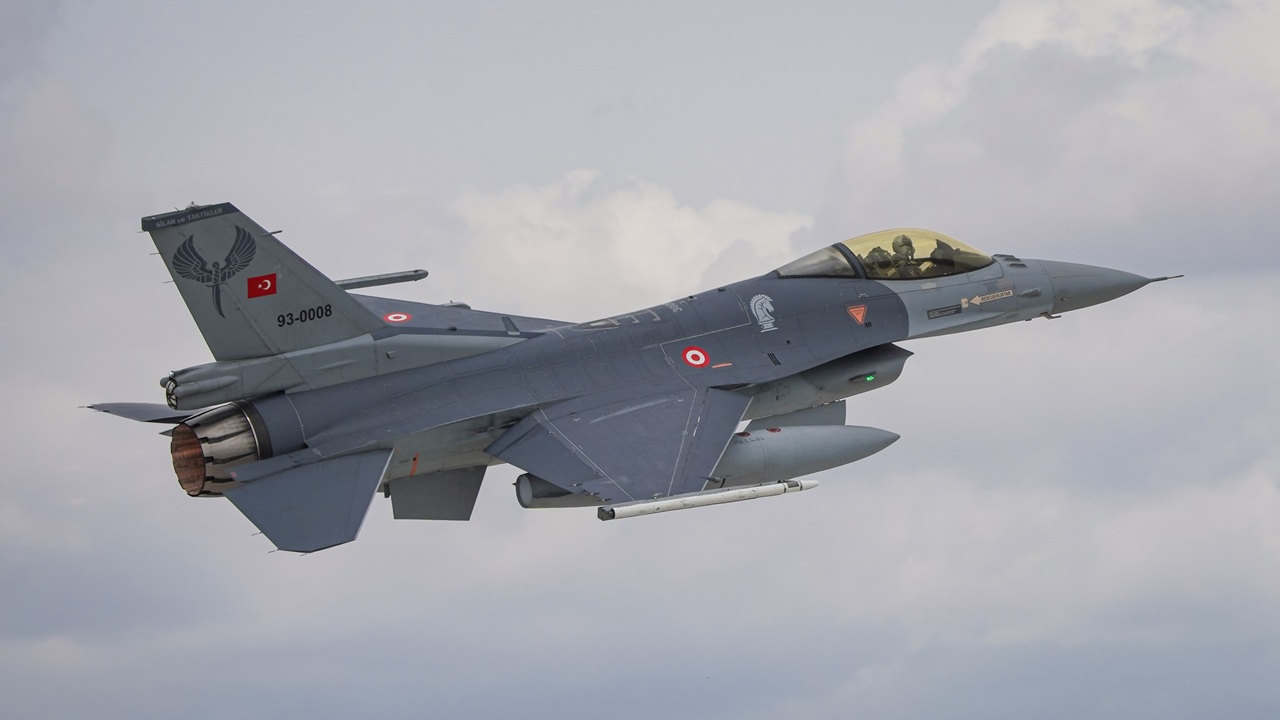
NATO member Turkey deployed six F-16C Fighting Falcons and air defense systems to Cyprus, specifically to the self-declared Turkish Republic of Northern Cyprus (TRNC).
The move is stirring up old conflict in the Mediterranean, long predating the ongoing US-Israeli war with Iran.
Turkey Is Protecting Northern Cyprus—and Only Northern Cyprus
“In the context of the latest developments in our region, six F-16 fighter jets and air defense systems have been deployed to the Turkish Republic of Northern Cyprus as of today,” the Turkish Ministry of Defense announced, adding that the purpose of its mission was to ensure the safety of the TRNC.
Turkey decided to deploy the aircraft after an Iranian drone, believed to have been fired by the Tehran-backed Hezbollah from Lebanon, struck the British Royal Air Force (RAF) Akrotiri base last week.
The aircraft, which arrived on Monday, are operating from Ercan International Airport, west of the divided capital of Nicosia.
“Footage released by Turkish media suggested the fighters were equipped for air defense and combat air patrol missions over the region,” Air Data News reported. It did not specify the planes’ precise armament.
Ankara has said additional air defenses and even drones could be deployed if required, but that is unlikely to be welcome news to Greece or other NATO members. In addition to the Turkish F-16s, Greece has deployed four F-16s and two frigates to the Republic of Cyprus, which exercises de facto control over the southern portion of the island.
NATO member Turkey has been critical of the buildup of European military assets on Cyprus and warned that such a move could drag the island into a conflict.
However, on Monday, the Marine Nationale (French Navy) flagship aircraft carrier, the nuclear-powered Charles de Gaulle, arrived in Cyprus. French President Emmanuel Macron met with Cypriot President Nikos Christodoulides and Greek Prime Minister Kyriakos Mitsotakis on the island nation. Ankara has not commented on the meeting.
Why Is Cyprus So Controversial for Greece and Turkey?
The situation with Cyprus—often called “the Cyprus problem”—was a flashpoint for the Eastern Mediterranean long before the Iran war. The island sits close to Turkey, but about 80 percent of its population is ethnically Greek and the remaining 20 percent is Turkish. The island belonged to the United Kingdom from 1878 until 1960, when it formally gained its independence. However, many Greek Cypriots then sought to unify the island with Greece, a notion that the Turkish minority fiercely opposed.
In 1974, a pro-Greek government seized power in a coup and attempted to secure Cyprus’ annexation by Greece. In response, the Turkish military invaded the northern half of the island and established the TRNC, ostensibly to protect the ethnic Turks.
More than 50 years later, the island remains divided in two, with the Republic of Cyprus in the south and the TRNC in the north. Turkey is the only UN member state to recognize the TRNC; the rest of the international community, including the United States and the European Union, recognize the Republic of Cyprus as the island’s legitimate government.
Ankara does not recognize the southern Republic of Cyprus, which hosts RAF Akrotiri.
Turkey May Have Violated US Arms Regulations
Beyond the fact that both Greece and Turkey—which, despite being NATO members, are regional rivals—have increased their military footprint on the contested island of Cyprus, there is the question of whether Ankara’s actions in bringing the fighter jets to Cyprus ran afoul of US export restrictions.
The Foundation for Defense of Democracies (FDD) suggested that Turkey might have violated “International Traffic in Arms Regulations (ITAR) that govern the export and end use of US-origin defense equipment.” It noted that Turkey’s F-16 Fighting Falcons, acquired via the US foreign military sales (FMS) program, are “subject to strict end-use conditions,” which prohibit the “operational use of such systems in ways inconsistent with US foreign policy interests, or without appropriate authorization.”
In other words, Ankara may have needed Washington’s permission to deploy the Fighting Falcons to the TRNC, and violated its end-use conditions by doing so without it. The US and much of the world view the TRNC as occupied territory.
“Beyond legal considerations, Turkey’s deployment of the jets represents another example of Ankara’s willingness to militarize contested spaces in the Eastern Mediterranean,” FDD added.
It isn’t just Greece that has been alarmed by Turkey’s increased military footprint on Cyprus.
“Israel, which lies less than 300 miles from Cyprus, is also likely to raise concerns, given Turkey’s support for Hamas and its promotion of trade restrictions against the Jewish state,” the FDD report noted.
Even if US lawmakers don’t voice concerns, it is likely Athens could protest the deployment of the aircraft. Turkey may argue it is attempting to offer protection to the island. It should be noted that an Iranian missile was shot down over Turkey, and it is unclear if the Greek F-16s would actually seek to protect the TRNC.
An unexpected consequence of Operation Epic Fury is that it is stirring up new trouble between Athens and Ankara—trouble that has no connection to Iran’s nuclear program or its malign activity in the Middle East.
About the Author: Peter Suciu
Peter Suciu has contributed to dozens of newspapers, magazines, and websites over a 30-year career in journalism. He regularly writes about military hardware, firearms history, cybersecurity, politics, and international affairs. Peter is also a contributing writer for Forbes and Clearance Jobs. He is based in Michigan. You can follow him on Twitter: @PeterSuciu. You can email the author: [email protected].