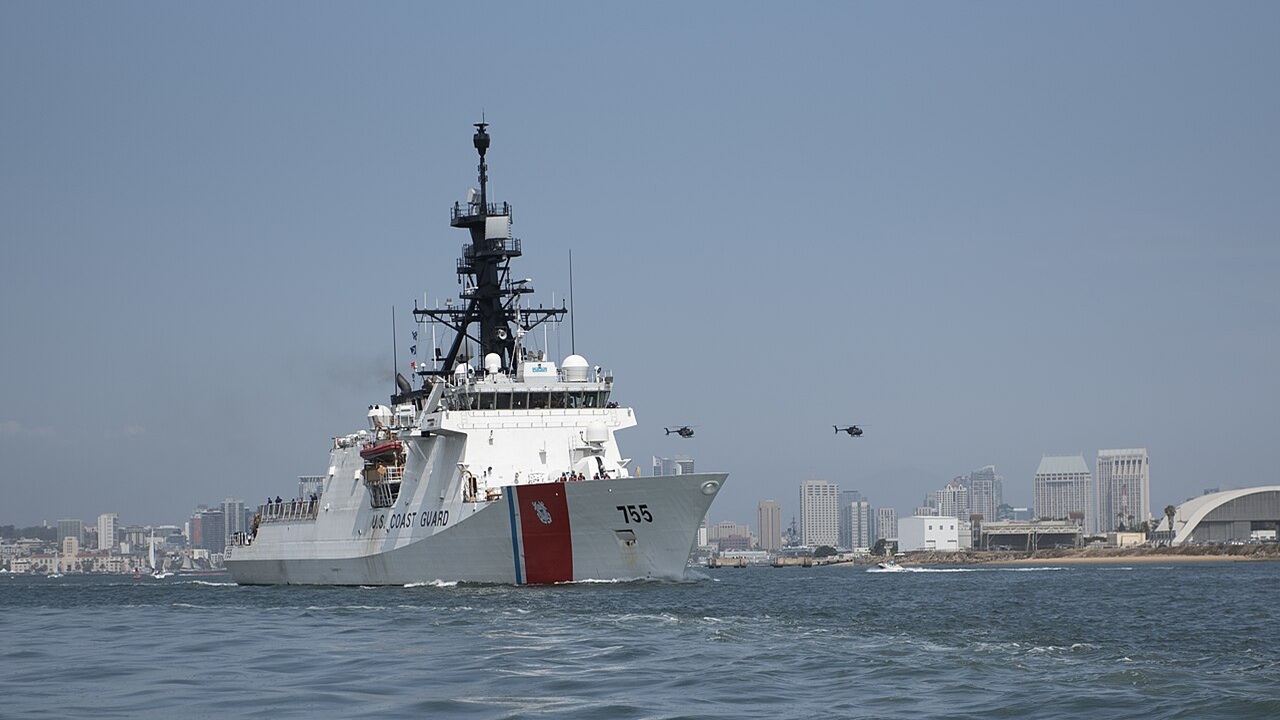
After its enormous drug bust, the USCGC Munro aided in the capture of the Motor Tanker Bella 1, a Russian-flagged oil tanker involved in smuggling operations.
During a recent 119-day multi-mission deployment that spanned more than 26,000 miles, the United States Coast Guard Cutter Munro (WMSL-755) set a record for the largest drug seizure ever recorded by the service.
The Munro’s crew detained six suspected drug smugglers and seized 2,052 pounds of cocaine—with a street value of more than $250 million. It was the “single largest maritime drug seizure in 18 years, and the largest ever in HITRON’s history,” the USCG wrote in a news release.
“This interdiction continued the Coast Guard’s historic counter-drug operations through Operation Pacific Viper, including the seizure of over 200,000 pounds of cocaine along maritime smuggling routes from South and Central America since early August,” the release said.
The Munro’s Journey into the Record Books
The cutter departed from her home port of Alameda, Calif., in early November and took part in the Pentagon’s Resolute Hunter exercise offshore of San Diego.
The sixth Legend-class National Security Cutter, which regularly operates in the Pacific Rim with port calls throughout Latin America and even Asia, took part in counter-narcotic and drug-interdiction patrols in the eastern Pacific, supporting US Southern Command’s (USSOUTHCOM’s) Operation Pacific Viper.
USCGC Munro “detected and identified a heavily laden go-fast vessel transiting along a known smuggling route in the Eastern Pacific,” when it decided to intervene.
Aided by two USCG cutter pursuit boats, the Scan Eagle short-range unmanned aerial system, and a MH-65 aircraft from the Helicopter Interdiction Tactical Squadron (HITRON), WMSL-755 tracked and interdicted the suspected vessel.
It fired warning shots, with disabling fire coming from the HITRON.
Though the US Coast Guard is nominally a branch of the armed services, it operates as part of the Department of Homeland Security (DHS) in peacetime—and is the only branch of the services with the authority to pursue law enforcement missions.
The Munro Chased Oil Smugglers for Weeks
USCGC Munro was then redirected to the Atlantic Ocean via the Panama Canal to support the Department of Defense’s and USSOUTHCOM’s Operation Southern Spear, the military build-up that led to the capture of Venezuelan strongman Nicolas Maduro in early January.
The cutter was then tasked with tracking the Motor Tanker Bella 1, a US-sanctioned vessel in Russia’s “ghost fleet” of smuggling ships. The Bella 1 was determined to be without nationality and subject to US jurisdiction.
“Munro’s crew continuously pursued the non-compliant vessel across the North Atlantic Ocean for 18-days and over 4,900-miles,” the Coast Guard added. It noted that the pursuit culminated with the boarding of Bella 1 on January 7.
The crew of the cutter supported US DoD assets, which seized control of the 333-meter crude oil carrier. The dark fleet vessel was subsequently transferred to the US Department of Justice (DoJ) and DHS.
“The service, our nation and our families can be extremely proud of Munro,” said Capt. Jim O’Mara, Munro’s commanding officer. “This crew rose to every new challenge thrown at them with professionalism and persistence, and they achieved historic results. This was a one-of-a-kind deployment for us, but it is also just one part of a much broader campaign and U.S. national strategy.”
Capt. O’Mara went on to credit the “support” from partners, allies, and our families. The cutter was away from home for nearly 120 days, including over the Christmas holiday.
“Our families had to adapt to each new twist, just like all military families do across the Armed Forces,” said Capt. O’Mara. “It is tough on them. But when they hold strong at home that keeps us motivated and focused on our mission. Now, we reunite with our loved ones, proud of what we accomplished and already preparing for the next mission.”
The Munro Is Named for an American Hero
WMSL-755 is named to honor US Coast Guard Signalman First Class Douglas A. Munro, who was killed on Guadalcanal on September 27, 1942, after volunteering to help evacuate a detachment of United States Marines who faced “annihilation by an unanticipated large enemy force.” Munro succeeded in safely extricating the Marines, including the last group as they headed to the boats, but was mortally wounded in the process.
Munro was posthumously awarded the Medal of Honor, the Purple Heart Medal, the American Defense Service Medal, the Asiatic-Pacific Area Campaign Medal, and the World War II Victory Medal. He remains the only Coast Guardsman to have ever been awarded the Medal of Honor.
The sixth Legend-class cutter, WMSL-755, is the second US military vessel to be named for Munro. The first was the United States Navy destroyer escort USS Douglas A. Munro (DE-422), which saw service at the end of World War II and again during the Korean War.
About the Author: Peter Suciu
Peter Suciu has contributed to dozens of newspapers, magazines, and websites over a 30-year career in journalism. He regularly writes about military hardware, firearms history, cybersecurity, politics, and international affairs. Peter is also a contributing writer for Forbes and Clearance Jobs. He is based in Michigan. You can follow him on Twitter: @PeterSuciu. You can email the author: [email protected].
Region: Americas
Topic: Naval Warfare, Drugs
Tags: United States, US Coast Guard, USCGC Munro, Ghost Fleet