With attendance still lagging at some opera houses in the post-COVID world, companies now increasingly feature long runs of traditional favorites with multiple casts that will guarantee sales. The Royal Opera in London is following this trend and opened the new year with eighteen performances of Verdi’s La traviata featuring three separate casts. This last performance of the run was sold out, suggesting there may be some wisdom in this approach. It also featured the noteworthy house conducting debut of the Royal Opera’s chorus director, William Spaulding, a talented American artist who has led choruses in several leading European theaters, conducted full performances, and developed a one-man show based on Milton’s Paradise Lost.
Enshrined in the standard repertoire today, Traviata was once a controversial work. Adapted from a novel and play by Alexandre Dumas fils, it relates the tragic but raw love story of Alfredo, a stand-in for Dumas himself, and the courtesan Violetta, who was based on Marie Duplessis, Dumas’s scandal-ridden mistress who died at the age of twenty-three. Verdi, who had been criticized for his own unconventional relationship with the soprano Giuseppina Strepponi, transformed Dumas’s Lady of the Camellias (first published in 1848 and premiering in 1852) into an opera.
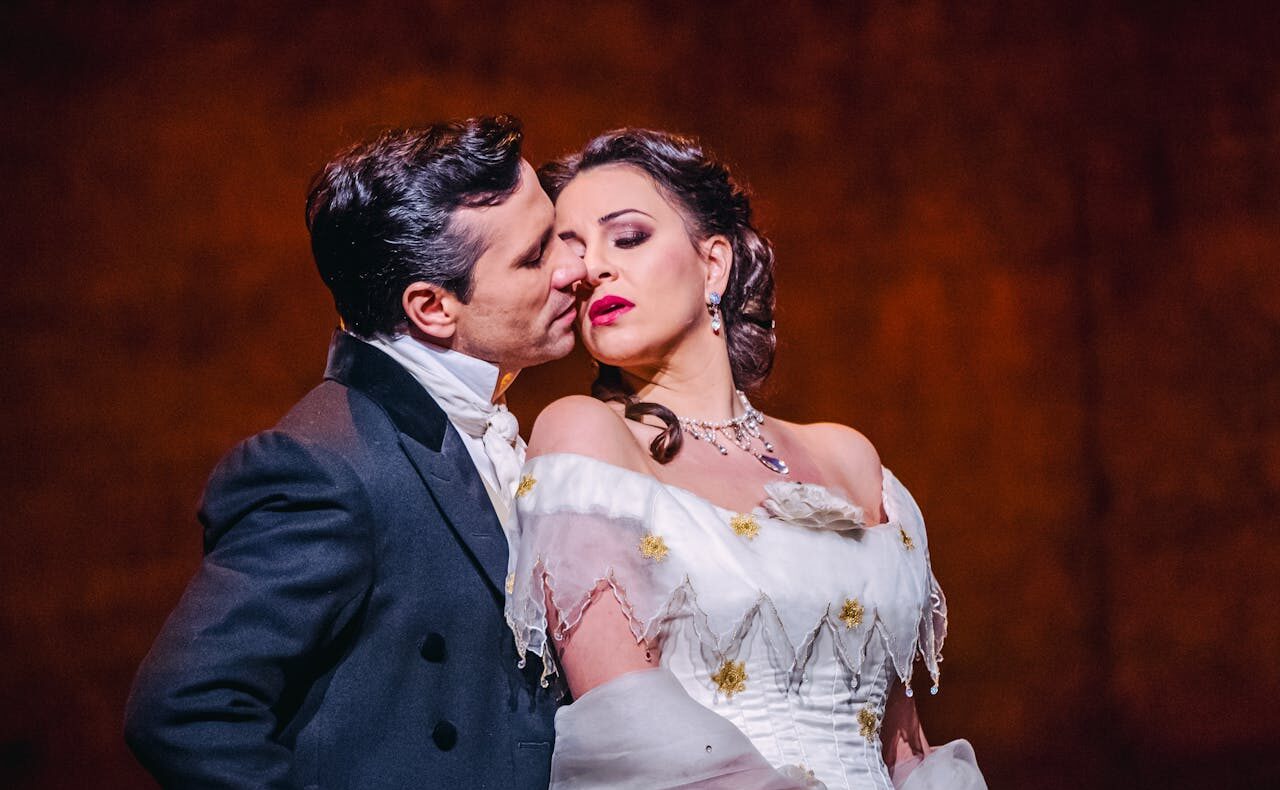
Propriety demanded that Traviata’s then-contemporary setting recede back in time to around 1700, when the veneer of history could at least somewhat cover this tale of passion and moral sacrifice. But with the passage of time, the era in which Verdi composed is now about as far removed from us as the Paris of Louis XIV and Madame de Montespan was from Verdi. Richard Eyre’s production, which opened at Royal Opera in 1994, takes a bit of license, slightly updating the action to the Second Empire of Napoleon III, when the French decadent movement was beginning to flourish. The sets are vast semicircular rooms capacious enough to accommodate not only the drama at hand but also the luxuriant world of appetite and excess that surrounds it. The costumes—hoop-skirted dresses and dapper suits—suggest an elevated milieu, but the words and glances tell a decidedly different story.
Eyre’s production has at one time or another over the past thirty years involved virtually every important soprano singing Violetta. This season’s casts include Ermonela Jaho, who has sung the role more than three hundred times, and—in this performance—Rachel Willis-Sørensen, a rising American singer who is in only her third production of the opera. Fresh from her well-received role debut as Arabella at the Met, Willis-Sørensen seemed to grapple with the challenge of a part that essentially demands three vocal types: a coloratura soprano for the first act’s party girl, a dramatic soprano capable of sacrificing love for propriety in Act II, and a lighter soubrette voice capable of capturing the regrets of a dying yet vindicated woman in the final act. Willis-Sørensen was at her arresting best in Act III, with a particularly plangent “Addio, del passato,” and the bloom in Violetta’s imperative phrase “Amami, Alfredo” in Act II resonated to the rafters. The tricky coloratura runs in the first act worked rather less in her favor, but she did a credible job in her singing of a woman unexpectedly falling in love.
The tenor Bekhzod Davronov, who hails from Uzbekistan and was trained in Moscow, endowed Alfredo with a warm, honeyed sound, but one that could never quite move beyond the character’s youthful ardor to embrace maturity by the opera’s tragic denouement. In certain moments, the role’s vocal challenges seemed rather beyond him. Alfredo’s Act II aria “De’ miei bollenti spiriti,” an expression of the great happiness he feels with Violetta, rollicked along well enough, but his pained regret, after realizing that their relationship cannot be sustained, fell oddly flat in the cabaletta “O mio rimorso!”: Davronov did not even attempt the written high C at the end of the aria or, it seemed, any other high note. The respectable German baritone Christoph Pohl sang the role of Germont, Alfredo’s meddlesome father, with reliable confidence.
Spaulding’s conducting, which included the choral preparation for his regular role at the Royal Opera, conveyed Verdi’s score dreamily yet with precision, resulting in gorgeous moments with the players on stage and in the orchestra pit. The dramatic pace was perfect, mastering suspense as the action built and unleashing passions as they became increasingly uncontrollable. One hopes to see him on the podium more often.