


Last September, Agriculture Secretary Brooke Rollins warned that the United States has “offshored our food, our beef cattle, our citrus.” She put the problem plainly: “If we can’t feed ourselves, this is a national security issue.” Fair enough. So why does so much of government land-use policy push projects that devour farmland — hyperscale data centers, utility-scale solar farms, and the sprawling infrastructure that comes with them?
If Washington wanted to drive up land prices, make farming harder, and funnel a generation of acreage into non-agricultural uses, it couldn’t improve on the current playbook. The uniparty does this everywhere, and red states often lead the charge.
Data centers: The ‘cloud’ that drains the water
Texas is suffering through a long drought. Yet Amarillo has approved an 18 million square-foot data center on what used to be cattle country. Land-grabs tell only part of the story. Data centers also drink water — and they don’t act like the kind of clouds that bring rain.
Reports indicate the Amarillo facility alone could use 912 million gallons of water per year. Large data centers can guzzle up to 5 million gallons per day, matching the daily use of a town of 10,000 to 50,000 people. That kind of demand crowds out ranchers and farmers who already operate under tight margins and tight water allocations.
If food security is national security, then farmland is strategic territory. Let’s start acting like it.
Texas data centers used roughly 49 billion gallons of water in 2025, rising to 399 billion gallons by 2030 — enough to lower Lake Mead by more than 16 feet annually. Meanwhile, ranchers face reduced access, higher pumping costs, and deeper draws from shrinking aquifers. Less water means smaller herds, smaller harvests, and more pressure to sell.
That’s how the cycle locks in. Water becomes scarce. Ranching becomes less viable. Landowners get squeezed. Tech developers show up with wads of cash and tax incentives. Grazing land disappears for good.
On what planet does it make sense to trade the beef and food we need for speculative gains from chatbots and cloud-based generative AI?
Maybe Elon Musk has the right idea when he suggests building data centers in space. Texas doesn’t need them planted on top of its ranches.
Some red states now treat these projects as untouchable “economic development,” even when they wreck local quality of life. Ohio offers a telling example. An Ohio EPA draft permit for a data center states: “It has been determined that a lowering of water quality … is necessary to accommodate important social and economic development in the state of Ohio.”
That sentence says everything. Regulators will sacrifice water quality to accommodate the newest corporate appetite. Families and landowners can adapt.
RELATED: Living human brain cells are training a chatbot to be ‘more like us’
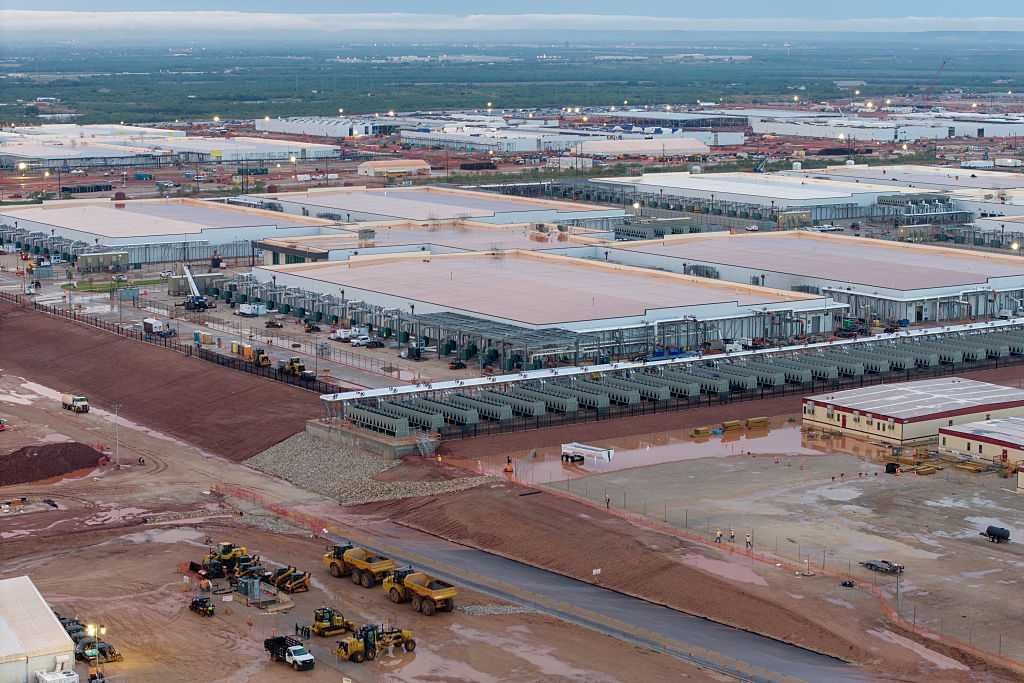 Photo by Kyle Grillot/Bloomberg via Getty Images
Solar ‘farms’ crushing farmland
President Trump has criticized the solar agenda from day one. He has called utility-scale solar inefficient and ugly — and he’s right about the aesthetics. Yet the administration now treats solar as a power source for data centers, while some MAGA influencers and pollsters try to sell the right on the plan. Pairing solar with hyperscale AI facilities accelerates the transfer of land out of food production.
Utility-scale solar typically requires five to 10 acres per megawatt. A solar build meant to feed a one-gigawatt hyperscale facility can swallow 5,000 to 10,000 acres. Supporters respond with percentages: Solar uses only a small share of total farmland. That dodge ignores where developers build. They don’t chase scrub. They target flat, well-drained, high-quality fields with cheap and easy access to transmission.
Follow the incentives. In states such as Indiana and Illinois, solar leases reportedly offer $900 to $1,500 per acre annually — far above the average return from corn and soybean ground. Landowners take the deal. Young farmers get priced out. Rural communities lose working land and the local economies that depend on it.
Reuters reported that in Indiana counties such as Pulaski, Starke, and Jasper, solar projects have secured 4% to 12% of some of the most fertile cropland. That’s not “marginal land.” That’s the kind of ground America needs to keep producing.
Tax breaks pour gasoline on the fire. Federal and state subsidies for data centers, solar farms, and battery installations push up land values and rents. In Pulaski County, Indiana, cropland rents reportedly jumped 26% since 2020 amid solar growth, outpacing state and national averages. Young families trying to farm don’t compete with subsidized megaprojects.
Indiana Republicans have compounded the damage by greasing the skids for carbon capture pipelines and special regulatory favors tied to the “Mid-States Corridor,” which will take even more farmland out of service.
Indiana’s own Department of Agriculture reports the state lost roughly 345,000 acres of agricultural land between 2010 and 2022. Residential sprawl drives much of that loss. Industrial conversion is accelerating — and data centers paired with solar build-outs speed it up.
So what exactly are these conservatives conserving?
Imports keep climbing. In 2023, imports supplied 59% of fresh fruit availability and 35% of fresh vegetables — up from 50% and 20% in 2007. America has the land to feed itself and then some, yet policymakers keep nudging production overseas. Mexico alone accounts for over half of imported fruits and vegetables, valued at more than $20 billion.
God gave this country an abundance of fertile land. He gave sun and rain to grow food. Our leaders now treat that ground as a blank canvas for industrial build-outs that don’t feed anyone.
If food security is national security, then farmland is strategic territory. Let’s start acting like it.