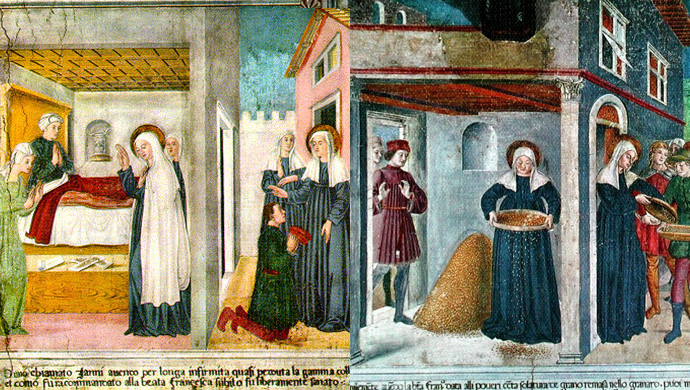
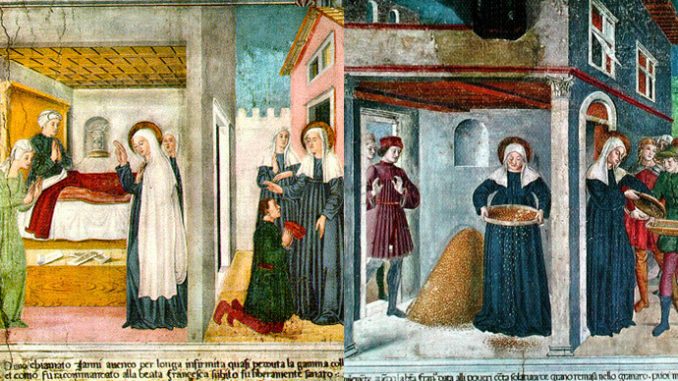
She never held a job in her life. She never went to college, and of her three children, only one survived her. She founded a religious community, but only joined it after her husband died. For most of her fifty-five years of life, she was simply a wife, mother, and homemaker.
How did such a seemingly ordinary woman become a famous heavenly patron of the great city of Rome?
Today, she is known as Saint Frances of Rome (1384-1440), but she was called Francesca Bussa de’ Leoni when she was born. Her parents were members of the Roman nobility, and according to the custom of the time, they arranged for her to marry into another wealthy Roman family when she was young. Frances was precociously devout and begged to become a nun instead. When she saw that her parents would not change their minds, she acquiesced and agreed to marry Lorenzo Ponziani. She was thirteen years old.
Soon after the wedding, Frances discovered her sister-in-law, Vannozza, quietly weeping. Frances and Vannozza discovered that they were both having a difficult time adjusting to life in the Ponziani palace with their in-laws, particularly in giving up their desire to enter religious life. Fortunately, their husbands were good Catholic men, so with their husbands’ blessing, the two attractive young women began looking for ways to become holy homemakers instead of nuns.
Rather than spending their days on parties and pleasures, Frances and Vannozza left their home each morning to seek out people in need. Dressed simply rather than as wealthy noblewomen, they entered poor neighborhoods and cared for the sick.
The two young women also encouraged one another in their spiritual lives. While remaining attentive to their duties as wives, they developed regular prayer lives, practiced physical mortifications, and drew strength from the sacraments. The entire household admired Frances for her amiable temperament, virtue, and wisdom. When her mother-in-law died, it was young Frances who was placed in charge of running the large Ponziani household. She treated her servants like brothers and sisters, not inferiors.
Frances was sixteen years old when she gave birth to her first child, Battista. She was twenty years old at the birth of Agnes, and twenty-three years old at the birth of Evangelist. Now that she was a mother, she made changes to her life of prayer and penance, but she did not give up her acts of service to the poor.
Frances and Lorenzo had a remarkably happy marriage. It is said that in their forty years of wedded life, “there was never the slightest dispute or misunderstanding between them.”1
One of Frances’ qualities that impressed others was her ability to remain calm even when she was interrupted. On one occasion, while Frances was kneeling in prayer, she was repeatedly called upon by her husband and others to deal with (probably trivial) requests. She responded to each intrusion with charity and patience. Frances famously reminded others that “It is most laudable in a married woman to be devout, … but she must never forget that she is a housewife. And sometimes she must leave God at the altar to find Him in her housekeeping.”2
However, there are always disagreements within a family, and not everyone agreed with Frances’ decisions. Some family members were not pleased about the public impression caused by Frances spending more time caring for the sick than attending social events. Frances also ordered the servants to never turn away anyone who came to the door asking for help. When Rome was affected by famine, she was so generous in giving help to the poor that her father-in-law, who, it must be said, was basically a good man, complained in exasperation that she intended to impoverish the Ponziani family as well.
But that event resulted in one of Frances’ most famous miracles. While her father-in-law raged and accused her of giving away all the food in the house (which she probably had done), Frances knelt and prayed. Her father-in-law sent servants to check the household pantry so that he could confront her with the bitter facts of her excessive generosity. Yet they quickly returned to him, shaking their heads and saying that all the missing food and drink had unexpectedly reappeared.
Another miracle occurred when rival armies were fighting in Rome. Lorenzo and other prominent men of the city had run away from the city to avoid certain death. The Ponziani home was burned, their possessions were stolen, and Frances was left behind with other women, children, and servants to live in the small portion of their home that had been left standing. Their enemies even kidnapped Frances’ young son, Battista, and held him for ransom. Yet when Frances prayed, Battista was inexplicably found safe and sound.
Frances continued to care for the sick during this period of violence, and dozens of people claimed to be healed by her prayers and even more by her homemade medicines. Yet her own son, Evangelist, and her daughter, Agnes, died of the plague, even though Frances cared for them until the very end.
After four years of fighting, Lorenzo was able to return home, but his health never recovered from his period of exile and war. He did resume his place as head of the household and arranged for their only surviving child, Battista, to marry a beautiful young woman named Mobilia. Unfortunately, Mobilia turned out to be a proud, overbearing woman who ridiculed her mother-in-law constantly. Proving her sanctity once again, Frances never lost her temper with her difficult daughter-in-law. Then one day, in the middle of an angry argument with Frances, Mobilia became seriously ill. Frances cared for Mobilia until she recovered, and the chastened Mobilia became a much gentler woman.
If imperturbable patience, miracles of healing, and self-sacrificing charity were not sufficient signs of Frances’ holiness, God granted her one more: visions. Before Frances’ daughter died, Frances’ guardian angel began appearing to her in the form of an eight-year-old child. The angel was constantly visible to her and gave Frances both guidance and correction for decades.
Although no one is required to believe in the contents of private revelations, Frances also claimed to experience visions of heaven, hell, and purgatory. In these visions, Frances saw people suffering punishments based on the sins they had committed. In one vision, Frances said that she saw each soul in purgatory was assigned a demon “to remind it constantly of its sins and the ways it had offended its loving Creator.”3 However, each soul was also granted an angel, who encouraged the soul and told it about “all the prayers and alms which were offered for its sake by relatives and friends who were still alive.”4
When Frances was forty-one years old, she founded a community of pious women. These women, called oblates, followed Frances’ pattern of life of prayer and service but did not take vows or live in a cloister. Eight years later, she established a monastery for these women called Tor de’ Specchi. Frances did not live among these women at first because of her duties to her family. She cared for Lorenzo for seven years, and after his death, she was able to enter the community herself. Despite her objections, she was immediately named superior. She spent the last seven years of her life as an oblate at Tor de’ Specchi.
Long before her death, Frances had become famous in Rome. She was a noblewoman who treated the rich and the poor, nobility and servants, and everyone else with equal dignity. She was known as a miracle worker through her prayers and her knowledge of healing. She experienced the joys and agonies of family life as well as the life of sacrifice of a religious. She survived war and plague and hunger and the deaths of her own children, yet she knew that God was close to her in even the most bitter moments.
Saint Frances was a holy homemaker, not a theologian, priest, or world leader, yet it was her personal witness that helped to restore faith in God to Rome during a time of violence. We too can look past the headline news and difficult family relationships to see God at work in the world today: in the Church, in the poor, and in our own families.
Endnotes:
1 Herbert Thurston, SJ, and Donald Attwater, Butler’s Lives of the Saints, Complete Edition, vol. I (Notre Dame: Christian Classics, 1956), 530.
3 Saint Frances of Rome, The Visions of Saint Frances of Rome (Gastonia: TAN Books, 2023), 94.
If you value the news and views Catholic World Report provides, please consider donating to support our efforts. Your contribution will help us continue to make CWR available to all readers worldwide for free, without a subscription. Thank you for your generosity!
Click here for more information on donating to CWR. Click here to sign up for our newsletter.