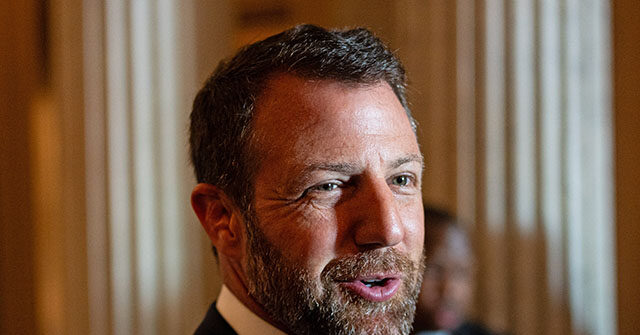
Pro-American lobby groups cautiously praised President Donald Trump’s decision to pick Sen. Markwayne Mullin as the new Secretary of the Department of Homeland Security (DHS).
“We’re congratulating on his nomination and indicating that we look forward to working with the Trump administration and with Secretary Mullin to continue ramping up deportations,” said one advocate for Americans and less migration. “He’s a little bit of a dark horse,” the source added.
A new coalition of groups that favors less migration posted a welcome note with a low-key reminder:
The newly formed Mass Deportation Coalition congratulates Senator Markwayne Mullin on his nomination to serve as Secretary of the Department of Homeland Security … The American people gave the Trump administration a mandate to deport the millions of illegal aliens in this country, and they deserve to see that mandate fully honored.
Pro-migration groups said little about Mullin, who has a mixed record on labor migration. But he was endorsed by retiring Sen. Thom Tillis (R-NC), who has been a champion for corporate hiring of migrant workers.
Trump chose Mullin after considering other hires, including Glenn Youngkin, an investment banker who served as Virginia’s governor, and Jason Chaffetz, a former House member.
Mullin will enter the job with the agency’s primary task already solved: Kristi Noem’s DHS has blocked the southern border to job-seeking illegal migrants.
That decisive and popular win has shifted the agency’s task towards mass deportations and reform of the many visa programs that import huge numbers of supposedly temporary migrant workers for jobs sought by Americans.
Mullin’s Mixed Views
Fox News described Mullin as a “hawk” on illegal immigration. He has repeatedly denounced amnesty bills, backed curbs on birth-migration loopholes, touted visa cancellations for radical migrants, and strongly backed border security. Those views are very popular with Trump’s pro-American base.
But he has a mixed record. For example, he told a Fox News radio that he favors the U.S. needs a legal inflow of roughly 1 million legalized migrants, or roughly one migrant for every four American births. The inflow numbers were set by Congress in 1990 at the end of the industrial era, but DHS has some bureaucratic authority to reduce and redirect the inflow of unproductive migrants, such as old or uneducated migrants.
Mullin has also signaled that he supports the inflow of temporary migrants for economic purposes. For example, Mullin has backed the bills and proposals to raise the inflow of blue-collar H-2B visa workers and to encourage the inflow of more white-collar H-1B visa migrants. But he also said in December that “the H-1B visas were designed to help grow these other [countries’] economies, much like we allowed people to take advantage of our economy, which is what President Trump is trying to resolve.”
Mullin suggested in February that he would accept Democrat-designed curbs on deportations in exchange for curbs on illegal voting. That deal would protect GOP politicians from illegal voting — but would expose ordinary Americans to pocketbook damage from illegal migrants. “I chair the No Labels group,” Mullin told Fox News Radio on February 9, adding:
We’ve had a very strong bipartisan approach to saying, “Hey, listen, if worse comes to worse, maybe we can put immigration reform with DHS and we can add the SAVE Act!” … The SAVE Act is what we [Republicans] want, they [Democrats] want immigration reform, and maybe there’s a longer conversation … I think the SAVE Act is very, very, very important.
On February 10, he suggested to Newsmax that he might back some form of legalization for job-seeking migrants, but not an amnesty that would allow the migrants to vote:
I’m in the camp of saying, okay, we are, right now, asking law enforcement to enforce our nation’s laws [so] let’s do it. And I’m also okay with saying, if we want to have this [legalization] debate, a bigger debate on saying that we need to allow the people to come out of the shadows, as the argument that Mike [Mike Lawler (R-NY)] said, okay.
“Our constituents, the American people that elected us, have to be on board with us doing that — and amnesty is not an option,” Mullin added.
Trump’s Deportation Mandate
As Secretary of Homeland Security, Mullin will have to oversee Trump’s evolving deportation policy.
But Mullin is a business owner and likely is sympathetic to other owners’ difficult task of finding good workers at fair wages amid a tight labor market. In December, Mullin outlined his views on temporary migration programs on the Will Cain Radio show:
There is a [national] labor shortage. It takes about a million immigrants a year just to fit our projected [economic] growth. We don’t have the workers … [when] if you’re below 3 percent unemployment, then you have [also] about 3 percent of the population that’s not employable because of mental health or whatever, other issues …
[My company is] in plumbing, HVAC and electric now, and we have between me and my partners, we have 370 locations around the country. We employ thousands of people … [and] the average plumber who is in the United States is about 48 years old, and in Oklahoma, — which the cost of living is very, very low compared to the East Coast — the average plumber makes about $120,000 a year. That is an extremely good living for Oklahoma … So we need to relook at our immigration system, to look at our education system, and we need to look at our high schools too, and see what type of workforce we’re actually needing to keep our economy moving forward.
Trump was elected on a popular promise to deport all illegal migrants.
Since the 1980s, millions of working-age Americans have slipped out of the workforce because employers have been free to hire illegal and temporary migrants. Millions of those discarded Americans have let themselves die of despair, drug addiction, and suicide.
But under Trump’s tight labor markets in 2019 and 2026, business owners have been pressured to hire, train, and pay the marginalized Americans who would have been allowed to quietly die under Joe Biden’s loose labor policies.
In 2025, Noem pushed to maximize deportations, partly by staging dramatic, street-level operations in D.C., Minneapolis, Chicago, Los Angeles, and elsewhere. The public strongly supports the deportation of all illegals, but the dramatic sweeps alarmed swing-voters, enraged many progressives, and frightened D.C. Republicans.
The alternative strategy is to quietly pressure employers to fire their illegal workers. The workplace pressure includes visits to check companies’ I-9 forms, and sending “no-match” letters from the Treasury Department to employers when employees use stolen or fake taxpayer numbers. That strategy is being pushed by Tom Homan, Trump’s enforcement fixer, who told a Florida audience on February 27 that “we’re going to see worksite enforcement explode this year.”
“Will they give Holman more leeway to do work-related enforcement?” asked Mark Krikorian, the director of the Center for Immigration Studies. “That’s the area where a new management at DHS could really make a difference and move the President’s agenda of mass deportations significantly.”
This “briefcase” strategy is bitterly opposed by business owners whose businesses depend on the government-created, post-1990 bubble of migrant consumers, renters, and workers. One reason for their opposition is their expectation that rival companies will gain an advantage amid partial enforcement.
The briefcase strategy is also opposed by Democratic politicians, many of whom oversee political machines that are funded by entangled corruption and illegal migration.
The establishment side of the GOP, however, favors a policy of talking loudly and doing nothing to reduce the pocketbook damage of migration to ordinary Americans. “We want to go after the most dangerous people — the gang members, the drug traffickers, the murderers, the rapists,” Tillis said March 8. “I believe that Markwayne recognizes that it’s quality over quantity,” he said.
The deceptive policy of passive support for illegal migration has transformed the demographics of the United States and enabled California and other states to turn blue. That GOP passivity also allowed Trump to sweep aside establishment GOP candidates in 2016 and 2024, and helped Zohran Mamdani win the New York mayorship in 2025.
But the quantity of deportations is now good politics for Trump’s new GOP.
Under Trump’s mass deportations policies, wages are up, and housing costs are down. Inflation is declining, transport costs are shrinking, crime is dropping, and corporations are spending heavily to help Americans become more productive. The resulting prosperity will likely help to raise birth rates as husbands gain higher wages and wives gain greater confidence in the future.
Also, Trump and his deputies are zig-zagging toward a new national strategy of economic growth via productivity and automation, not via Joe Biden’s crude and lethal policy of Extraction Migration. For Trump, the main threat comes from China, which relies on smart and diligent citizens to expand its high-tech factories and laboratories.
“We’re going to need robots … to make our economy run because we do not have enough people,” Trump told Breitbart News, adding:
We have to get efficient … we’ll probably add to [the existing workforce] through robotically—it’s going to be robotically … It’s going to be big. Then, somebody is going to have to make the robots. The whole thing, it feeds on itself … we’re going to streamline things. We need efficiency.
White-Collar Visa Workers
Trump and his deputies “are committed to stopping illegal immigration, unequivocally,” said Krikorian, adding:
But the President has said repeatedly, really for 10 years now, that American businesses need foreign workers, and so he approves of guest worker programs. We’ll see if that continues under the new management at DHS.
On The Will Cain Show, Mullin argued that H-1B visas have been abused, that universities are crowded with foreign students seeking work permits, and that the education system should be overhauled to help Americans take the jobs that are now going to foreign workers.
“It’s unfortunately true — our middle class has been lost because we’ve allowed our middle class to be shipped overseas,” Mullin said, adding:
The H-1B visas were designed to help grow these other economies, much like we allowed people to advantage of our economy, which is what President Trump is trying to resolve. The universities now have a very competitive program [for foreign students] … which is fine, let’s be competitive. But these are American universities first, and so I think we could fill those in [with American students]. I think I agree with what Charlie [Kirk] was saying, that they [the H-1B visas] have been abused … I’ve spoken to [Trump] about this in length, but I’m not trying to speak for the President. He’s like, listen, today, we have an issue, and to keep our economy growing at a 3 percent GDP and over. We don’t have the workforce prepared to do it now, so let’s bring people in temporarily. And I believe that “temporarily” …
When Congress created the H-1B program in 1990, business advocates said it was needed as a temporary project to fill jobs while young Americans were being trained for those jobs. In reality, once the cheap and compliant visa workers began arriving, U.S. companies reduced their training and hiring of Americans. They also used the resulting drop-off in American graduates as an excuse to demand more foreign workers.
Under President Joe Biden, the white-collar visa programs were expanded to keep a resident population of up to 2.5 million white-collar temporary migrants. The white-collar migrants hold jobs in the tech sector, banks, accounting firms, hospitals, universities, auto companies, computer security firms, the Fortune 500, and a myriad of subcontracting firms. Roughly 2 million white-collar migrants have become citizens since 1990, and one million are working while they wait in an overcrowded line to become citizens.
In turn, U.S. college grads are facing record unemployment as CEOs use the visa programs to outsource hundreds of thousands of jobs to AI-equipped workers in India. That brain drain is stripping young graduates of jobs, forcing mid-career American managers out of promotion-track careers, and consolidating critical technology, management, and political power in the hands of Indian CEOs and India’s government.
As DHS chief, Mullin would have the political authority to widen or shrink the various visa programs, including the H-1B, J-1, L-1, OPT, H4EAD, and TN programs.
The H-1B program by itself brings in roughly 120,000 new foreign workers each year and keeps roughly 750,000 foreign workers in a wide variety of white-collar jobs.
In addition, hundreds of thousands of foreign students each year also enroll in U.S. universities to get “Optional Practical Training” work permits, which are also a step to getting H-1B visas.
Both the H-1B and the OPT program allow foreign-born managers in major U.S. companies to hire students from their ethnic, regional, or national group, despite U.S. laws against workplace discrimination.
The programs are strongly supported by Wall Street because every $1 million in payroll cuts become $20 million, $50 million, or $100 million in higher stock values for shareholders and executive bonuses.
The visa programs are also used by corporate managers to sell Americans’ jobs to Indian workers in exchange for kickbacks. The silence among Indian migrants is rational because they need the CEOs’ help to win the golden prize of U.S. citizenship.
This black market also wrecks professionalism, sabotages corporate innovation, sidelines American executives, and supercharges outsourcing to the migrants’ home countries.
Since Christmas 2024, polls and social-media conversations show that many Americans now publicly recognize how Indian subcontractors are working with American employers to strip the American professional class of salaries, status, and political power. That expanding recognition persuaded Trump to announce minor curbs on the H-1B program in September 2025.
The D.C. establishment has shown little about the huge job losses among American professionals — and a deep reluctance to recognize the damage done by the visa programs. For example, an op-ed for the New York Times ignored the visa programs, as it reported on March 5:
Thomas Greifenberger graduated from the University of Delaware last spring. Although he double-majored in finance and marketing and minored in economics, it took him just three years to earn his bachelor’s degree. He had hoped that his solid grades and demonstrated drive would help him land a position in the financial services industry. But when Mr. Greifenberger began his job search, it quickly became apparent to him that he was sending résumés into a void …
He has returned home to Long Island, where he is now employed by his family’s tree service business. Mr. Greifenberger enjoys the work — he is often the guy up in the bucket, pruning branches — and the tangible results it yields. But he admits that it’s not the future he had envisioned for himself. “I still go on LinkedIn from time to time, but I think that ship has sailed for me,” he said.
The combined threat of AI, outsourcing, and visas could wreck the American middle class, leave U.S. national security dependent on foreign managers, cripple the housing market, and sink the consumer economy. The pro-migration Atlantic reported on February 18:
White-collar workers would go through what blue-collar workers went through beginning in the 1970s. Advances in machine technology improved productivity and depressed employment in Detroit; Pittsburgh; Gary, Indiana; and Worcester, Massachusetts. Rust Belt communities fell apart and never recovered. Then China joined the World Trade Organization, and globalization spurred another round of job losses, causing even more permanent damage. Affected workers ended up poorer, less happy, and less healthy. They died sooner. Their kids were worse off too.
To get the economy going again during the AI transition, the country would need to figure out how to get white-collar workers back to work. And I really mean figure out—essentially from scratch.
Meanwhile, Mullin told Cain that too many Americans are being recruited for college studies.
“Not everybody has to go to college, but we put it in the mindset of high school students that you’ve got to go to college. And when they go to college, and they don’t succeed, they get this failure mentality in their head, and it’s hard for them to overcome that,” he told Cain.
Blue-Collar H-2B Seasonal Visas
Amid pressure from the GOP’s base of business owners, Congress and Trump raised the inflow of H-2B workers to roughly 200,00. They are used for a wide variety of seasonal jobs, including trucking, welding, hotel service, construction, ski resorts, restaurant, roofing, and landscaping work.
Companies favor these foreign workers because they are more productive than available Americans in the shallow end of the U.S. labor pool. The seasonal H-2B workers are more likely to be compliant, healthy, fit, drug-free, diligent, and free of other priorities, such as childcare. They are also conveniently delivered by recruiters and staffing agencies.
A growing number of states allow illegal migrants to get licenses for skilled blue-collar jobs, such as plumbing and HVAC technicians. In November, law enforcement officials exposed a New York plumbing firm that allegedly made $74 million by using at least 200 illegal migrants.
Some GOP legislators are even trying to help illegal migrants keep trucking jobs amid a crackdown by Transportation Secretary Sean Duffy.
In his Cain interview, Mullin offered his explanation for why Americans employ far more migrants than 20 or 30 years ago.
“People do hire more people to clean their houses, people do hire more people to mow the yards … at the same time, our birth rate has gone down, and …. our labor need has increased,” he said, adding:
I’ll use [the] UAE as [an example]. UAE has 1 million UAE citizens. They have 8 million immigrants, because that’s what it takes to keep their economy moving forward … Most of the [Americans who did manual labor] are owners or managers of larger companies. That’s where most of them went to. If you could pull up to a job site, you’ll have a framer, you’ll have masonaries, you’ll have roofers, you’ll have sheet-rockers, you’ll have mud and tapers. You’ll have all that that. The owner will be a citizen, and a lot of his labor will be immigrant workforce because the pace of growth that our economy is going through right now, the pace has been going through for the last 20 years, has not been able to keep up with the labor for force or … the birth rate. There has been a huge gap between … and so these [prior-generation American] individuals that you’re talking about that were cleaning the houses have become owners and managers now.
He continued:
Take a normal state that actually is pro growth, there isn’t a work area problem — it is a labor shortage. So there isn’t a company out there that’s not trying to hire. We have hundreds of job openings across the United States inside our companies. And you’d go to any trade and they’re doing the same thing. You go to any job site, the job sites being slow slowed down [are] because they can’t get enough people to show up to work because the labor force just isn’t there right now.
That claim is echoed by many other politicians, including Mullin’s home-state Governor, Kevin Stitt (R).
H-2A Farmworkers
Congress has set no cap on the inflow of H-2A workers for farm jobs. Also, Congress has set no economic incentive to replace or augment migrant farmworkers with robots, such as robotic cow-milking machines. The New York Times reported on February 9:
Before he began using the robots, Mr. Hemminger’s farm produced about 800,000 pounds of milk per worker per year. Today the farm produces 2.5 million pounds of milk per worker per year. He employs half as many people as he would otherwise need — a dozen workers to manage his herd of more than 2,000 dairy cows.
“Mr. Hemminger’s farm is a vision of a better future. Mr. Trump doesn’t know how to get us there,” the article added.
Political Battles Ahead
Business lobbyists in D.C. impose year-round, face-to-face, seductive, and effective pressure on politicians, even as the GOP politicians fear that migration give-aways will crash their numbers on election day.
Pro-American groups do not have that concentrated lobbying power, but they do have Trump’s 2024 mandate, the administration’s shift to productivity, and many polls. “Hoping for great things from a DHS Secretary Mullin,” said Krikorian