The Royal Navy—once the pride of the United Kingdom—has shrunk to around two dozen warships, insufficient to project power in any meaningful sense.
Even before President Donald Trump first took office in January 2017, some US lawmakers warned that the United States Navy was too small to meet the challenges of the 21st century. By that time, the service had shrunk to levels not seen since World War I.
The US Navy remains one of the strongest fighting forces in the world. It still has 11 aircraft carriers, more than any other country—and they also happen to be the world’s 11 largest. Yet the ongoing conflict in the Middle East shows that given America’s awesome global responsibilities, it may not have enough vessels in service. The US Navy is increasingly stretched thin, and there are concerns that it would struggle to deal with more than one crisis at a time.
That is a bad situation for Washington. But it could be worse, as an example across the Atlantic shows.
Does Britannia Still Rule the Waves? Not Really
While the US Navy struggles to respond to multiple crises, the UK’s Royal Navy may not even be ready to deal with a single crisis. Known for centuries as the “Senior Service,” the fighting force more closely resembles an elderly pensioner whose best days have long since passed than a fit and ready warfighter ready to address modern threats.
The Times reported this week that the Royal Navy is now at its smallest level since the English Civil War—which, for those who haven’t brushed up on the history of the British Isles, was fought in the mid-17th century, more than two centuries before the American Revolution. The 400th anniversary of that conflict’s beginning is a mere 16 years away.
As the UK’s paper of record noted, during the Falkland Islands War fought in 1982, the Royal Navy “deployed 127 ships” to the South Atlantic to fight Argentina. Today, the Senior Service has less than half that number of commissioned ships. Of those, just over two dozen are actual combat ships.
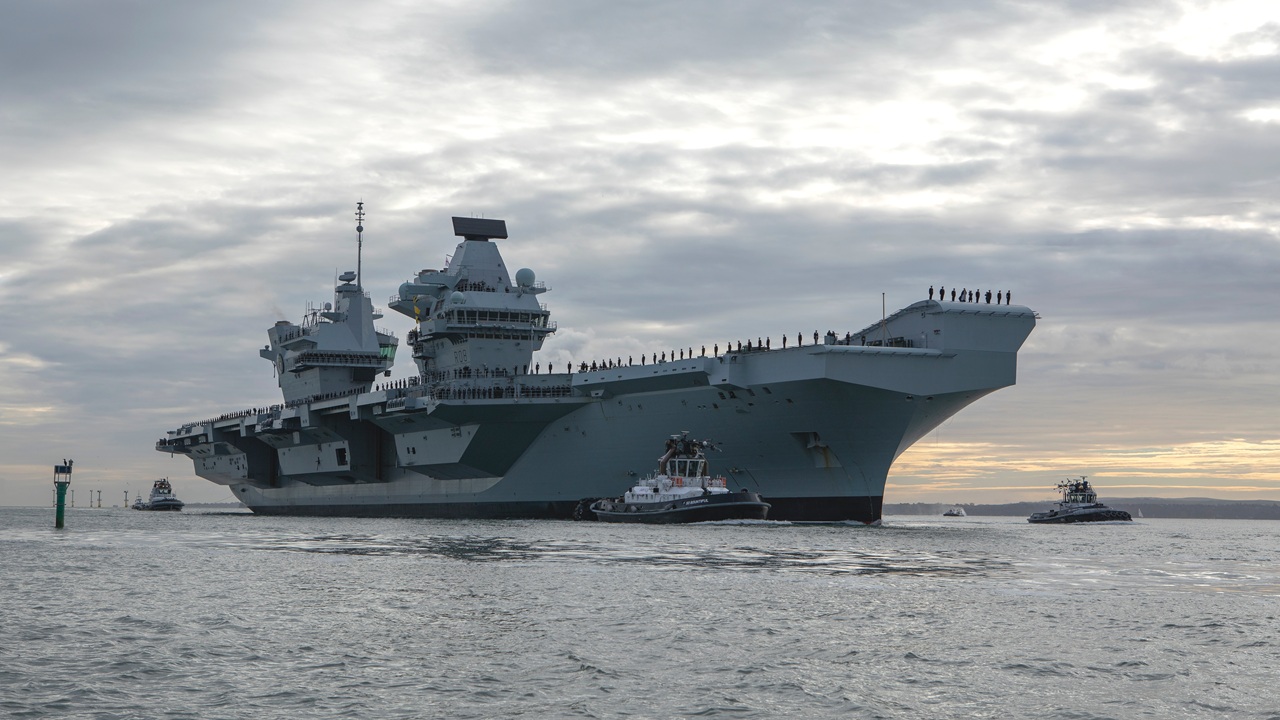
The Royal Navy’s surface fleet currently consists of two aircraft carriers, six Type 45 Daring-class destroyers, and seven Type 23 Duke-class frigates. It is supported by approximately 34 patrol and mine vessels, and two amphibious land platform ships. Of the warships officially in service, only about a dozen are active, with many others in long-term maintenance.
Military historian Mark Felton warned last year on his YouTube channel that the Royal Navy has more admirals than it has ships. It should be noted that not all of those individuals are in operational command; many of them have international and joint staff roles, with many responsible for shore-based staff, personnel training, logistics, and NATO responsibilities.
Still, it begs the question as to why the Royal Navy needs so many flag officers when it has so few warships.
The Royal Navy Has Two Carriers—but Can’t Support Them Properly
What is notable about the decline of the Royal Navy is that an attempt was made to correct course by building not one, but two aircraft carriers. Such vessels allow the UK to project power around the world and show the flag.
However, the Indo-Pacific deployments of both HMS Queen Elizabeth in 2021 and HMS Prince of Wales required support from multiple international partners. The Royal Navy lacks the escorts needed for one carrier strike group (CSG).
That’s partially why, during the tensions in the Middle East following the October 7, 2023, terrorist attacks in Israel, the Royal Navy never sent a carrier to support the US Navy. The Royal Navy did not have support ships, including fleet replenishment vessels, to make such a mission feasible, and there were likely concerns that the already-stretched US Navy would be required to protect the British flattop as well as its own. When HMS Prince of Wales led the Carrier Strike Group 2025 (CSG25) on the Operation Highmast deployment to the Pacific last year, the flotilla practically snuck past the Middle East.
Another factor in why no Royal Navy carrier took part in the operations was that the UK’s flattops haven’t been particularly reliable. Both were sidelined with serious mechanical issues.
A retired Royal Navy submariner told The Times that it was a mistake for the UK to purchase the two high-profile aircraft carriers instead of focusing on the smaller warships and submarines that actually back up a nation’s naval might.
“Instead of six Ferraris, we could have had 100 BMWs,” the retired sailor suggested.
This week, the UK has announced that the Type 45 Daring-class guided-missile destroyer HMS Dragon (D35) will be deployed to Cyprus, after RAF Akrotiri, the main base on the island, was struck by an Iranian drone. However, it will take several days for the lone warship to reach the region.
It is an indicator of the state of the Royal Navy, which can only offer a slow response with minimal capabilities.
The matter could be even more embarrassing for London, as French President Emmanuel Macron is ordering the Marine Nationale’s (French Navy’s) flagship nuclear-powered aircraft carrier Charles de Gaulle to the region. Neither British aircraft carrier is available, but for the reasons already stated, it is highly unlikely that the Royal Navy would or could deploy one.
History buffs may appreciate that the French will support NATO operations in the eastern Mediterranean, not far from the waters where the Royal Navy defeated the French Navy in the Battle of Aboukir Bay in 1798. If the battle were fought today, the Royal Navy wouldn’t stand a chance—if it could even show up!
About the Author: Peter Suciu
Peter Suciu has contributed to dozens of newspapers, magazines, and websites over a 30-year career in journalism. He regularly writes about military hardware, firearms history, cybersecurity, politics, and international affairs. Peter is also a contributing writer for Forbes and Clearance Jobs. He is based in Michigan. You can follow him on Twitter: @PeterSuciu. You can email the author: [email protected].