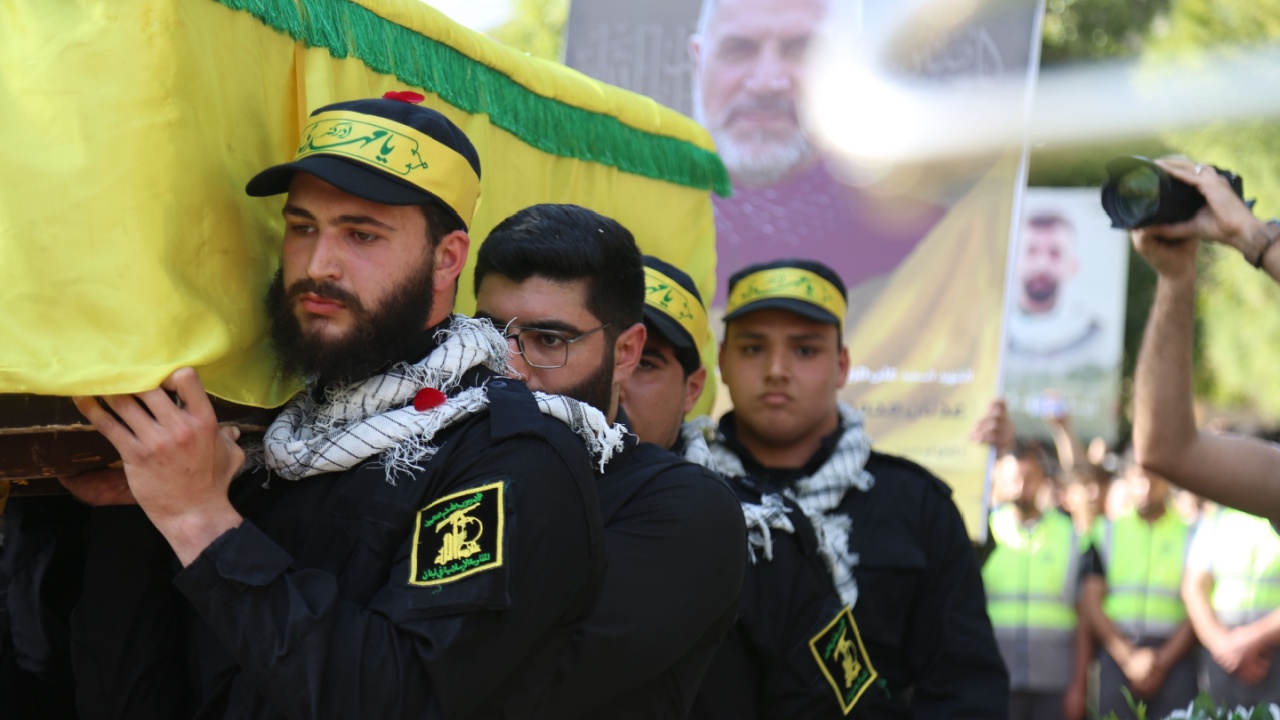
The Lebanese terrorist group’s seemingly self-defeating move underscores its absolute loyalty to the Islamic Republic of Iran.
Lebanon is now a front in the US-Israeli campaign against Iran. Within hours of Iran announcing Supreme Leader Ali Khamenei’s assassination, Hezbollah launched rockets and drones into northern Israel, prompting a predictably massive Israeli response in which Hezbollah “will pay a heavy price.” Hezbollah’s move, otherwise inexplicable and seemingly suicidal, appears geared to alleviating the war’s pressure on Iran to maximize the regime’s chances of survival.
Hezbollah was deliberately non-committal about joining the fray in the weeks leading up to the outbreak of hostilities. OnJanuary 26, Secretary-General Naim Qassem said Hezbollah “cannot be neutral” in a war against Iran, due to the religious and political significance of its supreme leader. The course of action that Hezbollah would take, however, would be decided “at the time and based on the course of the battle,” he said. After an Agence France-Presse report suggested Hezbollah was drawing a “red line” on Khamenei’s safety, the group quickly clarified to Alaraby al-Jadeed that it remained committed to Qassem’s stance and would not preempt the course of the war.
After Khamenei’s death had been confirmed, Hezbollah’s initial statements were mournful but non-threatening, strengthening the impression that the group would not intervene. Hezbollah even scheduled a mass gathering on March 3 in the southern Lebanese city of Tyre to eulogize the fallen Iranian supreme leader.
Hezbollah finally ended this uncertainty when it attacked Israel. In the first statement issued by its Islamic Resistance, the group framed the operation as “retaliation the criminal Zionist enemy cruelly and treacherously shedding the pure blood of…Khamenei.” The statement then also described the barrage as a delayed act of self-defense against Israel’s ongoing operations in Lebanon, which is how the group has since tried to reframe its decision to attack Israel.
At face value, however, Hezbollah’s justifications are unconvincing. Khamenei, as a person, is important to Hezbollah. But like former Quds Force Commander Qassem Soleimani or fallen Secretary-General Hassan Nasrallah before him, Khamenei is ultimately a replaceable cog in the regime’s well-organized system.
The group would therefore not risk self-destruction or exacerbating the Iranian regime’s current predicament merely to avenge him. They could have been satisfied with framing his death as yet another “blessed martyrdom” and inevitable sacrifice in the long war against the United States and Israel, as they have after the assassination of other significant figures.
Furthermore, Hezbollah’s actions on March 2 had no chance of forcing Israel to cease its attacks in Lebanon. The group has only begun the process of rebuilding its arsenal and command and control structure, which were severely degraded in the last conflict with Israel.
Even now, Hezbollah admits to lacking any conventional parity with Israel. Attacking could only have provoked more intense Israeli action while having minimal impact on the IDF or its deployment. Spinning its actions as nationalistically-motivated self-defense seems aimed at preempting a domestic backlash—especially from the Lebanese Shia community—for dragging them and the country into a second war to serve foreign interests in as many years.
Hezbollah is ultimately loyal to the Islamic Republic and its survival. That, in turn, depends on how far the United States is willing to go in this war. Shortly before Hezbollah began firing, President Donald Trump—despite briefly signaling continued openness todialogue with Iran—had nevertheless stressed US forces would sustain their campaign against the regime for at least a month. As of Friday, March 6, the president has now announced his willingness to sustain hostilities much longer.
Therefore, even knowing the consequences of provoking the Israelis, Hezbollah must have assessed that the conflict was heading in a direction endangering the regime’s survival. And it appears their intervention was geared at indirectly influencing American public opinion just enough to change that.
US officials who understand the unyielding nature of the Iranian regime’s hostility to the United States have failed to properly explain it to the American public—focusing on Tehran’s noxious anti-American sloganeering rather than laying out the direct and complex threat posed by Iran and its proxies like Hezbollah. Reflecting this and the growing isolationist leanings of Republican voters, US public opinion heavily opposes military action against Iran. This sentiment could grow if the war with Iran drags on, and it will weigh heavily on President Trump and the Republican Party as the congressional midterm elections approach.
Therefore, Hezbollah likely attacked to slow the course of the war by forcing Israel to divide its attention and resources, particularly its air force, along two fronts—at once alleviating pressure on Iran and hoping the resulting deceleration of the war effort would cause American anti-war sentiments to weigh more heavily on Trump and lead him to end the war prematurely.
About the Authors: David Daoud and Ahmad Sharawi
David Daoud is a senior fellow at FDD, focused on Lebanon and Hezbollah. He previously worked as a nonresident fellow at the Atlantic Council, director of Israel, Lebanon, and Syria research at United Against Nuclear Iran (UANI), and a research analyst at FDD. David also has experience working as a staff member on Capitol Hill, providing analysis on matters related to the Middle East, Israel, and Iran. Follow him on X: @Davidadaoud.
Ahmad Sharawi is a research analyst at The Foundation for Defense of Democracies, focusing on Middle East affairs, specifically the Levant, Iraq, and Iranian intervention in Arab affairs, as well as US foreign policy toward the region. Previously, Sharawi worked at the Washington Institute for Near East Policy, where he focused mainly on Hezbollah. He created a map visualizing the border clashes on the Israeli-Lebanese frontier and authored articles on Jordan and Morocco. Ahmad previously worked at the International Finance Corporation and S&P Global. He holds a BA in international relations from King’s College London and an MA from Georgetown University’s School of Foreign Service. Follow him on X: @AhmadA_Sharawi.