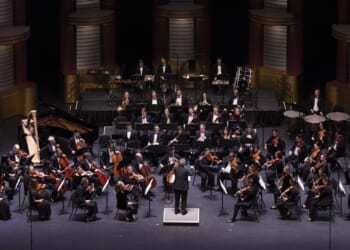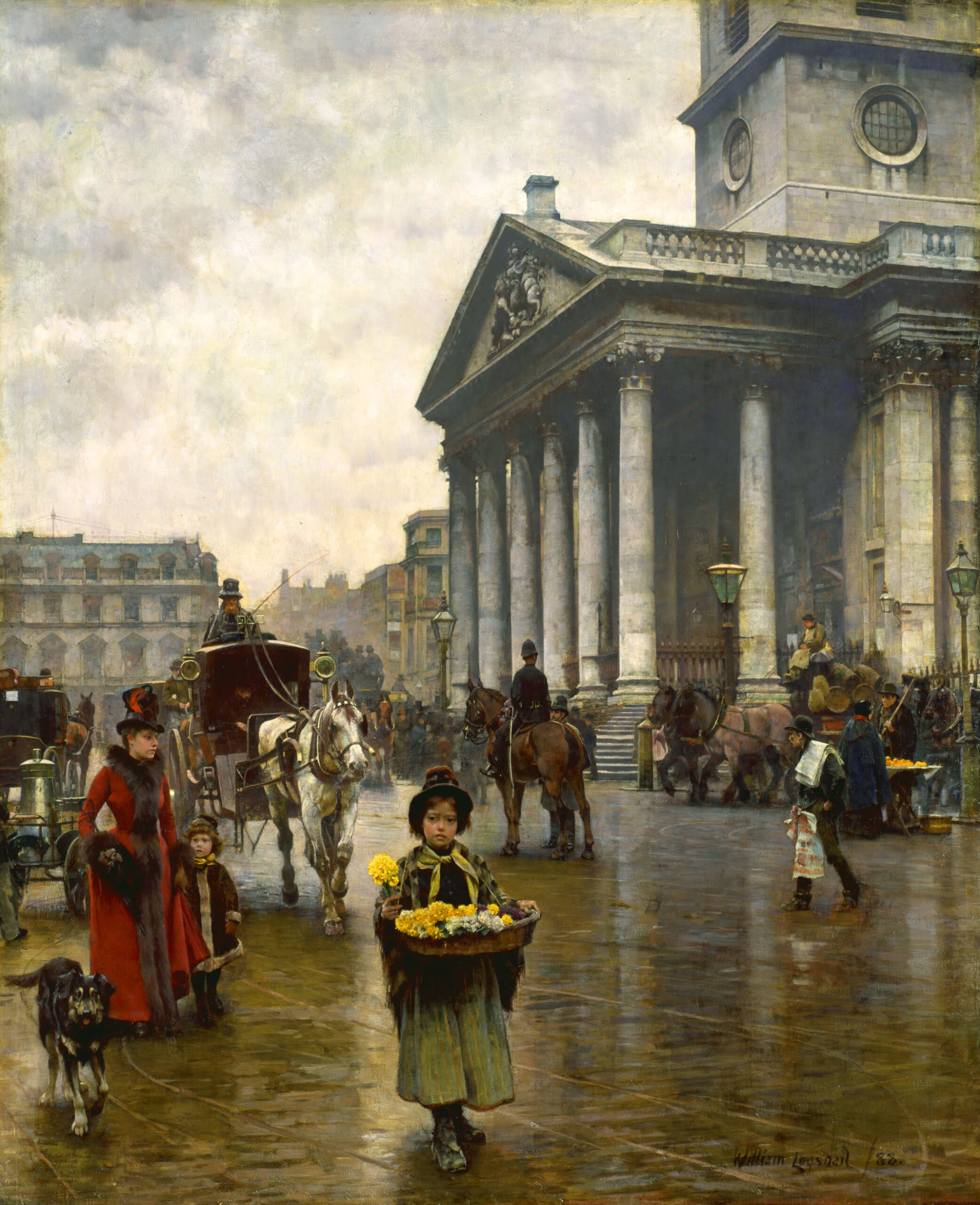
Last night in Carnegie Hall, I heard an English voice say, “I brought the London weather with me.” He had. It was rainy. On the stage was the Academy of St Martin in the Fields, the London orchestra (one of many). It was led by its music director, Joshua Bell, the violinist from Indiana.
More about this arrangement in a moment.
According to the calendar, Bell is in his late fifties, but, from my seat, he looked the same as he did in his late twenties. What witchcraft is this?
Bell has been the music director of ASMF (to use the orchestra’s shorthand) since 2011. He sits in the concertmaster’s position, but on a piano bench, not on the standard chair. He conducts freely with his right arm, which is to say, with his bow. Except when he is playing.
First on last night’s program was Charles Ives: his Variations on “America,” which the composer wrote for organ. It has been arranged in various ways since. ASMF played an arrangement by Iain Farrington, a versatile English musician.
We are in an “America year,” given the 250th anniversary of the Declaration of Independence. The music world is programming lots of music by American composers.
Of course, with the Ives piece, you get two for one: because what is “America” (“My Country, ’Tis of Thee”) but the Brits’ national anthem? (Musically, I mean. The words are something else.)
ASMF played the piece very well—crisply and stylishly, and with a somewhat dark tone. Along the way, we had a beautiful, burnished trumpet solo.
Mr. Bell did plenty of conducting, from that piano bench. I had to wonder: Why not just . . . you know: conduct? Ditch the violin and stand in front of them and conduct, if you’re going to do all that conducting anyway?
Maybe I could tell you a quick story about William F. Buckley Jr. In his work studio—an outbuilding—he had a little organ. One Fourth of July, he was working on nothing but those Ives variations, on “America.”
Next on the program last night was the Brahms Violin Concerto. Bell stood in front of the orchestra and conducted, until he turned around to play.
For decades now, I have been ranting in these pages, or on this website, about “play-conducting.” Usually, I’m talking about pianists who play and conduct at the same time—often in Mozart concertos. I will spare you my rant. But part of it is: the soloist’s playing is warped, because he conducts with his playing, as well as his gestures.
Moreover, to play-conduct a Mozart concerto is one thing—but the Brahms Violin Concerto?
You know, it went pretty well last night. Pretty darn well. I will not give you chapter and verse but will make a few points.
Joshua Bell likes to write his own cadenzas for concertos—and he is good at it. His cadenza for the Brahms is inventive, but not too much so. That is, it accords with the concerto as Brahms wrote it.
And Bell played the cadenza exquisitely—even magically. The final pages of the first movement achieved transcendence (really).
The second movement, the Adagio, begins with a famous oboe solo. ASMF’s player played it adequately, but he can no doubt do better. As for Bell, he played the Adagio with lots of soul, lots of heart. It reminded me: “There’s no need to be too cool in this music. In fact, coolness is wrong.”
The final movement began together—perfectly together, which I note because I had, and have, my doubts about this play-conducting business. The movement as a whole was merry and jaunty, as it should be. And it was sprinkled with paprika, meaning that the Hungarian quality of the music came out.
Did Bell play an encore? A Bach sarabande, maybe? No. In other circumstances—with another orchestra, and a conductor—he might have. Then he might have retired to his hotel room.
But he returned to “lead” the Symphony No. 1 of Schumann, the “Spring” Symphony. It began with a lousy entrance. But the symphony at large was basically itself—its genial, felicitous self. In the finale, there was some nice birdy flute playing.
Once more, I’ll ask, “Why?” Why not just—you know: conduct? It seems to me that the “leader,” sitting on that bench, occasionally rising off it, is neither fish nor fowl. He is essentially a conductor. But sometimes he is drawn away by his violin duties (“duties”).
The conceit of ASMF is—well, listen to its propaganda:
ASMF’s player-led approach empowers every member of the orchestra. It creates a direct line and electrifying connection between the orchestra and its audiences, resulting in ambitious and collaborative performances that transcend the traditional conductor-led model.
Oh, give me a break. Look: last night’s concert was not conductorless. Bell was conducting his hiney off, all night. He was just doing it with the encumbrance of a fiddle.
Anyway, he does it very well. He is an extraordinary musician.
There was an encore, which Bell announced. His ninety-year-old mother, he said, had come in from Indiana. The orchestra had been on tour, playing, among other things, Dvořák’s Symphony No. 8. That was not on the program last night. Bell’s mother lamented that she would not be able to hear the Dvořák.
So they played a movement from it. With technical precision and flair.
Maybe they know what they’re doing . . .