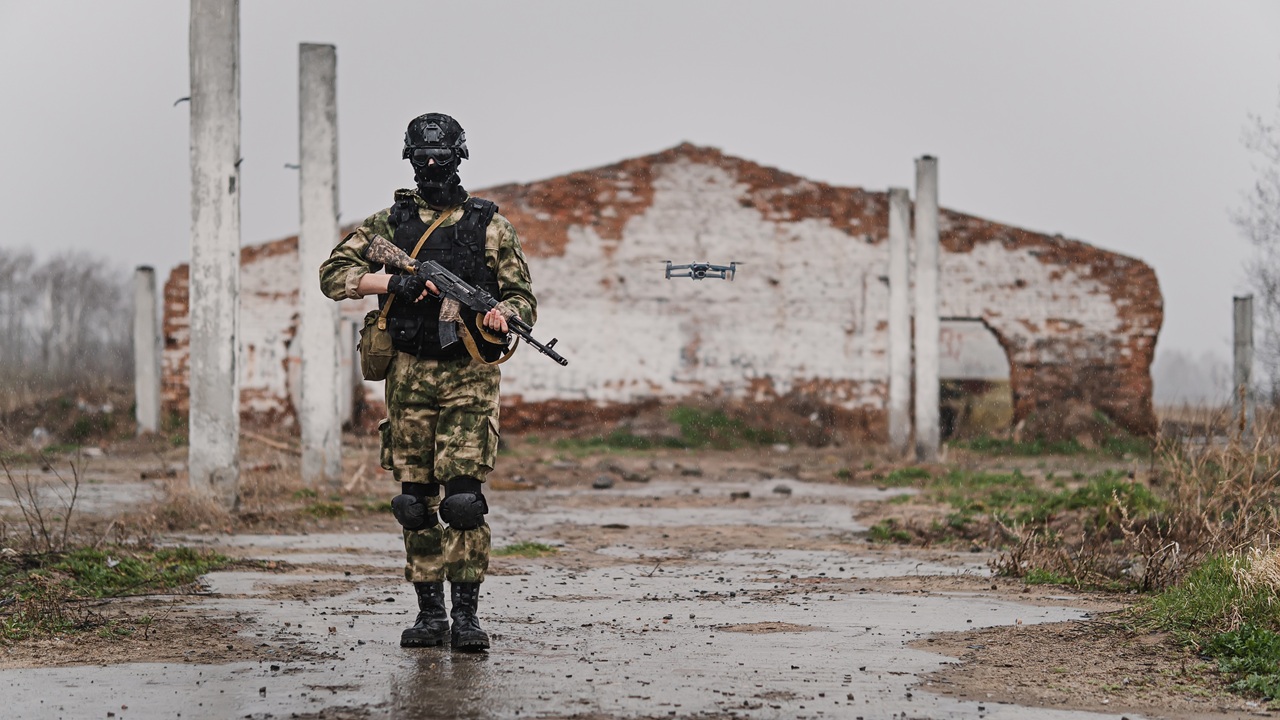
The new “Obereg 2.0” is the latest iteration in a series of advanced Russian body armor concepts—most of which have never been distributed to the country’s frontline infantry.
Russia’s Rostec announced this week that it had developed a new “modernized tactical body armor vest,” which will be produced at its Tula-based Oktava plant. The Obereg 2.0 body armor was developed to protect wearers from bladed weapons, small-arms fire, and even fragments.
About Russia’s “Obereg 2.0” Body Armor
According to a report on Russia’s state-media agency TASS, the Obereg 2.0 body armor can also protect “vital organs, the neck, groin, shoulders, and the collar area, according to protection classes Br1 and C2.”
The former is the lowest, or entry-level, protection for bullet-resistant materials. It protests against small-caliber handguns and sporting rifles. The C2 standard applies to higher-velocity rounds, including armor-piercing rifle rounds.
“The vest can be equipped with Br4 armor panels, which protect against 5.45×39 and 7.62×39 machine gun rounds, and the more durable Br5, which stops bullets from high-powered 7.62×54 rifle rounds,” the news post added.
“The Oktava plant in Tula, managed by RT-Capital, part of the Rostec state corporation, has developed a modernized tactical body armor vest of the Obereg line. The new equipment is lighter than previous versions and also features improved ergonomics and increased durability and survivability of the armor plates,” Rostec said in a press statement.
According to official statements, the body armor was developed in sizes ranging from 46 to 56 and in several configurations, covering the wearer’s vital organs and the waist and collar area in the basic version. Shoulder and groin protection can also be added. In all configurations, the armor is equipped with quick-release mechanisms at the shoulders and waist for rapid removal.
“Our team continues to work on improving body armor, studying and testing the latest materials for use in production,” said Oktava CEO Pavel Pavlenko. “Our main priorities are reducing the weight of the product, increasing the area of protection, and enhancing its protective properties.”
Pavlenko didn’t confirm when the new Obereg 2.0 body armor would enter full-rate production, or when it might enter service with the Russian military.
However, he added, “The Obereg 2.0 is a successful combination of quality, reliability, and ergonomics. I am confident this product will be in demand and appreciated by our servicemen.”
Russia’s Infantry Clearly Needs Better Armor
The Obereg 2.0 is just the latest in a series of personnel armor systems developed in Russia. It builds on the original Obereg (“Amulet” in Russian) body armor, first introduced in 2023 and presented at the Army 2023 Military Technical Forum in August of that year.
For more than a decade, the Kremlin has also touted its “Soldier of the Future” program, dubbed Ratnik (Russian for warrior). The lightweight body armor was designed to protect up to 90 percent of a soldier’s body. It also features a highly integrated, wireless networked communication system that provides greater situational awareness and sharing of vital information and intelligence between each soldier and unit. However, while highly touted by the Kremlin, it has seen only limited use in the ongoing conflict in Ukraine, likely due to cost and connectivity issues.
Moreover, it hasn’t been issued in the numbers that Moscow claimed it would be.
“The Ratnik system consists of almost 60 distinct components, ranging from revamped ballistic vests and a new helmet system to active hearing protection to several boot options for different seasons and new radio equipment,” The National Interest reported in October 2021—noting that 300,000 Ratnik equipment sets had been procured.
That might be news to the Russian troops fighting in Ukraine, who have long faced equipment shortages along the front line. For not dissimilar reasons, Russian soldiers have died at historically alarming rates while pushing forward against entrenched Ukrainian positions.
That same report added that the more advanced Sotnik gear “was previously projected to make its way to select special forces units by 2025, with a wider distribution run across Russia’s military by 2030. It remains to be seen if the manufacturer is able to mass-produce as ambitious a product as Sotnik on such a short timeline.”
In other words, very few Russian units now fighting in Ukraine will receive the new armor. They will not miss much, as few received the Ratnik armor, either.
Even as Russia continues to develop new body armor, such as the Obereg 2.0, only a handful of frontline troops will ever receive it. However, such reports propagate the notion that Russia’s military is equipped with the latest tanks and combat aircraft, and that the troops on the ground are outfitted with the best body armor and the most advanced small arms. The new armor won’t protect the soldiers, but it might help protect the myth of invincibility.
About the Author: Peter Suciu
Peter Suciu has contributed to dozens of newspapers, magazines, and websites over a 30-year career in journalism. He regularly writes about military hardware, firearms history, cybersecurity, politics, and international affairs. Peter is also a contributing writer for Forbes and Clearance Jobs. He is based in Michigan. You can follow him on Twitter: @PeterSuciu. You can email the author: [email protected].