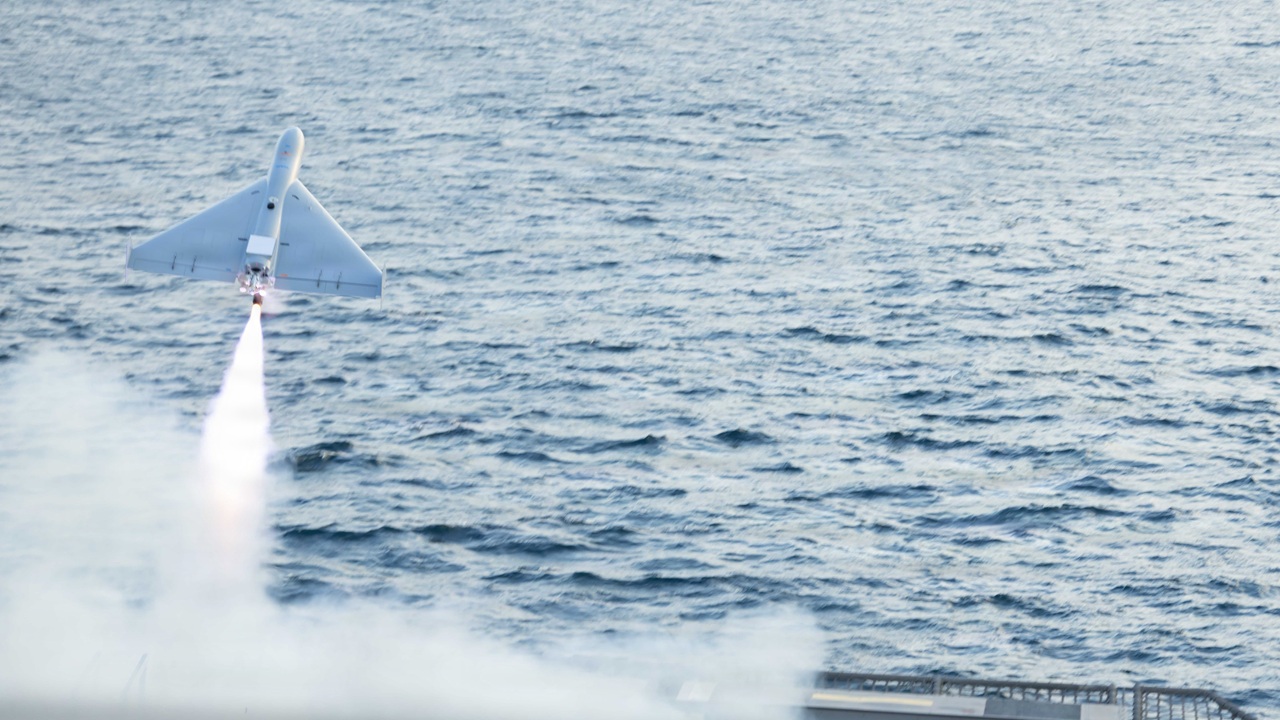
There is some irony in the fact that America’s LUCAS drone—now being used to strike targets across Iran—is virtually a copy of Iran’s indigenously designed Shahed drone.
The airstrikes carried out by the United States on Saturday against targets in Iran included the use of some of the most advanced and capable military aircraft in service today. United States Air Force Northrop B-2 Spirit bombers flew CONUS-to-CONUS missions from Whiteman Air Force Base (AFB), Missouri, supported by fifth-generation Lockheed Martin F-22 Raptor air superiority and F-35 Lightning II multirole fighters.
America also used its Low-Cost Unmanned Combat Attack System (LUCAS), a V-shaped one-way attack drone, in the strikes.
For Iran, the LUCAS Drone Looks Awfully Familiar
What makes this all the more noteworthy is that the drone, developed for the US military by the Arizona-based SpektreWorks, was reverse-engineered from the Iranian Shahed-136 “kamikaze” drone—albeit with smaller dimensions.
| Drone | Shahed-136 (Iran) | LUCAS (USA) |
| Year Introduced | Early 2020s | 2025 |
| Number Built | Unknown; many thousands | Unknown |
| Length | 3.5 m (11 ft) | 3 m (10 ft) |
| Wingspan | 2.5 m (8.2 ft) | 2.43 m (8 ft) |
| Weight | 200 kg (440 lb) | 80 kg (180 lb) |
| Propulsion | MD-550 piston engine | 215cc internal combustion engine |
| Top Speed | ~185 km/h (115 mph) | Unknown |
| Range | ~2,500 km (1,600 mi) | ~800 km (500 mi) |
| Service Ceiling | Unknown; must conduct attacks at ground level | Unknown; must conduct attacks at ground level |
| Loadout | 50 kg (110 lb) warhead | ~18 kg (40 lb) warhead |
To add insult to injury, the United States likely became aware of the drone’s effectiveness during its battlefield use in Ukraine—a use that was only possible because Iran had sold thousands of the drones to Russia, and assisted it in setting up its own construction lines for its domestic variant of the same drone, known in Russia as the “Geran.”
The United States likely acquired downed Shahed and Geran drones from Ukraine’s armed forces, and used them as a guideline for the LUCAS.
United States Central Command (CENTCOM) confirmed the use of the LUCAS, announcing it was a “HISTORIC FIRST” in a social media post.
“CENTCOM’s Task Force Scorpion Strike – for the first time in history – is using one-way attack drones in combat during Operation Epic Fury. These low-cost drones, modeled after Iran’s Shahed drones, are now delivering American-made retribution,” @CENTCOM wrote on X (formerly Twitter).
The first-of-its-kind unit, Task Force Scorpion Strike (TFSS), was established in the Middle East in late 2025 to rapidly deploy the LUCAS against regional threats.
“The President ordered bold action, and our brave Soldiers, Sailors, Airmen, Marines, Guardians, and Coast Guardsmen are answering the call,” said Adm. Brad Cooper, commander of CENTCOM, on Sunday.
The LUCAS Drone Is a Truly “Low Cost” Solution
The attack drone’s FLM 136 model has a range of approximately 500 miles and can carry 40 pounds, twice the payload of a Hellfire missile. The LUCAS can be launched via catapults, rocket-assisted takeoff, and mobile ground and vehicle systems.
“Equipping our skilled warfighters faster with cutting-edge drone capabilities showcases US military innovation and strength, which deters bad actors,” Cooper previously explained in December.
Each LUCAS costs around $35,000, comparable to an Iranian Shahed or a Russian Geran drone. That’s still the cost of a brand new midsize car, but far less than the millions of dollars that most advanced missiles now cost. In addition, unlike a missile, the LUCAS can be configured for reconnaissance missions.
“Iran could have seen the LUCAS coming as it was test-launched from a US Navy ship in the Persian Gulf in December,” Fortune reported.
The LUCAS, designed to operate autonomously, can also be employed in strikes that include coordinated, swarm-like attacks to overwhelm an adversary’s defenses.
The LUCAS drones used in the recent strikes were reported to be ground-launched. Still, the US Navy has previously test-fired the low-cost one-way drone from the Independence-class Littoral Combat Ship USS Santa Barbara (LCS-32) in December in the Persian Gulf, just weeks after the TFSS was created. LUCAS could provide much-needed capabilities to the LCS program.
“This first successful launch of LUCAS from a naval vessel marks a significant milestone in rapidly delivering affordable and effective unmanned capabilities to the warfighter,” said Vice Adm. Curt Renshaw, commander of NAVCENT/C5F. “This achievement demonstrates the power of innovation and collaboration in this critical region.”
About the Author: Peter Suciu
Peter Suciu has contributed more than 3,200 published pieces over a 30-year career in journalism. He regularly writes about military hardware, firearms history, cybersecurity, politics, and international affairs. Peter is also a contributing writer for Forbes and Clearance Jobs. He is based in Michigan. You can follow him on Twitter: @PeterSuciu. You can email the author: [email protected].