In the opening hours of Operation Epic Fury, the United States destroyed many Iranian surface ships—but it is doubtful they ever posed much of a threat to the US Navy.
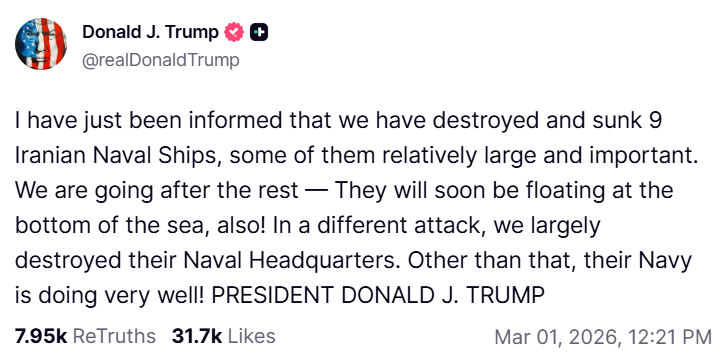
President Donald Trump claimed on Sunday that the US military had destroyed at least nine Iranian warships as part of “Operation Epic Fury,” the United States’ ongoing military campaign against Iran. The president said US forces would continue to strike and sink the remainder of Tehran’s naval forces.
“I have just been informed that we have destroyed and sunk 9 Iranian Naval Ships, some of them relatively large and important. We are going after the rest. They will soon be floating at the bottom of the sea, also! In a different attack, we largely destroyed their Naval Headquarters,” Trump wrote on Truth Social. “Other than that, their Navy is doing very well!”
US Central Command (CENTCOM) confirmed that several Iranian Navy vessels have been sunk, The Wall Street Journal reported on Sunday. That included an Iranian Navy Jamaran-class corvette.
“The ship is currently sinking to the bottom of the Gulf of Oman at a Chah Bahar pier,” CENTCOM said in a statement. “As the president said, members of Iran’s armed forces, IRGC and police ‘must lay down your weapons.’ Abandon ship.”
Another warship, reported to be an Alvand-class frigate, was also spotted in satellite photos shared online, burning pier-side at the port of Konarak in southeastern Iran, near the Pakistani border.
How Big Is Iran’s Navy?
Iran’s armed forces are notable for their division into two parts—the conventional armed forces, and the Islamic Revolutionary Guard Corps (IRGC), a special branch of the military answering directly to the Supreme Leader and devoted to preserving Iran’s theocratic system. The IRGC is both militarily powerful and politically influential, and is likely to shape Iran’s leadership following the death of longtime ruler Ali Khamenei.
The division within Iran’s armed services extends to its naval forces, and the Islamic Republic operates two parallel navies—the Iranian Navy and the IRGC Navy. It appears that the vessels targeted in CENTCOM’s operations belonged to the Iranian Navy.
Of the two forces, the Iranian Navy is larger and better-equipped, in keeping with its mission to fight a conventional war against a rival power. Prior to the air campaign, it operated around 140 vessels of various kinds, including roughly 70–75 surface vessels, 20 submarines, 30 amphibious ships, and a handful of logistics units. The airstrikes appear to have targeted the largest of the surface vessels, leaving the Iranian Navy with few major surface assets with which to fight the US Navy’s carrier strike group. However, it does not appear that Iran’s submarine force was affected by the strikes, giving Tehran another option to defend its littoral waters.
The IRGC Navy has a similar number of vessels, but most of its ships are far smaller and faster—essentially missile-armed speedboats designed to hide along the shore and quickly engage larger targets. These vessels would be useful against civilian shipping, especially the oil tankers that constitute the economic lifeblood of the Gulf, but would stand little chance against the larger vessels of the US Navy. The IRGC Navy also possesses a handful of larger ships, such as the Shahid Soleimani-type corvettes; the status of these vessels is unknown.
In that sense, it is too early to declare that Iran’s naval capabilities have been “destroyed” altogether. But they have been significantly weakened—and were never in much of a position to challenge the US Navy in a head-on fight in the first place.
What Was Iran’s Fleet Good For, Anyway?
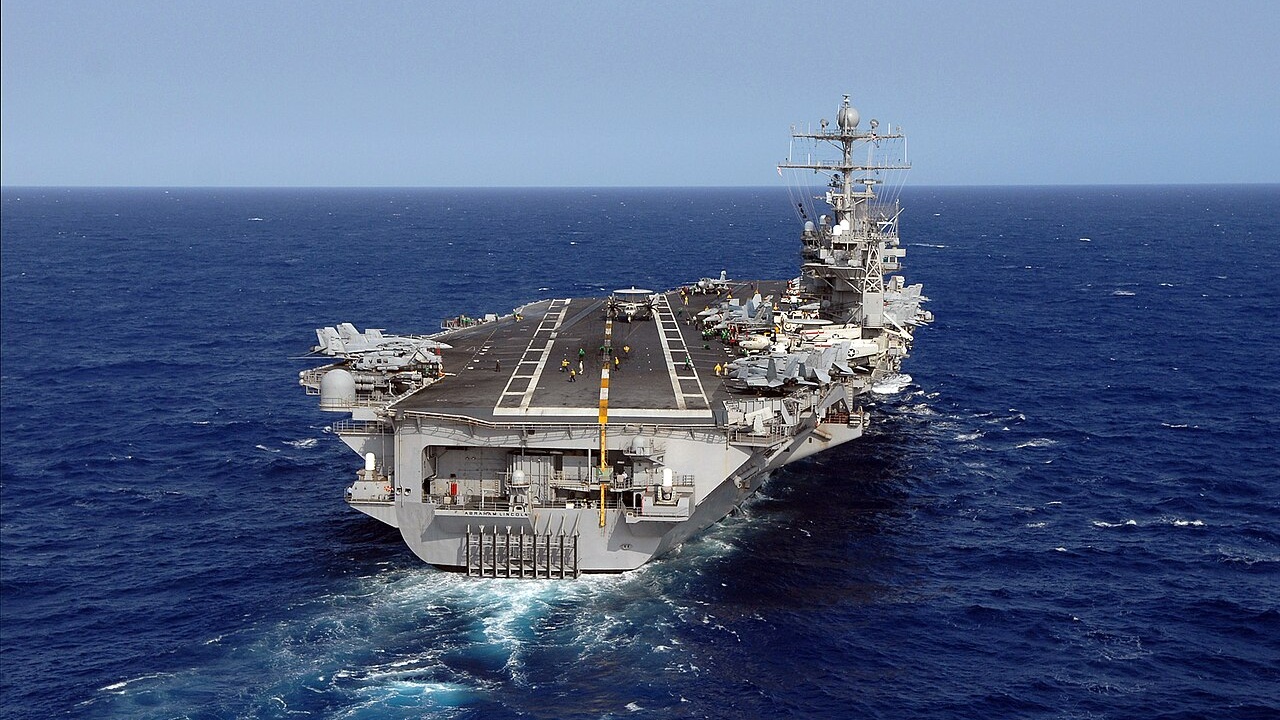
So, even as the Iranian Navy appears to have been crippled, the question should be asked if it really was a threat. In the early hours of Operation Epic Fury, Tehran showed no indication that it would sortie its frigates and corvettes against the United States Navy’s Abraham Lincoln Carrier Strike Group (CSG-3) or other naval assets in the region.
Indeed, the destruction of a significant number of the Islamic Republic’s naval forces certainly showcased the US military’s ability to strike at will—and highlighted the fact that Tehran can do little to protect large naval assets such as corvettes and frigates.
Regardless of the Iranian ships’ fate, the greatest threat to the Abraham Lincoln and its escorts would have likely come from land-based missiles rather than naval assets. It is relevant that, just under four years ago, the Russian Navy’s guided-missile frigate (and Black Sea Fleet flagship) Moskva was sunk by a Ukrainian land-based anti-ship missile. Ukraine has no navy to speak of, but has been successful in employing aerial, surface-skimming, and undersea drones to target Russian warships.
It’s Hard to Strike an Aircraft Carrier—but Easy to Say You Did
Iran is incapable of winning a war with the United States on the ground, but Tehran is already taking to social media to claim victory.
Even as the US strikes were being carried out against Iran, a statement from Iran’s Revolutionary Guard claimed that the US Navy’s Nimitz-class nuclear-powered supercarrier USS Abraham Lincoln (CVN-72) came under attack.
“Four ballistic missiles struck the US aircraft carrier Abraham Lincoln,” the IRGC said in a statement carried by local media, and then picked up on the social media networks. It added, “The land and sea will increasingly become the graveyard of the terrorist aggressors.”
The US quickly dismissed Tehran’s claims.
This attempt to sow misinformation/disinformation follows similarly unfounded allegations by Iranian proxies in the past that a US carrier had been targeted and even damaged. According to the Pentagon, no US carrier has taken damage during the deployments that began following the October 7, 2023, terrorist attacks on Israel.
Still, disinformation campaigns can rally the populace. With limited access to the outside world, the Iranian people may even believe the lies from the regime.
Then there is the concern that Tehran could still attempt to strike back, though its chances of success are at best limited. A carrier would be a very high-profile target, even if it would be very difficult to successfully strike and nearly impossible to sink—but even minimal damage would be a huge blow to the US claims of invincibility.
About the Author: Peter Suciu
Peter Suciu has contributed more than 3,200 published pieces over a 30-year career in journalism. He regularly writes about military hardware, firearms history, cybersecurity, politics, and international affairs. Peter is also a contributing writer for Forbes and Clearance Jobs. He is based in Michigan. You can follow him on Twitter: @PeterSuciu. You can email the author: [email protected].