From the emergence of the short-lived Hungarian Soviet Republic in 1919 to the 1956 Hungarian Revolution to the controversial current government, Hungary has, for more than a century, played an outsized role in the Western political imagination. Hungarian art, however, which bears witness to the country’s tumultuous history, is much less well known internationally.
The painter Lajos Tihanyi (1885–1938) never returned to Budapest after the fall of the Soviet Republic in 1919. He’s hardly an uncomplicated figure for national veneration, but “TIHANYI 140,” a large retrospective (some two hundred works of his are on display) at the Hungarian National Gallery, marking the 140th anniversary of his birth, makes the case that he is one of the most significant Hungarian artists of the twentieth century.
Deaf and mute from the age of eleven, Tihanyi was part of several Hungarian avant-garde groups that, like so many others in Central and Eastern Europe, absorbed Parisian innovations; the region’s art historians are condemned forever to defend the originality of their national artists. He seems to have learned to paint at the Nagybánya artists’ colony, where he spent three summers between 1907 and 1909, though he rejected the naturalism of its leaders and instead learned brushwork and color from younger Neo-Impressionists. He became a member of the Post-Impressionist A Nyolcak (The Eight), taking part in all three of their exhibitions in 1911–12, and was involved with the writer and theorist Lajos Kassák’s Ma(Today) circle in 1918. A year later, the Soviet Republic’s Artistic Directorate, led by Béla Uitz, bought Tihanyi’s works with funds made available by Minister of Culture György Lukács. Little is known about what Tihanyi did in this period, but life became difficult once the Communist regime fell. He fled to Vienna like his comrades and later lived in Berlin, Paris, and New York. He never again enjoyed the recognition he had known in Hungary.
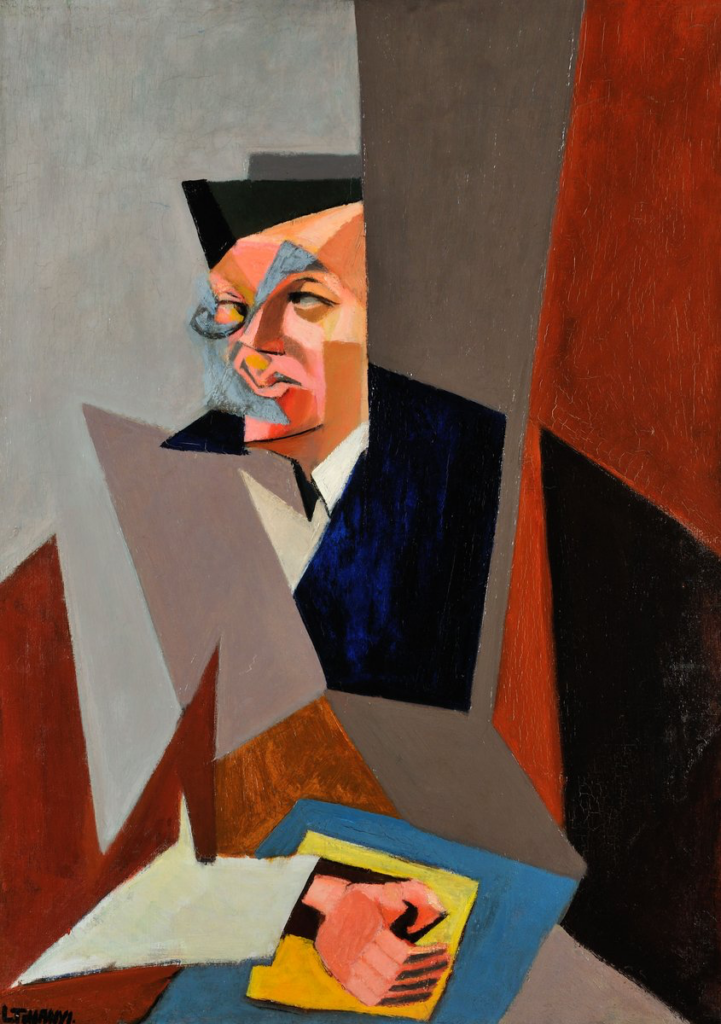
Tihanyi painted Kassák’s portrait in 1918, and the critic looks the part. Sitting in a wooden chair wearing a black collarless shirt, he stares into the middle distance. He’s not scowling, as so many others are in Tihanyi’s portraits, but the artist captures intense uncertainty in the frown lines across his huge forehead. Yet it is hard to grasp the rest of the body: the sloping shoulders are too broad, the right arm with its veined hands too thin. This marks the moment in which Tihanyi embraced Expressionism, just one of the many styles in which he worked; he had begun his career with Fauvist color before becoming ever more abstract.
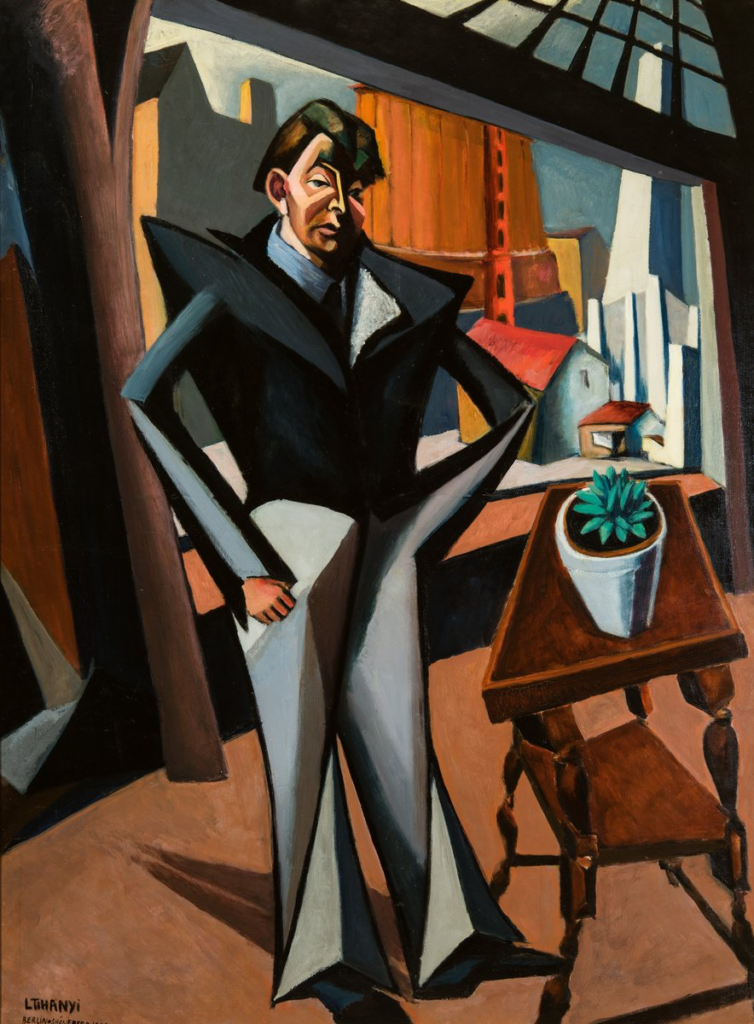
In Large Interior with Self-Portrait (Man Standing in the Window) (1922), Tihanyi captures himself in a dizzying, oddly proportioned room. His left side—face and body alike—extends into the factory buildings beyond the curved window, a synthesis of humanity with the industrial environment. The shoulders of his jacket, however, almost seem to belong to a suit of armor. Spanish Woman and Portrait of Tristan Tzara (both 1926) take this fragmentation of body and background further still. Both the anonymous woman and the Romanian Dada pioneer become almost unrecognizable: the latter’s face is twisted, his body reduced to polygons only just identifiable as a suit jacket and perhaps an arm. A year later, with the first of two pieces by Tihanyi called Abstract Painting (1927), almost nothing remains of the human form.
Five years after that, Tihanyi joined the Abstraction-Création group founded by, among others, the Dutch painter Theo van Doesburg. During this period, he produced Abstract Painting (1933) and Composition (1937), eradicating identifiable figures altogether. In the former, dancing white and black shapes commingle; the sleeves of the black form barely resemble arms while its right “hand” looks like a Möbius strip. In Composition, painted a year before the artist’s death, multiple scenes coexist, held together by what looks like a curious lever-and-pulley system. It’s a long way from Nagybánya.
There was much talk about the national identity of art in the early twentieth century, especially in Austria-Hungary. The critic Lajos Fülep—another portrait subject for Tihanyi—declared in Hungarian Art (1916) that form and style were themselves national values. Each nation’s artists were, he argued, tasked with solving a problem of form “rooted in the living environment and reality of the people,” making national ideals visible. There is some trace of this in Tihanyi’s early work, though there’s an inevitable difference in atmosphere between the Hungarian paintings and those produced in Paris.
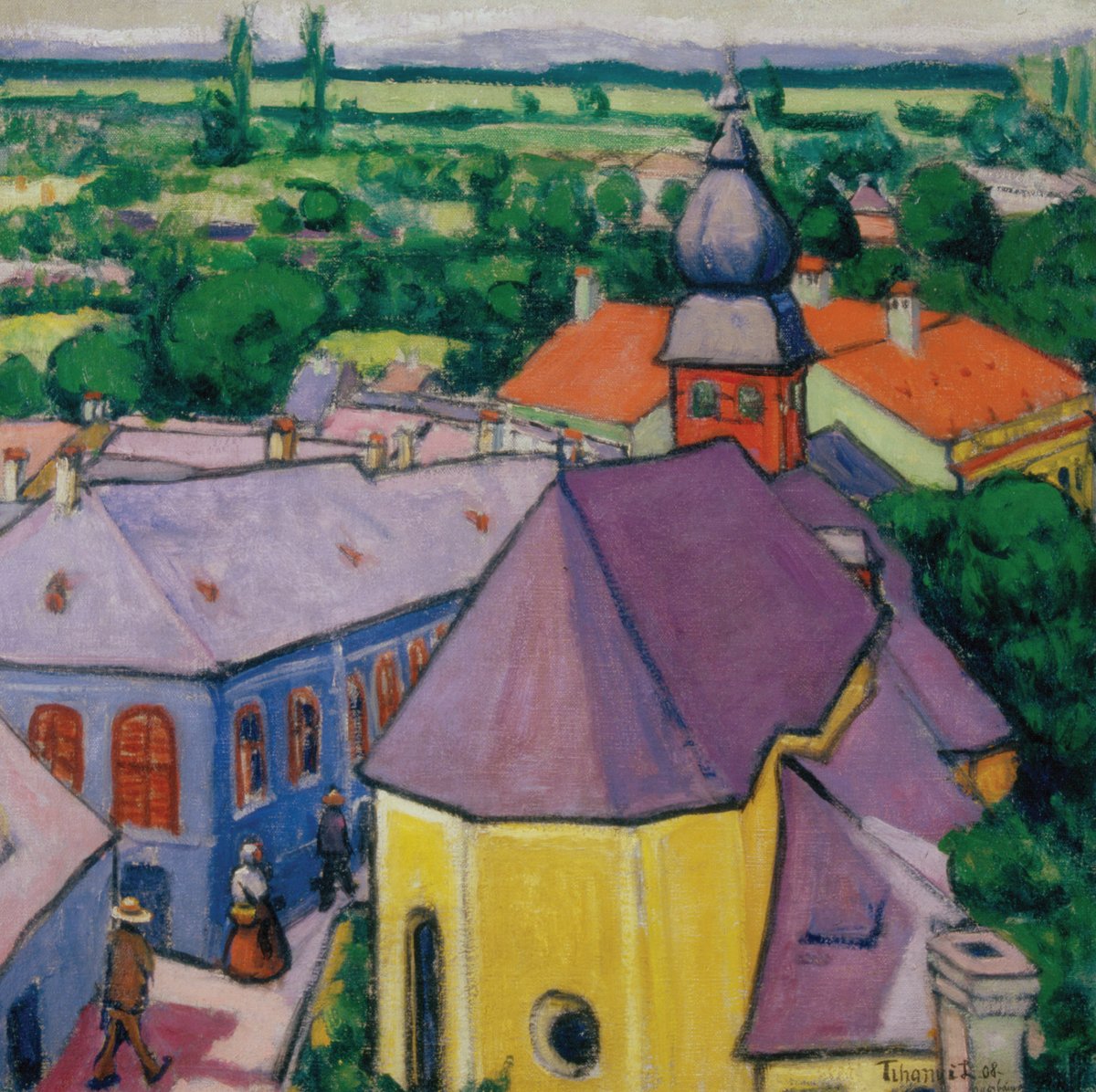
View from the Tower (1908), for example, shows us the Baroque Reformed Church in Nagybánya, the surrounding buildings, and the fields beyond. Today after two World Wars and at least four regime changes, it is impossible for the viewer to tell what liberties Tihanyi took with color. In his work, the red of the church’s modest onion dome becomes the tower itself; the sloping roof turns purple, the walls mustard yellow. The fields and trees beyond the town are gone now— Nagybánya, now the Romanian town of Baia Mare, has expanded considerably—though the presence of a sizable Hungarian minority means that questions of national identity remain.
Tihanyi’s quiet Nagybánya has three figures in the street next to the church and little other activity. By contrast, his Paris, as seen in Pont Saint-Michel (1908), is typically crowded: people scuttle down the elegant boulevards, impervious to shop signs and Morris columns; trams whiz over the Seine; barges creep along the river.
Tihanyi doesn’t seem to have shown any interest in politics until the Soviet Republic. A few days after its proclamation, he wrote the article “Culture Revolution” and argued elsewhere that only under a Communist regime can artists fulfil their destiny of living “the most desirable and truest lives.” A later letter, written after the regime’s collapse, expresses more doubt. In it Tihanyi insists that art belongs to humanity: its “eternal goals” cannot be taken up by the proletariat, whose interests and tastes are not the revolution’s driving force. “TIHANYI 140” doesn’t resolve the tensions in the artist’s work or thought, but it does expose them. The trajectory from Fauvist color to near-total abstraction mirrors the journey from Budapest to exile; national belonging to near-anonymity; ideological certainty to doubt. It shows how one artist shared the fate of the place he came from, even if he didn’t think much about Hungarian identity.