

On Friday, in an open letter to the 119th Congress, I joined more than 100 economists and public policy experts from universities, think tanks, and businesses across the country urging practical reform of the Highway Trust Fund. Our message is straightforward: Congress can — and should — take incremental, bipartisan steps now to put the fund on a stable, sustainable path.
The Highway Trust Fund long embodied a simple user-fee compact: People who use the roads pay for them. That bargain delivered predictable funding and reinforced fiscal discipline.
Congress has repeatedly patched the shortfall with transfers from the general fund, which papers over the problem while weakening the principle that made the system durable.
Now the system is fraying. Fuel taxes have not kept pace with inflation, rising construction costs, or improved fuel efficiency. Electric and hybrid vehicles — a growing share of the fleet — often contribute little or nothing through fuel taxes. Congress has repeatedly patched the shortfall with transfers from the general fund, which papers over the problem while weakening the principle that made the system durable.
Congress does not need to solve every long-term challenge in one bill. It can make meaningful progress in the next surface transportation reauthorization, which lawmakers must pass by Sept. 30.
First, lawmakers should reinforce the user-pay principle by ensuring all road users — including drivers of electric and hybrid vehicles — contribute a fair share through transparent, enforceable mechanisms. Fairness demands no less. When some users effectively get an exemption, the burden shifts to everyone else or to taxpayers at large.
Second, Congress should improve price sensitivity. Heavy commercial vehicles impose disproportionate wear and tear on highways and bridges. User fees should better reflect vehicle weight and road impact. That change would improve fairness and send clearer economic signals about infrastructure costs. A system that reflects actual use and damage is more rational — and more defensible.
Third, legislators should evaluate a transition from per-gallon fuel taxes to mileage-based user fees. A well-designed road-usage charge would ensure payments reflect miles driven and vehicle characteristics.
Any transition must preserve the core user-pay principle while avoiding disproportionate burdens on low-income households, small businesses, and farmers. State pilot programs show mileage-based systems can protect privacy and maintain public trust. Congress should build on that experience rather than delay modernization.
Fourth, Washington should reduce reliance on general-fund bailouts and set clearer expectations for revenue reform in the next major reauthorization cycle. Temporary patches undermine fiscal responsibility and create uncertainty for state planners and private investors.
RELATED: Trump is getting the job done for American truckers
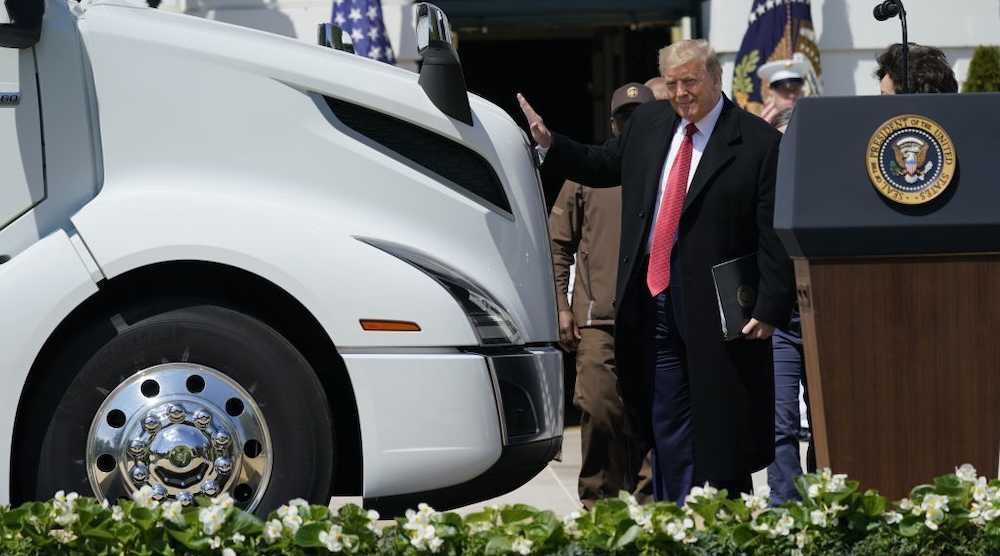 Photo by Chris Kleponis/Polaris/Bloomberg via Getty Images
Revenue reform alone will not secure the system. Transportation infrastructure now depends on digital systems that guide vehicles and manage logistics. America’s economy relies heavily on GPS-enabled positioning and timing. Disruptions to systems overseen by the U.S. Department of Transportation would ripple across freight networks, emergency services, and daily commutes.
China and Russia have shown the capability to interfere with satellite systems and GPS signals. A prolonged outage would cost billions of dollars per day. Vehicles sold in the U.S. should incorporate tested backup positioning technologies to guard against such threats.
Supply-chain security also demands attention. Chinese firms such as BYD and CATL dominate global battery production. The concentration of manufacturing — and embedded telematics — in companies subject to influence by the Chinese Communist Party raises legitimate concerns about espionage and strategic vulnerability.
The U.S. should expand domestic battery production and charging infrastructure, reducing dependence on foreign-controlled systems that can compromise data security and resilience.
Finally, Congress should pursue sensible federal deregulation to reduce the needlessly high cost of transportation projects — and require state and local partners to do the same. Streamlined permitting, faster reviews, and fewer duplicative requirements would stretch every Highway Trust Fund dollar and deliver projects faster.
These proposals are not partisan. They are practical steps rooted in fiscal responsibility and national security. A stable source of funding for roads is not merely a budget issue; it is essential to economic competitiveness, national mobility, and public safety. By reinforcing the user-pay principle, modernizing revenue mechanisms, protecting digital infrastructure, and strengthening supply chains, Congress can signal a shared commitment to safeguarding America’s transportation future.
The 119th Congress has an opportunity to restore the Highway Trust Fund’s integrity. Lawmakers should seize it.