Helicopter pilot Eric Slover was shot four times during his descent into the Venezuelan presidential compound, but maintained control of the aircraft.
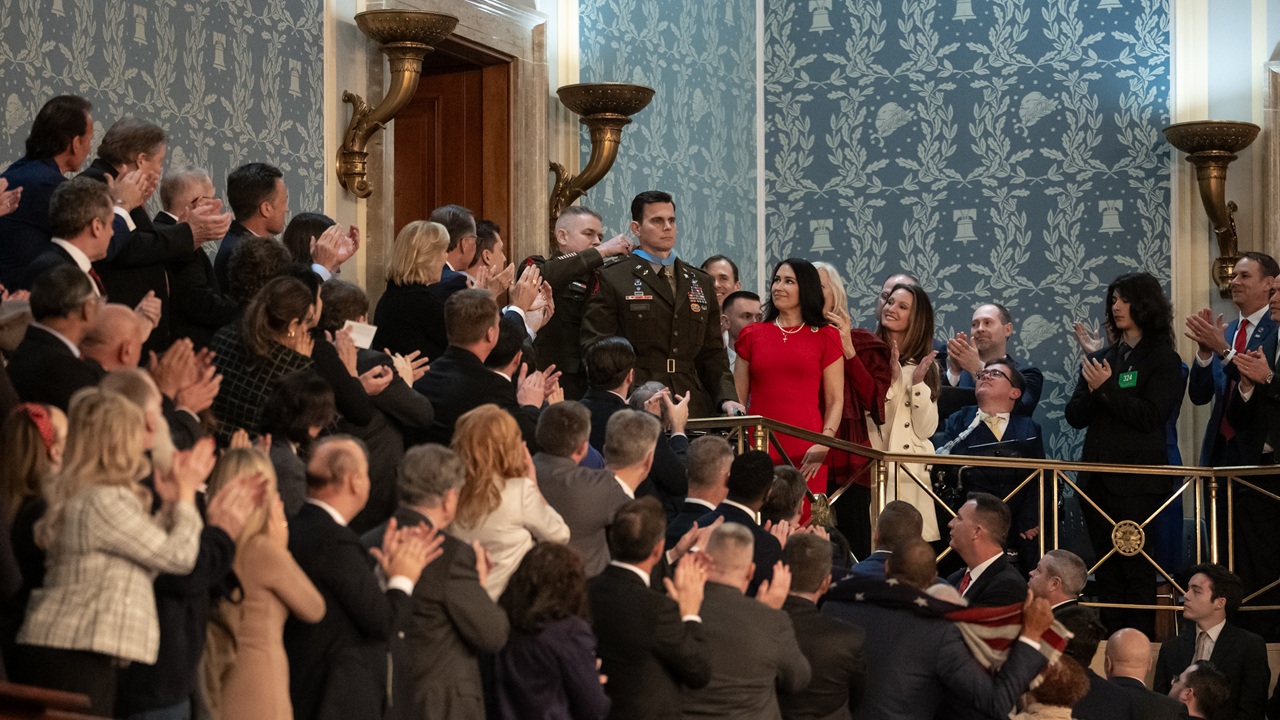
A special operations aviator received the Medal of Honor, the US military’s highest award for valor under fire, for his part in the recent operation to capture Venezuelan dictator Nicolas Maduro—as announced by President Donald Trump at the conclusion of his recent State of the Union address.
Slover’s Courage Under Fire
Near the end of the speech, President Trump announced that Army Chief Warrant Officer 5 Eric Slover had been awarded the Congressional Medal of Honor, the highest award for valor under fire, for his actions during “Operation Absolute Resolve”—the special operation to capture Venezuelan President Nicholas Maduro and his wife in January.
Slover is a member of the Army’s 160th Special Operations Aviation Regiment, better known as the “Night Stalkers.” This is the first Medal of Honor for the unit.
A few weeks ago, Trump visited Fort Bragg, the home of the Delta Force, and indicated that a soldier would receive the Medal of Honor for his role in the operation. Although many thought he was referring to a member of the ground force that stormed Maduro’s presidential palace, neutralized his elite Cuban guards, and captured him, he was referring to a Night Stalker.
Slover was the lead pilot in the first MH-47G Chinook helicopter to descend on Maduro’s presidential palace. Although the US military had neutralized Venezuela’s Russian-made air defense umbrella through a combination of electronic warfare, precision strikes, and cyberattacks, Maduro’s residence was heavily guarded by ground forces, who began to shoot at the helicopter.
“While preparing to land, enemy machine guns fired from every angle, and Eric was hit very badly in the leg and hip — one bullet after another,” Trump said during the State of the Union. “He absorbed four agonizing shots, shredding his leg into numerous pieces. Yet, despite the fact that the use of his legs was vital to successful helicopter flight, to deliver the many commandos who would capture and detain Maduro was the only thing Eric was thinking about.”
During the operation, Slover inserted the Delta Force assault force on target, even though he was bleeding profusely. An MH-47G Chinook can hold dozens of troops, and his steady flying in spite of his injuries certainly saved the mission—and the lives of some of America’s best soldiers.
After safely landing the helicopter, Slover directed his co-pilot, who was also wounded, to take control of the aircraft.
“The success of the entire mission and the lives of his fellow warriors hinged on Eric’s ability to take searing pain,” Trump added.
Army Lt. Gen. Jonathan Braga, the commander of the Joint Special Operations Command and a former commander of Delta Force, placed the medal around Slover’s neck.
About the Night Stalkers
The 160th SOAR has the most capable helicopter pilots in the world. The unit only accepts seasoned aviators with years behind the stick and often considerable combat experience.
The Night Stalkers’ restrictive recruitment practices are in place for a good reason. The unit directly supports the world’s most elite special operations forces in high-stakes missions. It was the Night Stalkers, in special stealth MH-60 Black Hawk helicopters, who ferried the SEAL Team Six squadron that killed Osama bin Laden in and out of Abbottabad, Pakistan. It was also the Night Stalkers who inserted the Delta Force assault force that took out Abu Bakr al-Baghdadi, the leader of the Islamic State.
In addition to the MH-47G Chinook and MH-60 Black Hawk, the Night Stalkers fly the AH/MH-6 Little Bird and the MH-60 Direct Action Penetrator (DAP), a heavily armed version of the MH-60.
About the Author: Stavros Atlamazoglou
Stavros Atlamazoglou is a seasoned defense journalist specializing in special operations and a Hellenic Army veteran (national service with the 575th Marine Battalion and Army HQ). He holds a BA from the Johns Hopkins University and an MA from the Johns Hopkins’ School of Advanced International Studies (SAIS). His work has been featured in Business Insider, Sandboxx, and SOFREP.