US and Israeli strikes on Iran should actively degrade the regime’s ability to kill protesters—including by directly targeting the Basij troops working to suppress them.
As the United States’ efforts at diplomacy with Iran stall, the US military is moving additional assets into the Middle East in preparation for war. Supreme Leader Ali Khamenei refuses to dismantle the Islamic Republic’s uranium enrichment capacity and shields the ballistic missile program from negotiations. If talks collapse, the question is not simply whether the United States can use force, but how to align military action with Iran’s ongoing protest movement so that pressure accelerates regime fracture rather than suppresses it.
Israel’s June 2025 strikes inside Iran, codenamed “Operation Rising Lion,” were an early attempt to link internal unrest with external pressure on the clerical regime; the name itself invoked Iran’s pre-1979 imagery in a plea for the Islamic Republic’s overthrow. Despite Israeli efforts to spur protests, however, Iranians stayed home as contradictory messaging from Washington and Jerusalem paired calls to rise up with evacuation warnings. Iranians also tended to view Israel as initiating the conflict rather than responding to regime aggression, thereby muddying the political framing—even though the strikes also failed to trigger a rally-round-the-flag effect for Tehran. Force alone did not mobilize the streets because it was not synchronized with a coherent political narrative inside Iran.
Nearly nine months later, the political environment is different. Iranians answered Trump’s calls for protests and pleaded for American intervention, regarding US action as indispensable help rather than the start of a new confrontation. After Iran accepted the aid of foreign militiamen from its Iraqi and Lebanese terror proxies to kill unarmed Iranian protesters, the protest movement appears far more willing to tolerate foreign intervention from its allies abroad. Ultimately, Iranians view the unrest as a revolutionary rupture centered on clear leadership and a defined transition plan that places Crown Prince Reza Pahlavi at the helm.
Airstrikes Can Aid Iran’s Protest Movement—if Timed Correctly
If Trump launches an extensive campaign resembling the 12-Day War, it would likely target senior leadership and missile stockpiles. Crucially, it should also include the forces actively suppressing protesters, paired with disciplined sequencing and direct communication to Iranians. Clear guidance on when and where to mobilize would reduce the risk of civilians entering strike zones and would extend momentum beyond Tehran into major provincial cities. Any prospective strategy should measure success not only by battlefield damage, but also by whether it shifts the internal balance of power without drawing the United States into another ground war.
The 12-Day War got the sequencing of external assistance to the protest movement broadly right, but it faltered in execution. Israeli strikes that began on June 13 focused first on nuclear and core military targets. By June 23, Jerusalem’s emphasis shifted toward the repression apparatus, including the Islamic Revolutionary Guard Corps, the Basij militia, law enforcement headquarters, and political prisons used to detain and kill dissidents. The logic was sound. First, Israel needed to degrade air defenses and missile capacity to limit retaliation. Once this was complete, it could pivot toward the regime’s internal coercive machinery, creating space for mobilization once large-scale urban bombardment subsided.
The problem was not the concept but the timing. Israel made a strategically sophisticated move by hacking the Islamic Republic of Iran Broadcasting network and airing footage of prior protests alongside calls for citizens to rise up. Leveraging the regime’s own propaganda hub allowed outreach despite internet blackouts. But the hack occurred on June 18 in the middle of intense bombing and before Israel’s shift toward dismantling the repression apparatus. Expecting mass mobilization while strikes hit urban areas, and before security forces were degraded, was never realistic.
Similar inconsistencies also played a role. Israeli Persian-language channels issued evacuation warnings on June 16, and Trump called on residents to immediately evacuate Tehran. Yet the next day, the hacked state television carried calls to take to the streets. When Iranians received the two competing instructions, they did not know whether to wait until the strikes subsided so they could protest or flee for their lives. In a country without shelters or warning systems and with living memory of the Iran-Iraq war in the 1980s, caution ultimately prevailed, and they remained off the streets. The issue was not lack of anti-regime sentiment, but the absence of synchronized sequencing between military pressure and political mobilization.
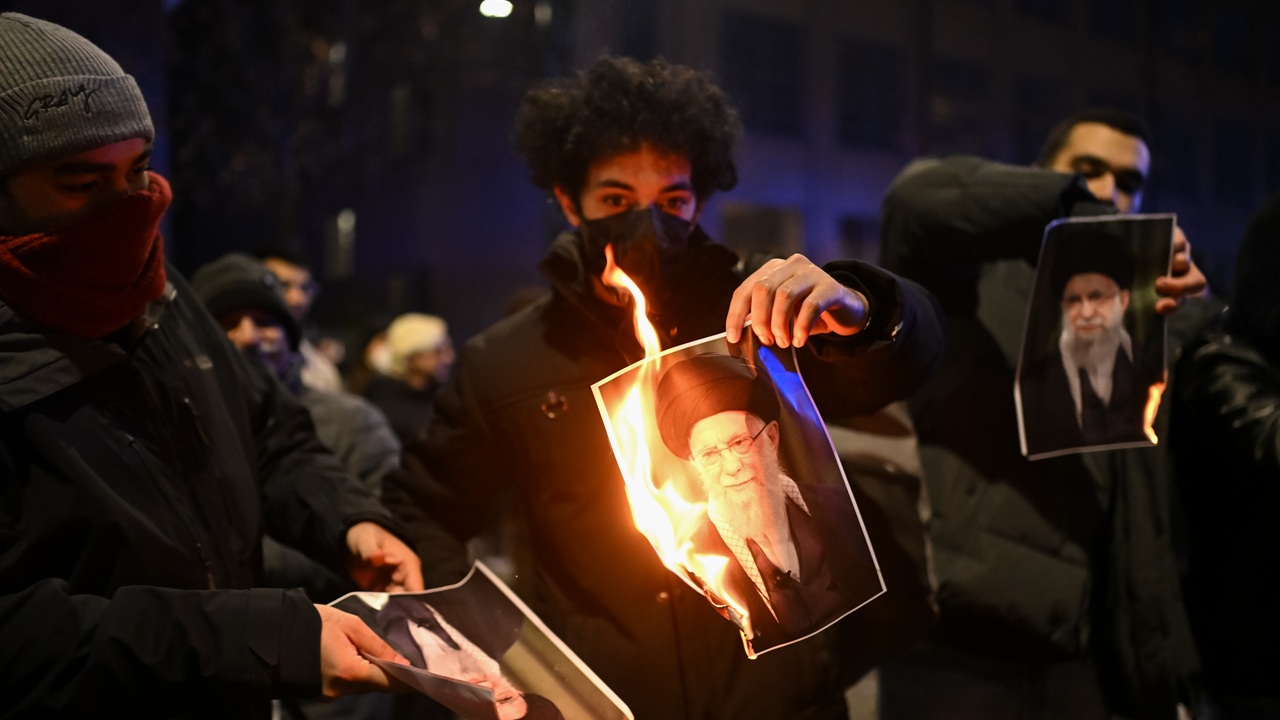
January 2026 proved that clear leadership and direct calls to mobilize can work to fill the streets. Iranians answered Pahlavi’s call for protests, with millions taking to the streets nationwide on January 8 and 9 in what became the largest anti-regime demonstration in the Islamic Republic’s history. Protesters waved the pre-1979 flag and chanted “death to the dictator” and “long live the king.” The movement no longer centers solely on removing the regime but on the transition that follows. Trump reinforced that momentum on January 13 when he declared that help was on the way and urged Iranians to occupy government institutions. The clarity and timing amplified the surge already underway. Mass turnout followed because the message was direct, aligned, and synchronized with the movement’s energy.
Israel and America Must Strike Directly at the IRGC
It follows, then, that striking at Iran’s repressive apparatus must go beyond hitting empty buildings. While bombing a local IRGC or Basij headquarters may be a symbolic statement, it is far more important to actively target Basij units and security forces actively involved in repression on the ground.
This is no easy task, of course. It means leveraging real-time intelligence and precision drone operations, rather than relying solely on airstrikes against large fixed bases. But it is possible to do. During the 12-Day War, Israel demonstrated the effectiveness of forward intelligence assets and drone bases inside Iran for targeted eliminations. The United States should apply those same capabilities directly against mobile repression units, including Basij squads on motorcycles or pickup trucks mounted with heavy weapons.
Altering the balance inside Iran depends on changing the risk calculus of those enforcing repression. At present the asymmetry is clear. Protesters face live fire, while Basij forces operate with relative impunity. Once security personnel see that their own lives are in jeopardy, they are more likely to defect than to suppress. They must lose the sense of impunity and understand that continued loyalty carries immediate personal cost.
About the Author: Janatan Sayeh
Janatan Sayeh is the Iran analyst at the Foundation for Defense of Democracies focused on Iranian domestic affairs and the Islamic Republic’s regional malign influence. Previously, he held various research roles at the International Republican Institute, Washington Institute for Near East Policy and the American Enterprise Institute. Born and raised in Tehran, Iran, he studied Hebrew and Arabic at the Hebrew University of Jerusalem and received his BA in political science from the University of California, Berkeley.