Why, as Christians, is it important to study the Early Church and to read scripture alongside the Church Fathers? Because if we want to know what God is trying to convey to us through His Word, not only do we need to pray for wisdom and discernment, but we need to study it and read it through the eyes of those who, through the Holy Spirit, translated and compiled the scriptures into the Bible we have today. We need to learn how to read through the eyes of those who wrote in that language, lived in that culture, and either walked directly among the apostles or were direct descendants of those who came shortly after (the Apostolic Age).
Scripture’s Origins
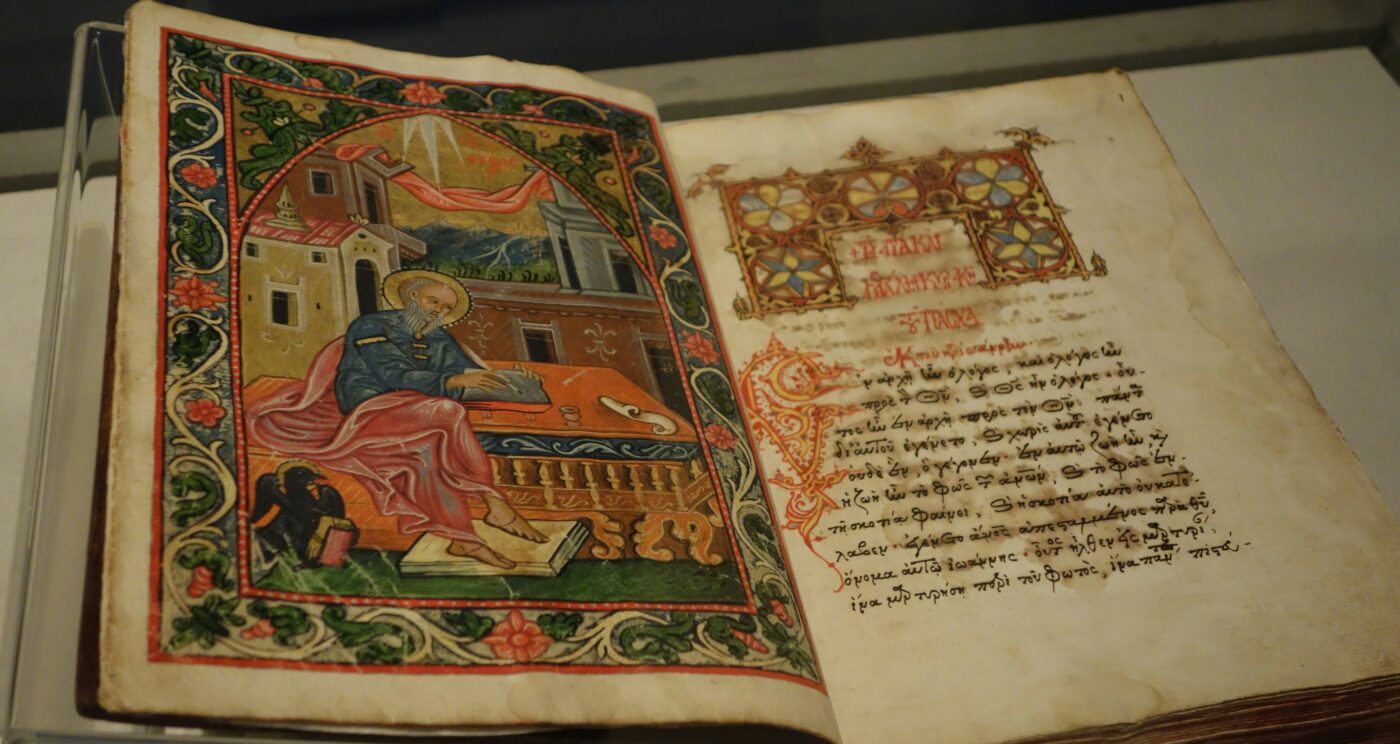
The Bible isn’t one book, written by one author, in English, ten years ago. It’s dozens of books, written in languages not easily translatable to ours, in a culture not easily translatable to ours; by dozens of authors, over a period of a 1,000+ years. It’s an ancient text canonized 1600 years ago, that’s been handed to us across multiple centuries, multiple cultures, and multiple translations. We have to recognize that we all bring an interpretive lens to how we view scripture—one that’s distorted by our own biases and the limitations of our own worldview—even by the most salt-of-the-earth, godly people among us.
Any historian will tell you, the closer you get to the primary source, the more accuracy you have. Any investigator will tell you if you want get the facts straight, get to the primary witnesses. That’s why we need to study the Early Church. Who better to study and discern scripture and doctrine from than those who were handed the scriptures directly from the apostles themselves and those close to them?
Reading scripture alongside the Church Fathers and understanding doctrine through the eyes of the Early Church have brought both my wife and I closer to the Lord than we could ever have imagined. After 30 years as evangelical Protestants, reading, studying, and praying through Church history, by first recognizing our own biases and then applying an unfiltered lens, has brought us into full communion with Jesus and His bride, the Catholic (universal) Church.
Uniting All Christians
There’s no shortage of evangelicals and Protestants, as well as evangelical and Protestant churches, having a tremendous impact for bringing the Kingdom of God to the world around them—churches led by, and filled with, mighty servants who’ve given their lives to the Lord. The Lord in His infinite love, grace, and mercy works through the unbiblical division in His body. But how much more effective can we be if, even through our disagreements, we were working together?
I’ve seen too many instances of churches, even some from the same denomination, that won’t work with other churches down the street or across town, for one reason or another, to serve, minister, and reach people with the Gospel. Therefore, it’s exceedingly important to prayerfully and scripturally educate ourselves on Church history, the Early Church, and the Church Fathers in order to bring about unity. We ought to ask ourselves: what did they believe about Church authority, apostolic succession, the Lord’s Supper, baptism, salvation, etc.?
When you do so, you’ll see that the unity of the Early Church—held together amid rising heresies—made the formation of the biblical canon possible over the first four centuries, through councils and the guidance of the Church Fathers.
The Teachings of the Early Church Fathers
Few voices were as formative as Ignatius of Antioch, the third bishop of Antioch and a disciple of the apostle John, who on his way to martyrdom in Rome (c. AD 107) wrote seven letters laying out the apostolic blueprint for a visible, unified, and sacramental Church—an ecclesial vision that would shape Christian doctrine and practice for the next two millennia. This vision defined the Church as:
- Centered on the bishop with presbyters and deacons
- United in faith and obedience as the safeguard against schism
- Gathered around the Eucharist as the real presence of Christ
- Under the bishop’s authority, identified as the one “Catholic” (universal) Church in communion with apostolic bishops
- Sustained by apostolic continuity and martyrdom as living witnesses to the Faith
A Church Father my wife and I were unaware of is Clement of Rome, a towering figure of the Early Church who, like Ignatius of Antioch, was formed in the Apostolic Age and is traditionally identified with Paul’s co-worker in Philippians 4:3. As the fourth Bishop of Rome, Clement wrote 1 Clement around 95 AD—the earliest surviving Christian writing outside the New Testament—intervening in a crisis at Corinth to defend apostolic authority, Church order, and the legitimacy of bishops and presbyters appointed in succession from the apostles. His letter reveals an early sense of Roman primacy and catholic unity. It calls believers to humility, repentance, charity, and peace and affirms an ordered ministry of bishops, presbyters, and deacons, that is rooted in Scripture and the apostles. Further, the letter holds together faith and works in a unified vision of salvation—justified by faith yet lived out through obedience and love—while modeling how doctrinal and pastoral disputes were resolved by the universal Church, rather than by isolated congregations.
Another example is Justin Martyr—probably the most well-known of all the Church Fathers in the post-Apostolic Age. He wrote the First Apology (155-157 AD) which gave us the structure of Christian worship in the Early Church, which looks exactly like the Catholic Mass today.
Finally, the Early Church’s remarkable unity—preserved through apostolic authority and the Spirit’s guidance—made the formation of the biblical canon possible over the first four centuries, something nearly unimaginable amid today’s divisions. A key guardian of that unity was Irenaeus of Lyons, whose landmark work Against the Heresies defended apostolic tradition against Gnostic distortions and insisted that true doctrine is received through the Church, not private interpretation.
Irenaeus taught Christ’s “recapitulation” of all things, clearly affirmed the full deity and true humanity of Jesus, upheld the Eucharist as Christ’s real Body and Blood, and articulated early Marian typology (Mary as the New Eve and Ark of the New Covenant). He also pointed to apostolic succession—especially the teaching continuity of the Church of Rome—as a practical safeguard of truth and unity. By resisting schism and rooting faith in the apostles’ living tradition, the Early Church preserved the canon. Without that unity, there would be no Bible as we know it.
The Goal: Unity
The hope here is to develop a healthy understanding of the foundational roots of the Christian Faith and the only two Christian Churches and traditions—Roman Catholic and Eastern Orthodox—that actually trace all their roots back to the apostles and Jesus. This would go a long way in fostering unity among divided Christians. It would dispel much of the misinformation and erroneous teachings about those two foundational Christian traditions that has led to so much ignorance, ugliness, and divisiveness among brothers and sisters in Christ.
Only then, in unity, can we truly hope to have the deep impact upon the culture that we’re called to have in the Great Commission of Matthew 28:18-20—an impact we’re too fragmented and divided to have now. I truly believe this unity is possible, if and only if, we’re able to recognize our own biases and look objectively upon the historical evidence that we have access to in reading scripture through the eyes of the Church Fathers.
Photo by Aleksandra Sapozhnikova on Unsplash