The Russian soprano Anna Netrebko’s remarkable career has passed the three-decade mark, yet she continues to add major dramatic roles to her repertoire while retaining the vocal wherewithal to do so. Last October at Naples’s Teatro San Carlo, she sang for the first time Amelia in Verdi’s Un ballo in maschera, and last month she reprised her ravishing portrayal of a wife falsely accused of adultery at the Paris Opera’s Bastille theater.
Like so many of Verdi’s Italian operas (to say nothing of his French ones), Ballo (1859) shows a French influence, being based on D. F. E. Auber’s Gustav III ou le bal masqué, a five-act opéra historique with a libretto by Eugène Scribe, which premiered at the Paris Opera in 1833 and relates the assassination of the Swedish king Gustav III at a masked ball in 1792. In addition, Ballo partakes of the effervescence of French opera, reflected in the page Oscar and even in the demeanor of the king himself (known as Riccardo) and his court. By contrast, the drama arising from the love triangle comprising Riccardo, his trusted secretary Renato, and Amelia (Renato’s wife) is fully Italianate in its passions and musical style and plays to Netrebko’s vocal and dramatic strengths.
Her voice, which remains sumptuous and darkish, ideally suits Amelia’s soaring melodies, as at the phrase “Consentimi, o Signore,” sung with ample sound at her first appearance in the fortuneteller Ulrica’s hut. She conveyed the terror of the aria “Ma dall’arido stelo devulsa” and yet blossomed excitingly with its climactic rise to a high C, followed by a pianissimo B flat to start the ensuing cadenza. I have always had problems with Amelia’s second aria, “Morrò, ma prima in grazia,” in which she acquiesces to her husband’s plan to kill her because of her supposed unfaithfulness but begs to say goodbye to their son first, yet here Netrebko gave it an emotional charge. Last season when she sang in Verdi’s La forza del destino at La Scala, she remarked in an interview that the role of Leonora, who is absent for a long sequence leading up to the final scene, offers little opportunity for character development. One could infer from her vibrant, thoroughly involved portrayal here that she has no similar qualms about Amelia.
She was surrounded by a respectable cast. The tenor Matthew Polenzani contributed a musically and dramatically cogent Riccardo, but in the great love duet—one of the most ecstatic in opera, even if both participants know their love will never be consummated—he could not match Netrebko for beauty of tone. The baritone Étienne Dupuis is known for his lyrical French roles, and although Renato needs more vocal weight, Dupuis was excellent in the part nonetheless, bringing venom to his denunciation of Riccardo in the aria “Eri tu” and joining with palpable delight the conspiracy against the king. Elizabeth DeShong brought a sense of foreboding and ample range to Ulrica while never allowing her attractive mezzo to sound raucous; the soprano Sara Blanch sparkled vivaciously as Oscar. In the pit Speranza Scappucci polished her image as a go-to woman for conducting Italian opera.
Originally planned for Naples, Ballo had a complicated history arising from objections by censors there to the opera’s regicide. Eventually, it was given in Rome in 1859, roughly a year later than planned, but with the king reduced in status to Riccardo, the Count of Warwick, and the setting changed to Boston in the late seventeenth century. Modern performances tend to restore the Swedish setting (while using the score’s final version), which is in keeping with the tone of the opera, but sometimes the Boston backdrop is retained, as with the Metropolitan Opera’s well-received 1980 production by Elijah Moshinsky.
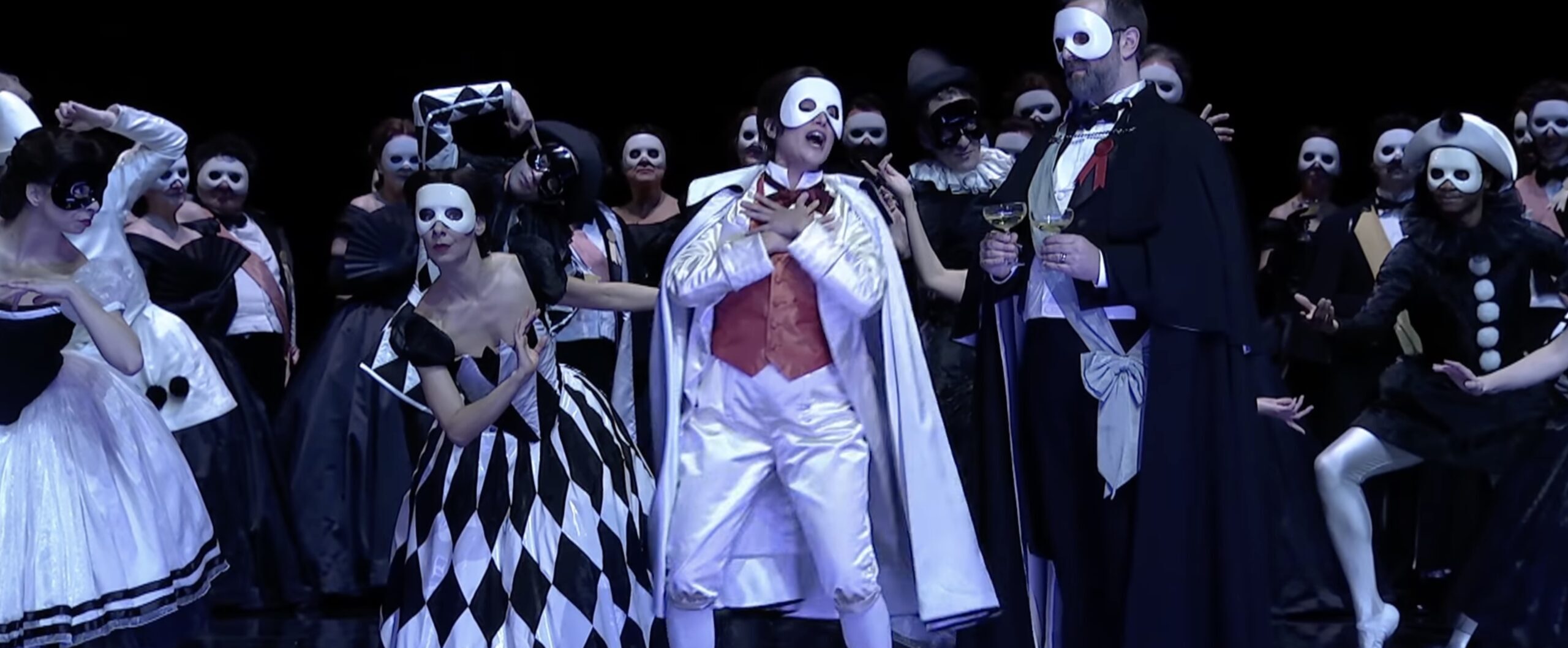
Likewise, Paris’s peculiar production by Gilbert Deflo, dating from 2007, stages the opera there. Its monumental sets (designed by William Orlandi) and the men’s uniforms suggest the Civil War, but surprisingly for Boston a number of men are dressed in gray. Riccardo’s council chamber, in gleaming white marble, looks like something from a historical opera seria set in Rome. A statue of a young man (JFK?) has replaced the specified portrait of Riccardo that Renato rails against in “Eri tu.” Were these choices meant to add a whimsical touch mirroring Ballo’s comic dimension? Deflo doesn’t say so in his program essay. In any case, the drama played out effectively, and the ball itself, “aside from that,” was amply festive.
In the last year or two, a number of opera houses and other musical institutions have begun to reengage Netrebko after ceasing to work with her following Russia’s invasion of Ukraine. For instance, the Royal Opera House in London hired her for two productions in the current season. At the Paris Opera her engagements have continued uninterrupted, including performances of Cilea’s Adriana Lecouvreur in the 2023–24 season. Apart from her Palm Beach gala with piano before a select audience last year, the United States now stands essentially alone in shunning the woman who can still be credibly called the leading soprano of our time.