Massive war casualties, 21st-century repression, and media control. In the latest episode of Russia Decoded, hosts Andy Kuchins and Chris Monday unpack how state media effectively insulates Russia’s urban middle class from the grim realities of a grinding war of attrition.
As the Ukraine war grinds into its fifth year, Moscow’s military losses have reached a scale not seen since World War II. According to a new CSIS report, total Russian casualties since February 2022 stand near 1.2 million ; in other words, Russia sustains roughly the same number of casualties per month that the Soviet Union suffered over 9 years of war in Afghanistan. Yet, unlike the societal discontent that accompanied Soviet losses in the 1980s, the Russian public today remains strikingly quiet. This domestic compliance rests, in part, on the Kremlin’s framing of the Ukraine War as an existential battle for the nation’s survival against a decadent West.
The narrative of civilizational struggle is mirrored in state media’s selective reading—and weaponization—of the history of World War II. Last week, Saint Petersburg commemorated the 82nd anniversary of the end of the Siege of Leningrad, an occasion state media used to humanize President Vladimir Putin through tales of his family’s endurance and sacrifice during the siege. Incensed at recent remarks by Polish President Karol Nawrocki on Soviet complicity in Nazi crimes and the Molotov-Ribbentrop Pact, Russian news programs pushed a counter-narrative of Polish complicity through a story on the 1934 German-Polish non-aggression pact. These broadcasts bolster the Kremlin’s larger message: today, as in the past, Russia must defend itself against the “Nazi” West.
In recent weeks, Moscow has hosted a flurry of Middle Eastern leaders, including UAE President Mohamed bin Zayed and Syrian President Ahmed al-Sharaa. Vladimir Putin has leveraged these visits to bolster Russia’s image an indispensable global power broker. Diplomatic pageantry deflects from the realities of economic stagnation at home, military attrition on the frontlines, and Russia’s diminished global status.
In the latest episode of Russia Decoded, Andy Kuchins and Chris Monday unpack how Vladimir Putin and Russian elites understand the world, and how they seek to influence it. Listen now on Apple, Spotify, or wherever you get your podcasts.
About the Speakers: Andy Kuchins and Chris Monday
Andrew C. Kuchins is currently a senior fellow at the Center for the National Interest and an adjunct professor at the Johns Hopkins University School of Advanced International Studies. He has served as President of the American University of Central Asia and the Director of the Carnegie Moscow Center as well as the Russia and Eurasia Programs at the Carnegie Endowment for International Peace and the Center for Strategic and International Studies. He is the author or editor of 7 books and published columns for The Wall Street Journal, The New York Times, The Washington Post, and many other media outlets.
Chris Monday is an associate professor of economics at Dongseo University in Busan, South Korea.
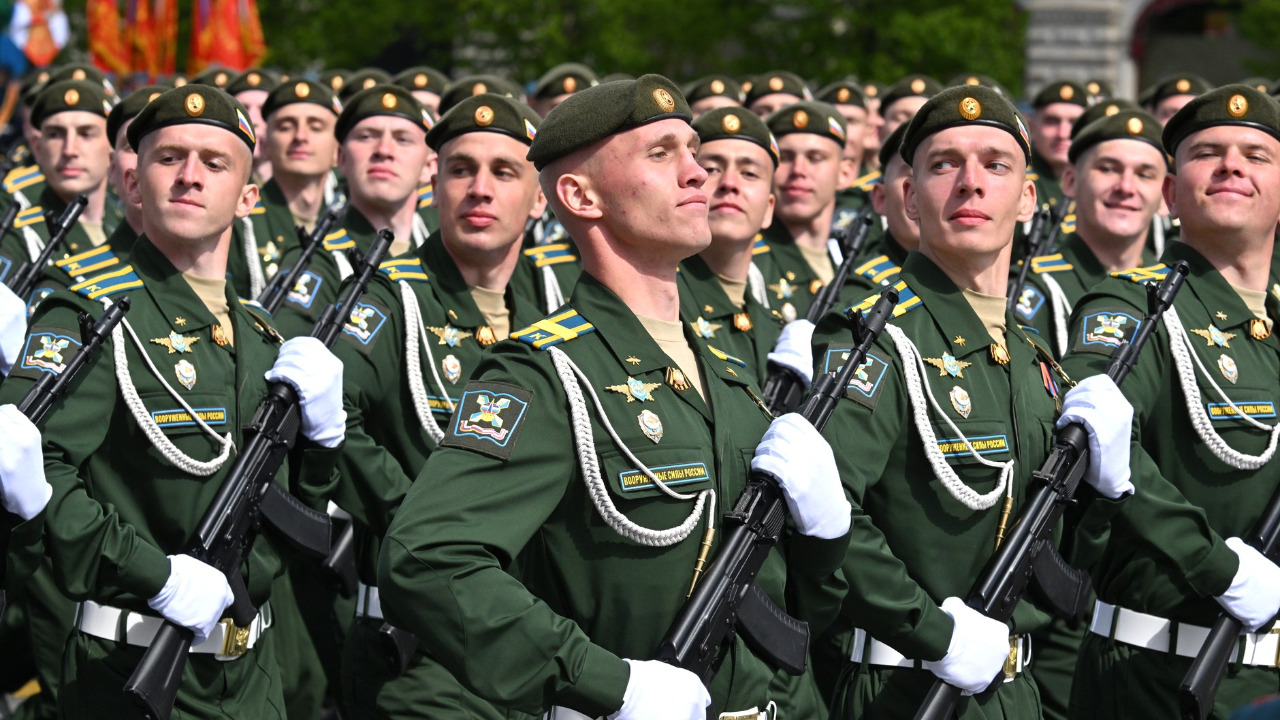
Image: Victory Day Parade in Moscow, May 9, 2025 (Kremlin photo via Wikimedia Commons).