In a previous article, we looked at why Adam and Eve, whom God created full of grace, sinned when Satan tempted them (click here to read it). But this begs the questions—what temptation caused Satan and other angels to sin, and why would God have created them knowing this would happen? This article will hopefully elucidate the reasons. Let’s begin with the angels in general.
The Angels
God created each angel directly, and He created them full of sanctifying grace (see A Tour of the Summa I, q.62, a.1-5). If God had not created them with grace, they would have been missing something that God made them to have; they would have been defective. However, by creating them full of grace, God put them in communion with Him sans the Beatific Vision.
Additionally, God gave them actual grace, His strength to do good and reject evil. Therefore, all angels were good at the moment they began to exist, and they had the grace to remain good. Many angels chose God by a single act, but some chose themselves. Let’s look at why.
Angelic Intellection
St. Thomas Aquinas points out that for purely spiritual beings who possess God-infused knowledge and do not need to think discursively like humans, their decision for or against God happens almost immediately after God creates them. Unlike humans, who need to spiritually and mentally mature in knowledge and faith, God created the angels with full maturity (A Tour of the Summa I, q.54, a.4-5).
Being pure spirit, the angels saw themselves, including their knowledge, immediately and had the power to make a decision that merited either Heaven by grace or Hell by sin. They understood their choices and the related consequences fully. They had no need to deliberate. As a result, their actions were either praiseworthy or blameworthy at the very instant of their choices.
Their choice would be akin to a justified human being walking with God until they remove all sins and all inclinations to them from their lives, doing God’s will and growing in love with Him. Then, when they become full of grace, they decide to commit mortal sin. This is similar to the level of spiritual maturity with which God created the angels.
Glory or Condemnation
Thomas mentions two operations (or acts) in the angels that led to either glory or condemnation. In his Summa Theologiae, Thomas states, “The first instant in the angels is understood to respond to the operation of the angelic mind, whereby it introspects itself…This operation was good in them all” (ST I, q.63, a.6, ad.4). This simply means that the angels looked within themselves immediately just as God designed them to do.
At that very moment, they recognized and understood their astounding natures, their positions in the hierarchy (nine levels) of angels, their relationship to the rest of would-be creation, and their relationship to God. This first operation was good. They functioned properly. Then, there was a second operation.
Pride
Regarding this operation, Thomas writes:
From such operation some of them were converted to the praise of the Word…while others, absorbed in themselves, …“[swelled] up with pride.” Hence, the first act was common to them all; but in their second they were separated. Consequently, they were all good in the first instant; but in the second, the good were set apart from the wicked (ST I, q.63, a.6, ad.4).
Essentially, some angels saw their beauty and superiority to the rest of creation and referenced their greatness to God, and they gave Him praise and glory. However, others became enamored with themselves and swelled with pride, thereby failing to refer their greatness to God. Accordingly, by their second action, these angels chose themselves. God glorified the ones who chose Him, and He condemned the ones who chose themselves.
Envy
Following St. Augustine, Thomas holds that the angels also committed the sin of envy (ST I, q.63, a.2). Angels not only knew themselves, but they also knew the creation over which God had given them responsibility. This knowledge included that of humans. Knowing themselves, they knew that they were superior to humans. They also knew that God created humans for glory and to glorify Him. St. Luke tells us that the raised are “equal to angels” (see also 1 Corinthians 6:3). For those angels who swelled with pride, this equality became a source of envy.
You can imagine the prideful angels thinking, “If we can’t have Heaven, then those inferior beings can’t have it either.” Consequently, they fell into envy, which according to Thomas, is sorrow for another’s good. From here, we know the rest of the story. Satan set his sights on Adam and Eve, tempting them to sin, and he and the other fallen angels (i.e., demons) have been tempting us ever since.
Additionally, I once heard a priest say that the devil wants our children because he cannot have any. This may be another source of the demons’ envy. God shared his power to create persons with humans but not with angels. We can create persons made in God’s image and likeness, but they cannot.
Why God Allowed This to Happen
At this point, one might wonder why God would create the angels whom He knew would sin. Like I mentioned above, God created all the angels good and full of grace. They were all marvelous. However, Satan and some other angels rebelled just as God knew they would. By intentionally abusing their free will, they chose a different path that was nevertheless under God’s providence, and God used their terrible decision to our advantage (A Tour of the Summa, I, q.22, a.1-4 and ST I, q.22, a.2, ad.2).
Also, God knew eternally that He would become man to redeem us from death and save us from our sins. If there was no sin, there was nothing from which to save us. Consequently, our love would have never matured (click here to see why). This may sound counterintuitive, but the Fall and our resulting sins become opportunities to love God with entire hearts, minds, souls, and strength, and our neighbors as ourselves (see A Tour of the Summa II-II, q.165, a.1).
This love matures in such a way that, through Jesus Christ and because of Him, God sets us above the angels in Heaven. Hebrews 2:7-8 states, “You made [man] for a little while lower than the angels, you have crowned him with glory and honor, putting everything in subjection under his feet.”
Regarding this passage, the Ignatius Catholic Study Bible commentary explains:
The Greek version [of this passage] envisions two distinct stages in this human vocation: man is first made in subordination to the angels, yet he is destined to be crowned and elevated over the angels. This vocation is fully realized in Christ.
Satan, by his rebellion, participates in God’s providence by giving humans countless opportunities to love God with a profundity that he will never know. God uses Satan’s rebellion to forge our love in the crucible of temptation and sin. He uses the author of sin as an instrument for our complete sanctification. Satan’s disordered pride and his envy of us serves God’s purpose by helping the inferior (us) to become far superior to him (Satan). Pause here and reflect on the awesomeness of God.
We must never forget, underestimate, or understate the honor that God bestows on man. In our busy lives, we often fail to reflect on the many gifts that God has given to us. But all these gifts are nothing compared to the glory He will give us in Heaven. Therefore, we must cooperate with grace, journey out of sin completely, and allow God to sanctify us perfectly. In doing so, our love for Him will grow exponentially, and the light of Christ will shine through us for the world to see.
Author’s Note: Here are some related resources:
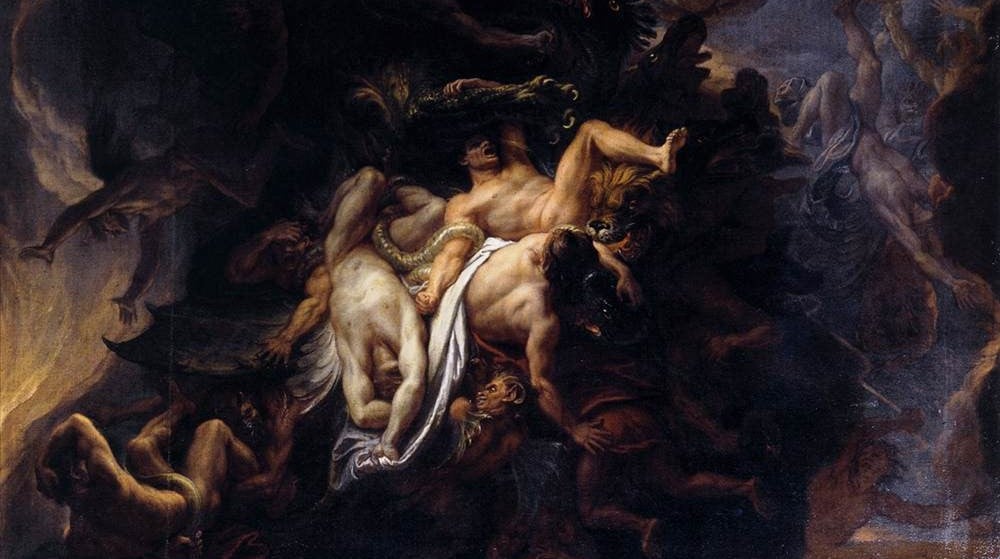
Image from Wikimedia Commons