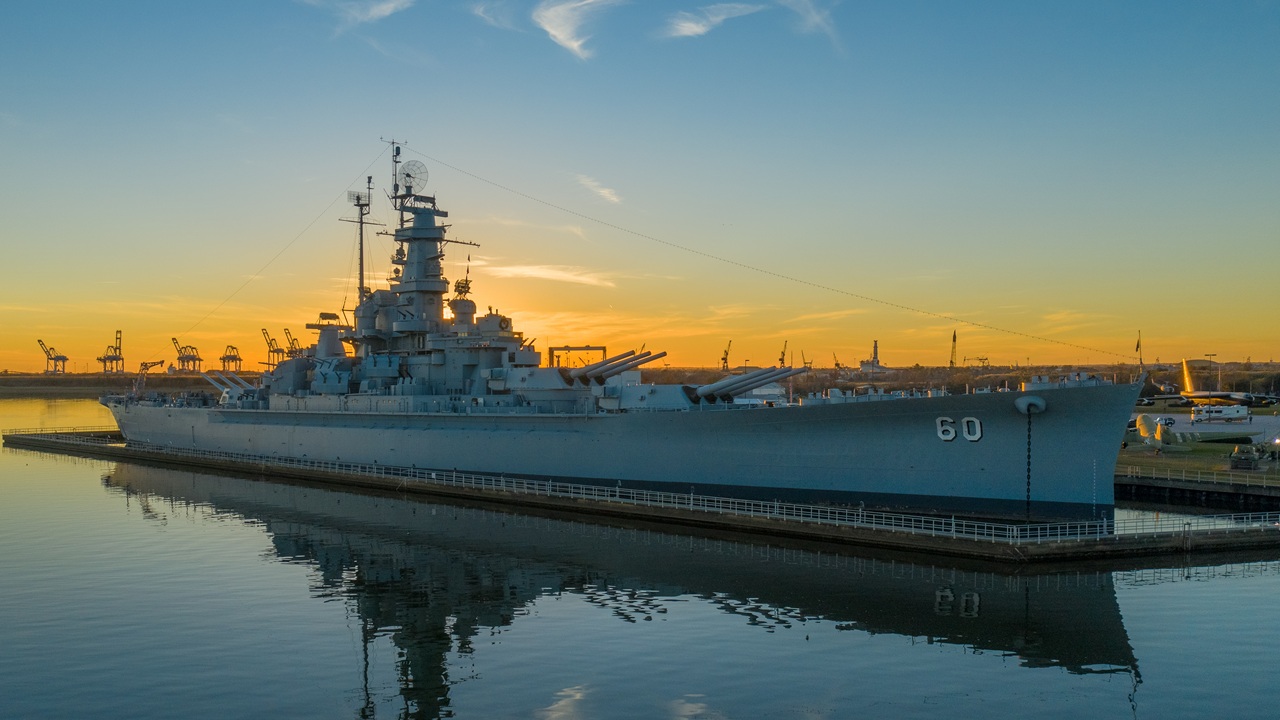
Though battleships saw extensive and meritorious service in World War II, the conflict exposed their weaknesses against the rising power of the aircraft carrier.
For the first half of the 20th century, the battleship was the dominant symbol of naval power. Nations measured prestige and security by the size of their battle fleets. Yet, within a single decade, the battleship went from decisive weapon to static liability. What changed so completely, and so quickly?
Why Did Modern Navies Create Battleships?
Battleships emerged as the ultimate capital ship in the late 19th and early 20th centuries. The HMS Dreadnought, commissioned into the Royal Navy in 1906, came to define the class—a massive surface vessel defined by its incredibly heavy armor, enormous guns, and ability to engage enemy fleets directly. In the years that followed, battleships became central to naval doctrine, which favored decisive fleet engagements. In essence, gaining control of the sea came down to winning battleship-versus-battleship fights.
Before World War II, battleships were in their heyday, designed to control sea lanes, destroy enemy fleets, and project power through naval bombardments. As battleships grew increasingly large and powerful, international conventions were created to regulate their size—notably the 1921 Washington Naval Conference, which capped the major world powers’ battleship fleets. However, the category’s place within naval doctrine was secure. Even as aircraft carriers emerged, they were initially viewed as support vessels secondary in importance to the battleship.
Battleships played a vital role in World War II—yet the innovations of the Pacific War also exposed their flaws. Battleships were short-range and inflexible, incapable of projecting power beyond the range of their guns. Aircraft carriers, on the other hand, could strike from hundreds of miles away—a point demonstrated at Pearl Harbor, to catastrophic results for the United States.
The US Navy Won World War II with Aircraft Carriers
The Japanese attack on Pearl Harbor illustrated the vulnerability of battleships to air power. Multiple US battleships were damaged or sunk at anchor. Crucially, the attackers were not enemy battleships, but carrier-based aircraft—harkening the ways in which naval power projection would change in the years to come, as the engagement showed armor could not stop precision aerial attacks.
What began in Pearl Harbor culminated at the Battle of Midway, when the decisive action was fought between carriers that remained well outside of each other’s sight. Following the US Navy’s victory in that fight, the carrier was cemented as the decisive naval weapon. Fleets fought without ever seeing each other, and battleships played little to no role in the outcome of the battles that followed.
Other specific examples made the point, too. In Europe, Nazi Germany’s Bismarck battleship was crippled by an aircraft-delivered torpedo—dropped from an antiquated Fairey Swordfish biplane, no less—and finished off by surface vessels once its mobility was lost. The Yamato, the largest battleship ever built, was sunk exclusively by carrier aircraft before reaching combat range. These losses showed that no amount of armor could protect against massed air attacks.
After World War II, the US Navy Kept Its Battleships—but Didn’t Buy New Ones
The central problem confronting battleships was that they required close proximity to engage targets; they could not strike inland or beyond the horizon independently. This created situations of high vulnerability, especially once detected. The enormous costs behind each battleship came to be viewed more and more as a sunk investment for a vessel that offered only limited tactical flexibility.
In the years that followed, the US Navy kept its enormous Iowa-class battleships afloat, and they continued to serve in a handful of specialized roles until the 1990s. Yet the overall trend of naval warfare shifted decisively away from surface combat towards long-range strikes and air superiority. Aircraft carriers could adapt by changing aircraft, projecting power far inland, and scaling missions from deterrence to war. Battleships, meanwhile, couldn’t evolve without a fundamental redesign.
Today, in spite of scattered efforts to bring them back, battleships are still irrelevant—because their core missions were not just threatened, but replaced outright. Airpower made heavy guns irrelevant at sea, and submarines and long-range missiles have finished what aircraft began.
About the Author: Harrison Kass
Harrison Kass is a senior defense and national security writer at The National Interest. Kass is an attorney and former political candidate who joined the US Air Force as a pilot trainee before being medically discharged. He focuses on military strategy, aerospace, and global security affairs. He holds a JD from the University of Oregon and a master’s in Global Journalism and International Relations from NYU.
Image: Shutterstock / E. Vince De Sousa.