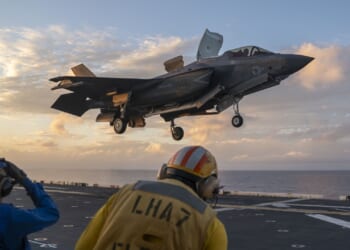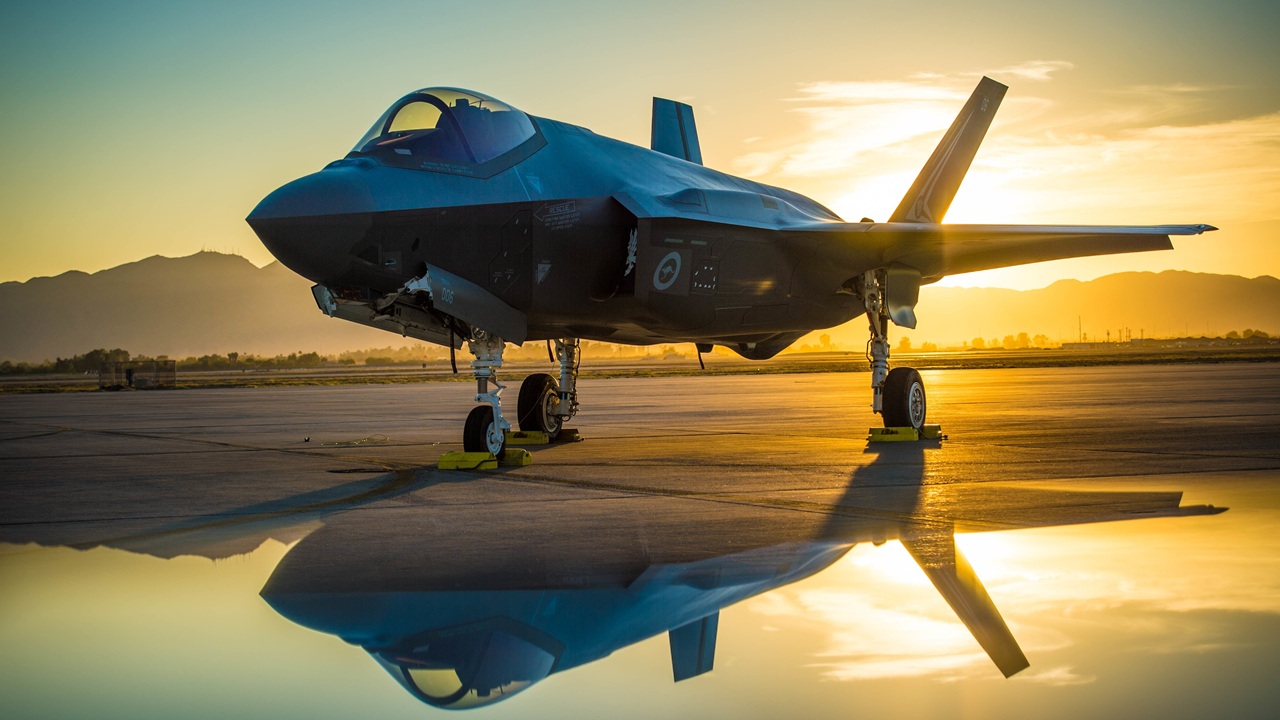
The F-35A is the US Air Force’s variant of the Joint Strike Fighter—yet is broadly similar to the Navy’s F-35C, and could be substituted for it during training.
The Lockheed Martin F-35 Lightning II was developed to serve in distinct roles for the United States Air Force, United States Navy, and United States Marine Corps. The Air Force operates the conventional takeoff and landing (CTOL) variant, with the US Navy and Marine Corps flying the F-35C, the carrier-capable model. The USMC also operates the short takeoff and vertical landing (STOVL) F-35B, which can operate from remote air strips and from the Navy’s amphibious assault ships.
However, according to images shared on social media, the US Navy has begun discreetly testing a CTOL F-35A, with an F-35A aircraft spotted near a US naval base in California last month.
The Navy Was Spotted Flying an F-35A
Details remain sparse, but the aircraft (serial number 17-5240) was spotted flying near the Mojave Air and Space Port in California on January 23. The F-35A was previously flown by the US Air Force’s 422nd Test and Evaluation Squadron at Nellis Air Force Base (AFB), Nevada.
According to a report from Aerospace Global News, citing flight tracker FlightAware, the F-35A is approximately seven years old and previously operated from Naval Air Station JRB Fort Worth, Texas, where it made its maiden flight.
The Navy Times further confirmed that the fifth-generation fighter is part of an exchange program between the US Air Force and US Navy to test out weapons and even aircraft.
“A characteristic shared between the F35-A and C variants is their mission systems,” a defense official explained to the Navy Times. The report added that, “For testing purposes, one service’s aircraft could be used by another branch. In that case, according to the official, the F-35, whether the A or C, would suffice.”
How Are the F-35A and F-35C Different?
| Aircraft | F-35A (US Air Force) | F-35C (US Navy) |
| Year Introduced | 2015 | 2019 |
| Number Built | 500+ | ~150 |
| Length | 51 ft 4 in (15.7 m) | 51 ft 6 in (15.7 m) |
| Wingspan | 35 ft (10.7 m) | 43 ft (13.1 m) |
| Weight (MTOW) | 70,000 lb (31,800 kg) | 70,000 lb (31,800 kg) |
| Engines | One Pratt & Whitney F135-PW-100 afterburning turbofan (~43,000 lbf thrust with afterburner) | One Pratt & Whitney F135-PW-400 afterburning turbofan (~43,000 lbf thrust with afterburner) |
| Top Speed | Mach 1.6 (~1,200 mph, 1,930 km/h) | Mach 1.6 (~1,200 mph, 1,930 km/h) |
| Range | ~1,200 nmi (1,380 mi, 2,220 km) with internal fuel | ~1,200 nmi (1,380 mi, 2,220 km) with internal fuel |
| Service Ceiling | 50,000 ft (15,240 m) | 50,000 ft (15,240 m) |
| Loadout | One GAU-22/A 25 mm rotary cannon (internal on F-35A only)Internal bays, up to 4 × AIM-120 AMRAAMs or 2 bombs + 2 AMRAAMsExternal hardpoints, up to 18,000 lb (8,160 kg) of ordnance (compromises stealth) | Internal bays, up to 18,000 lb (8,200 kg) of ordnance across two bays6 external pylons (when stealth not prioritized), for additional bombs, missiles, or fuel tanks |
| Aircrew | 1 | 1 |
The F-35A and the F-35C are essentially the same in dimensions and capabilities—which should come as little surprise, given their substantial design overlap. The F-35A is marginally lighter and faster, given its larger wingspan, which could make it better suited as a training aircraft for novice pilots and for testing new weapons. For experienced Navy pilots, however, the transition from the F-35C to the F-35A should essentially be seamless.
Another factor in the Navy’s use of the foreign plane may be numerical. More than 500 F-35As have been delivered to the US Air Force, whereas the United States Navy and USMC have just over 100 F-35Cs—meaning that F-35Cs can sometimes be limited in supply for training.
The F-35C was designed to operate from carriers and is considered the most rugged and structurally robust variant of the Joint Strike Fighter (JSF) family of fifth-generation stealth aircraft. It features a reinforced airframe and heavy-duty landing gear.
“The F-35C needed to be more durable than its fellow variants as life at sea subjects an airframe to saltwater, high wings, and catapult shots/cable landings, which are a brutal combination,” explained Harrison Kass for The National Interest. “The F-35 received coatings, materials, and seals designed to resist corrosion. At the same time, the arresting hook bulkhead was built with strengthened alloys, and the internal structures were braced for repeated high-load cycles.”
About the Author: Peter Suciu
Peter Suciu has contributed over 3,200 published pieces to more than four dozen magazines and websites over a 30-year career in journalism. He regularly writes about military hardware, firearms history, cybersecurity, politics, and international affairs. Peter is also a contributing writer for Forbes and Clearance Jobs. He is based in Michigan. You can follow him on Twitter: @PeterSuciu. You can email the author: [email protected].
Image: Shutterstock / Rawpixel.com.