The Turkish fighter jets are expected to play a role in Somalia’s ongoing campaign against Al-Shabaab militants in the countryside—and could also serve as a warning signal to Israel.
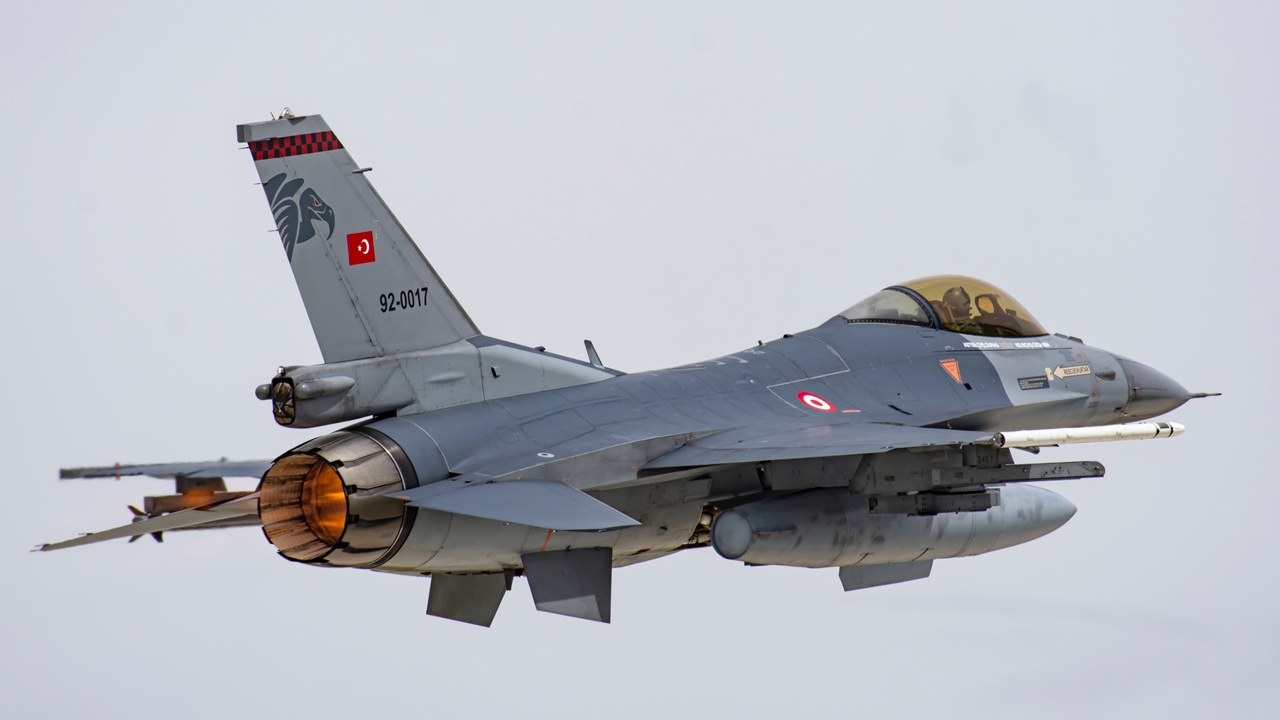
NATO member Turkey (Türkiye) has the second-largest fleet of US-made F-16 Fighting Falcon combat aircraft and plans to enhance its aging fighters with the F-16 Block 70 and Viper upgrades.
However, not all of those aircraft will be protecting the skies over Turkey. Last month, Ankara announced that it had expanded its military footprint in the Horn of Africa by deploying F-16s to Somalia, a key Turkish ally.
According to a report from Bloomberg, Turkish Fighting Falcons and attack helicopters have been sent to the African nation to help it carry out its ongoing war against al-Shabaab militants in the countryside. The deployment also comes as Turkey has increased its investment in Somalia’s energy and space sectors.
Turkey also provided more than $1 billion in humanitarian aid to Somalia in response to last year’s devastating drought that has left millions at risk of hunger and displacement.
The F-16 Fighting Falcon’s Specifications (Block 70 / Viper)
- Year Introduced: 2023
- Number Built: ~23
- Length: 49.3 ft (15.03 m)
- Wingspan: 31.0 ft (9.45 m)
- Weight (MTOW): ~48,000 lbs (21,772 kg)
- Engines: One Pratt & Whitney F100-PW-229 afterburning turbofan
- Top Speed: Mach 2.0+ (approx. 1,500 mph or 2,414 km/h)
- Range: 1,740 nautical miles (~2,002 mi, 3,220 km)
- Service Ceiling: ~50,000 feet (15,240 m)
- Loadout: Nine hardpoints, including six under wings, two on the wingtips, and one under the fuselage. Two additional locations under the fuselage for pods. An internal, six-barrel M61A1 Vulcan 20mm cannon.
- Crew: 1–2, depending on variant
A New Nest for Turkey’s Fighting Falcons
The basing of the F-16s at the Horn of Africa isn’t a surprise, as Turkish engineers had been dispatched to the region last fall to prepare for the aircraft at the Mogadishu International Airport. Turkey first opened a base, its largest foreign facility, in the Somali capital in 2017.
The F-16s will be operated by Turkish pilots and supported by Turkish ground personnel, but will be there to aid Somalia’s counter-terrorism capabilities. Ankara is providing additional “military assistance, training and advisory activities,” the Turkish Ministry of Defense said in a statement.
The deployment and support for Somalia could further worsen relations between Turkey and Israel, as the latter recently recognized the self-proclaimed Republic of Somaliland. The government in Mogadishu views Somaliland as a rebellious part of its territory and firmly rejects the region’s 1991 declaration of independence.
Ankara called Israel’s recognition of Somaliland to be “overt interference in Somalia’s domestic affairs.”
Even as Turkey and Israel disagree on the state of Somaliland, the F-16s will be used to combat al-Shabaab, which still maintains swaths of territory in Somalia.
“Türkiye will continue to fulfill the requirements of brotherhood in the Somali people’s struggle against terrorist organizations,” the National Security Council announced via a social media post, adding “Türkiye will continue with determination in 2026 its multidimensional activities carried out for the purpose of preserving peace and establishing stability in various conflict and crisis zones ranging from its near abroad to a wide geography encompassing Asia, Africa, and Europe.”
Beyond the F-16s, the Turkish military has deployed armed drones, notably the TB2 Bayraktar and Akinci, and at least three T129 Atak attack helicopters to Somalia to support counterinsurgency operations.
Turkey Absolutely Loves the F-16 Fighter
Last month, Turkey became the latest NATO alliance member to deploy combat aircraft to the Baltic region as part of a NATO air policing mission. An undisclosed number of F-16 Fighting Falcons are now operating from Lithuania.
Turkey, which was famously excluded from the F-35 program for adopting the Russian-made S-400 “Triumf” air defense system, has been moving forward with its procurement of the F-16 Block 70 aircraft. Ankara has sought to upgrade as many as 79 of its older Fighting Falcons to the Viper standard.
The F-16 Block 70 Fighting Falcons are equipped with advanced avionics, extended structural service life, and enhanced safety features such as the Automatic Ground Collision Avoidance System (Auto GCAS), with a structural service life of 12,000 hours. In addition, the fighters are outfitted with the APG‑83 AESA radar, which shares 95% software commonality and 70% hardware commonality with the F‑35 radar.
About the Author: Peter Suciu
Peter Suciu has contributed over 3,200 published pieces to more than four dozen magazines and websites over a 30-year career in journalism. He regularly writes about military hardware, firearms history, cybersecurity, politics, and international affairs. Peter is also a contributing writer for Forbes and Clearance Jobs. He is based in Michigan. You can follow him on Twitter: @PeterSuciu. You can email the author: [email protected].
Image: Shutterstock / twintyre.