G.K. Chesterton’s classic The Everlasting Man was originally written as an alternative account of human history to H.G. Wells’ The Outline of History. He critiques Wells’ choices about what was most important in the history of humanity and proposes an alternative set of essential things that stick out, and thus deserve to be in an outline of history.
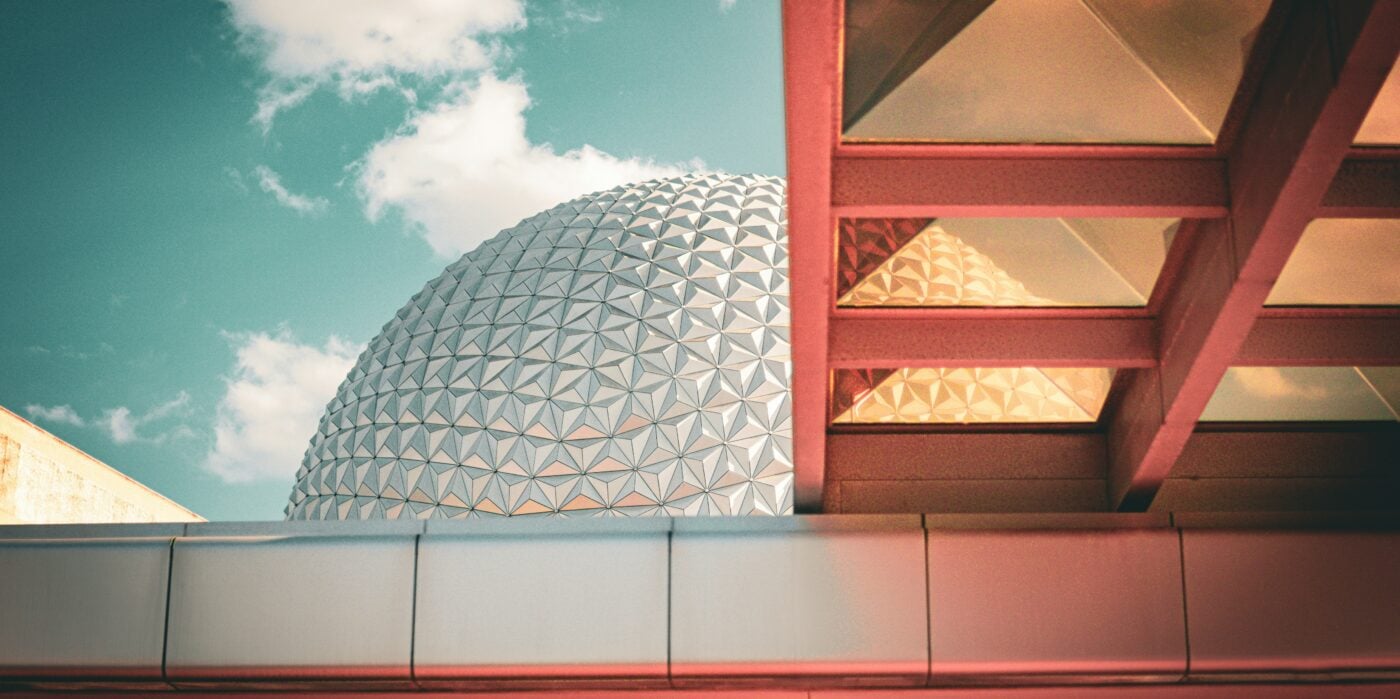
In our contemporary time, Disney has its own version of an outline of history, which hundreds of thousands of people ride every year. I am, of course, talking about the ride SpaceShip Earth at EPCOT, the giant sphere which is the common symbol of the EPCOT park. SpaceShip Earth takes riders through a history of the world, with animatronics and special effects playing as a narrator recites a script.
Disney’s Outline of Human History
SpaceShip Earth begins with primitive humans who can now speak to each other, they have language and can work together. The Narrator explains, “We are all one, struggling to survive until we learn to communicate with one another. Now we can hunt as a team and survive together.”
The second scene jumps a supposed fifteen thousand years to the original cave paintings, the first communication by writing, the first communications technology. The Narrator explains, “It takes 15,000 years to come up with the next bright idea: recording our knowledge on cave walls. There was only one small problem, when we moved, the recorded knowledge stayed behind.”
Next comes ancient Egypt, where paper was invented in the form of papyrus. This allows a significantly greater accumulation of knowledge. The Narrator says:
Let’s move ahead to ancient Egypt, because something is about to happen here that will change the future forever. This unknown Egyptian pounding reeds flat is inventing papyrus—a sort of paper. Papyrus, in turn, creates better record keeping of plans, designs, and unfortunately taxes. But it also brings with it the dawn of great civilizations.
The fourth advancement is the development of a common alphabet which allows different early civilizations to read each other’s writings. This development of the alphabet was done by the Phoenicians who were trading among the various peoples.
While math seems to have originated in Mesopotamia, Disney places it in Greece where it became more developed and widely taught. The Narrator explains, “The ancient Greeks were great inventors of the future. First, they established public schools, and then begin teaching an intriguing new subject called mathematics. And with math comes mechanical technology and the birth of a high-tech life we enjoy today.” Rome follows Greece and develops a vast road system. Yet, when Rome falls, the great library at Alexandria is burned, and much knowledge is lost.
Disney recognizes the great work of the monks in preserving civilization after the fall of Rome and especially praises their copying work: “in Europe, monks toil endlessly, recording books by hand.” In 1450, the printing press is invented, and this launches the Renaissance by enabling the rapid dissemination of knowledge. This changes everything and development quickens at a rapid rate.
The newspaper is next, followed quickly by the telegraph and the radio. The radio allows us to communicate across huge distances instantly, including with astronauts in space and on the moon. But in order to successfully get to the moon, the computer had to be invented. Computers showed great potential, but they were too big to be readily available.
The final development which ends Disney’s outline of history is the home computer (smaller, more available computers in general). According to Disney, this is a major revolution comparable to the printing press and will likely change the future dramatically by ushering in a new renaissance.
According to Disney’s outline, the key things in the history of humanity have been the developments in communications technology. Surely, these have enabled the exchange of knowledge and have dramatically changed the world. Yet, is this outline of human history significant?
Chesterton’s View
G.K. Chesterton offers another vision. According to him, the key things in human history are not the gradual development of technology. On the contrary, these are rather unexceptional and ordinary.
Of course, technology will gradually develop and certain key advancements, such as paper, the printing press, or the internet, will quicken this. But an outline of human history based on these events is hardly an outline; it’s merely a single line of technological progress. Chesterton writes, “The one thing that seems to me quite wrong about it is the outline; the sort of outline that can really be a single line…in simple and homely language, I mean the things that stick out” (Chesterton, The Everlasting Man, “Conclusion”). While Chesterton laid this critique against H.G. Wells’ outline, it seems to apply equally well to Disney’s outline of history because Disney simply traces the gradual development of communications technology.
A better outline, it seems to me, and apparently to Chesterton, would note the key differences and developments in what humans were communicating to each other; it would be a history of thought and value. More specifically, it would be a history or outline of the radical changes in human thought and value. Chesterton follows this route in The Everlasting Man and creates his outline of history by noting two key transitions in the world (Chesterton, The Everlasting Man, “Introduction”).
The first was the development of mankind. The arrival of mankind on the earth was a radical and unpredictable change. Humans are profoundly unlike the rest of the world; we are the only one to make outlines of history. We are the only ones to have true thoughts and values beyond basic survival. Thus, this should be central to any meaningful outline of history.
The second great transition was the arrival of Christianity, the transition of pagans to Christians. This also was a radical development which was unpredictable from the outside, but it has changed human life dramatically.
Disney’s outline of history, according to a Chestertonian criticism, is not an outline, but a single line of progress pointing towards future inevitable technological advancements. A true outline of history should note what sticks out or is unexpected and what dramatically alters human society. The best outline should focus on where these two things converge. This is what Chesterton’s Christian outline of history does. Any outline of history that does not notice, or is not centered on, the event from which we count time (i.e., the life of Christ) fails to note the extraordinary event that has shaped the human experience.
In the end, Disney offers a rather boring outline of human history focused on communications technology, but empty of beauty, truth, or goodness. Disney’s outline focuses on mankind’s mastery of the rest of the natural world, but ignores the perfection, or destruction, of our own human natures. Disney’s outline gestures towards mankind’s future technologies on this planet, but ignores the eternal destiny that each of us faces.
Photo by Sean Nufer on Unsplash