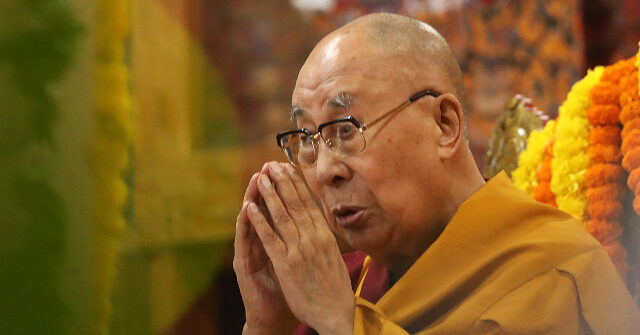
The Dalai Lama, the leader of Tibetan Buddhism, won a Grammy Award on Sunday night for narrating an audiobook featuring his reflections.
While the spiritual leader celebrated with humility, and Tibetans saw the award as a recognition of their persecuted culture and religion, the Chinese Communist Party responded with ire, warning the academy responsible for the awards not to indulge in “anti-China activities.”
Tibet has been occupied by the Chinese Communist Party for 60 years. While the Han Chinese communists have not succeeded during that time in eliminating the ethnic Tibetan community from the region nor in destroying Tibetan Buddhism, they have consistently endeavored to do so since the establishment of what China has tried to rename with the colonialist Mandarin name “Xizang.” China recently celebrated the 60th anniversary of the conquest of Tibet in August, throwing a massive parade featuring a rare visit by genocidal dictator Xi Jinping.
Part of that oppression has been the exile of the Dalai Lama since 1959. The Tibetan Buddhist leader has lived in India since then, often publishing works with his interpretations of Buddhist principles and issuing public statements on world affairs. The Chinese government considers the Dalai Lama a “separatist” enemy and actively pressures states and other world entities not to engage him.
The Dalai Lama won his first Grammy on Sunday for an audiobook titled, “Meditations: The Reflections Of His Holiness The Dalai Lama.”
“I receive this recognition with gratitude and humility. I don’t see it as something personal, but as a recognition of our shared universal responsibility,” the Dalai Lama said in a statement after being notified of the award. “I truly believe that peace, compassion, care for our environment, and an understanding of the oneness of humanity are essential for the collective well-being of all eight billion human beings.”
“I’m grateful that this Grammy recognition can help spread these messages more widely,” he added.
The Chinese Foreign Ministry responded to the award during its regular press briefing on Monday, dismissing the global influence of and respect for the Buddhist monk.
“The Dalai Lama is not purely a religious person,” Foreign Ministry Spokesman Lin Jian told reporters. “He is a political exile committed to anti-Chinese separatist activity under the disguise of religion.”
Lin warned that the Communist Party “firmly opposes relevant sides using the award as a tool to carry out anti-China activities.”
Notably, the Chinese government omitted this statement from its English-language transcript of the regular briefing on Monday.
The Hindustan Times reported the mood as celebratory among Tibetan exiles in McLeodganj, where the government-in-exile is located, over the recognition of the Dalai Lama, regardless of the Chinese regime’s protests. A top exiled Tibetan official told the newspaper that the award was a “powerful signal to the Chinese leadership” that it cannot suppress or erase Tibetan Buddhism.
“This Grammy recognises not just the tone and tenor of the Dalai Lama, but pays tribute to the content of a voice that has become a universal inspiration for love,” Tibetan activist Tenzin Tsundue was quoted as saying. “For the first time, the Grammys have awarded a voice that looks inward to work outward for the wellbeing of humanity.”
The Dalai Lama has preserved Tibetan Buddhist worship despite decades of repression and attempts to destroy the religion by the Communist Party. Under Xi Jinping, also responsible for a genocide ongoing today in neighboring East Turkistan, the Communist Party has implemented a host of genocidal policies against Tibetans, most prominently the abduction of thousands of children to be indoctrinated in communist “boarding schools.” The schools teach the children the Mandarin language and communist atheism, severing their ties to their identity.
The United Nations, through its International Labor Organization (ILO), confirmed last year that China has enacted “widespread and state-sponsored forced labour practices in both the Xinjiang Uyghur Autonomous Region (Xinjiang) and the Tibet Autonomous Region (Tibet).” The process of enslaving large percentages of the Tibetan population has been accompanied by the mass theft of land from traditional farmers, who are then forced into industrial slavery.
The Chinese Communist Party has also attempted to hijack the process of identifying “living Buddhas,” such as the Dalai Lama and Panchen Lama. Tibetan Buddhists believe that the Dalai Lama and other living Buddhas reincarnate in children after their deaths. The Party has decreed that they are not allowed to reincarnate without strict government approval.
“The formation of the Living Buddha reincarnation system is inextricably linked to the support of the central government,” Li Deching, the deputy director of the government’s China Tibetology Research Center, proclaimed following the Dalai Lama’s 90th birthday in July. “As such, a key aspect of the system is that the final authority for approving a reincarnated successor rests with the government.”
The Chinese government abducted and disappeared the current Panchen Lama, a boy named Gedhun Choeyi Nyima, in 1995, when he was six years old. He has never been seen again, though Beijing occasionally makes a half-hearted effort to claim the boy grew up and is living a private life. The Communist Party then chose a different boy to be the Panchen Lama, who Tibetan Buddhists do not recognize.
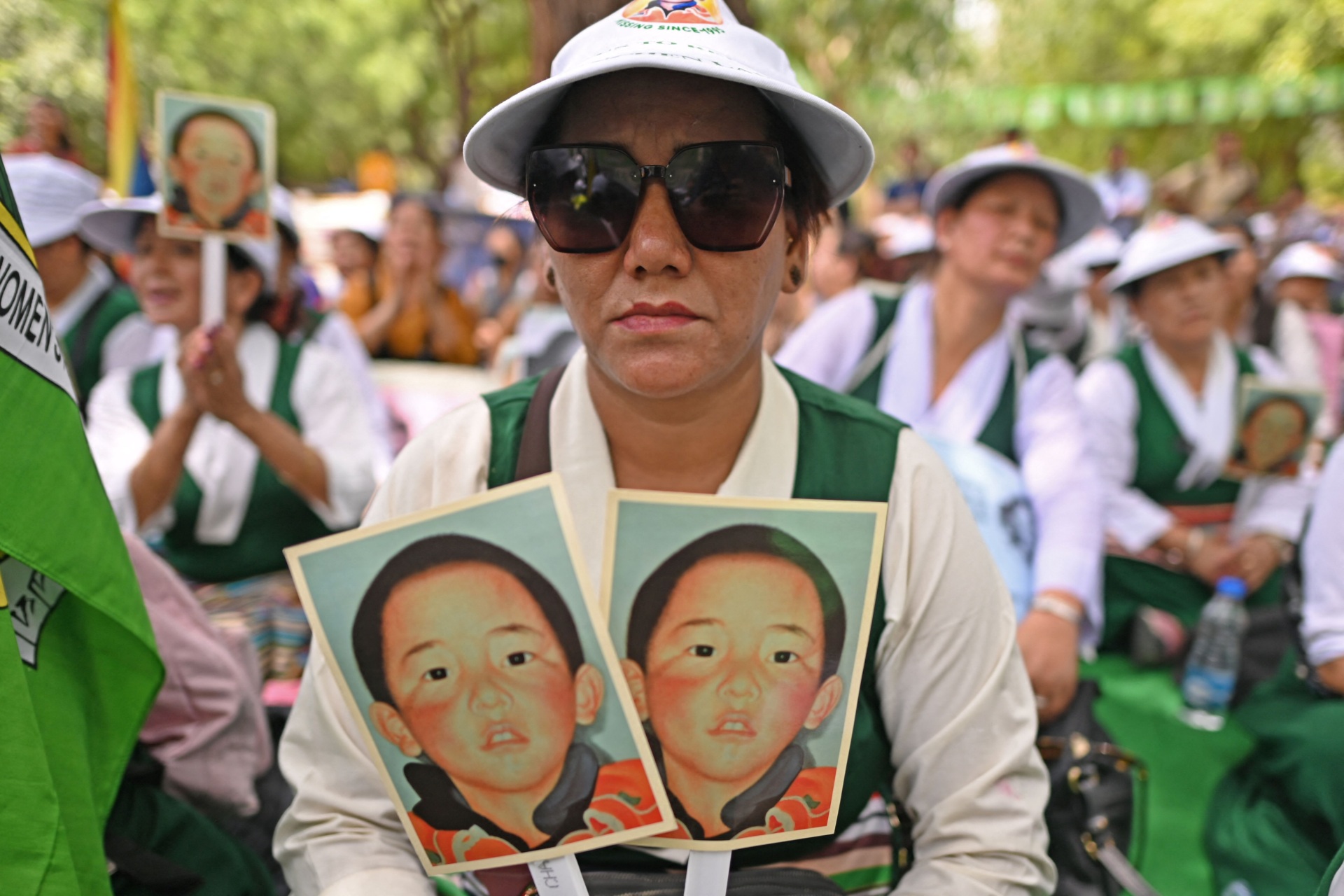
Activists and members of the Tibetan Women’s Association (Central) living in exile take part in a protest against the disappearance of 11th Panchen Lama, Gedhun Choekyi Nyima, allegedly kidnapped by Chinese authorities as a child, demanding his immediate release in New Delhi on May 17, 2023. (SAJJAD HUSSAIN/AFP via Getty)