Two weeks ago, I wrote about the New York Philharmonic in a Tchaikovsky symphony: No. 2 in C minor. I spoke of the beginning of the second movement, that little march. The timpanist, I said,
did something I had never heard before. In his opening measures—his introduction to the movement—he effected a diminuendo.
I’m not sure Tchaikovsky wrote it, but I liked it.
Last Friday night, the Philharmonic began its concert with the Beethoven Violin Concerto. And, lo, the timpanist effected a crescendo on his opening beats.
I’m not sure Beethoven wrote it. I’m not sure I liked it. Anyway—the crescendo was interesting.
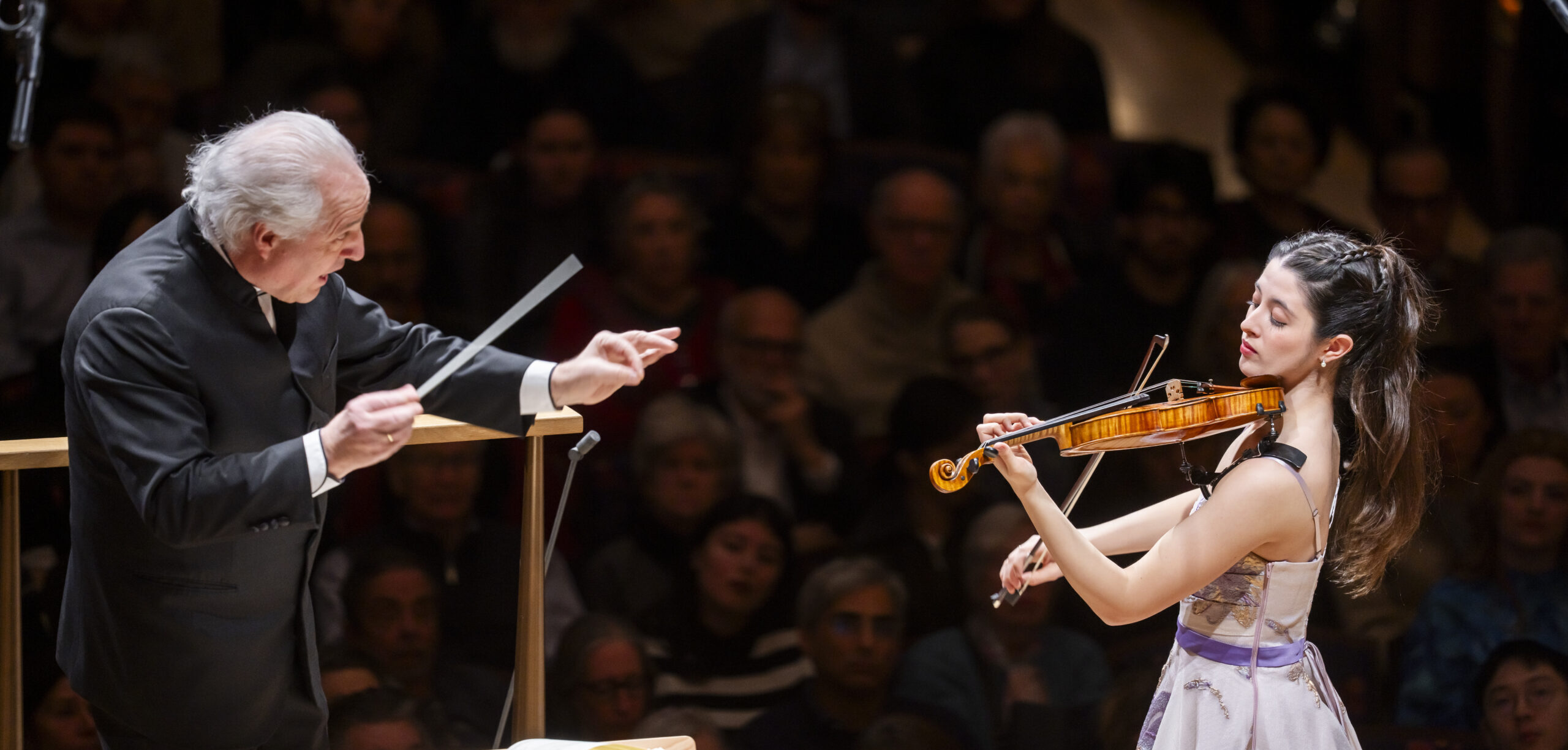
On the podium was Manfred Honeck, the Austrian who is the longtime music director of the Pittsburgh Symphony Orchestra. In the first movement, he was . . . Beethoven-like. A good thing to be in a Beethoven work.
He was brawny and breathable. (This brawniness was refined, I should say.) He was intense but not maniacal. He permitted no slackness.
The soloist was María Dueñas, the young wonder (twenty-three) from Spain. She has recorded the Beethoven concerto with Honeck.
Last season in New York—at Weill Recital Hall—she played a duo recital with another young wonder, the Russian pianist Alexander Malofeev. I wrote, “Señorita Dueñas was a revelation, at least to me—perhaps I am the last to know.” She exhibited a range of technical and musical abilities.
On Friday night, in the first movement of the Beethoven, she made sweet, plaintive sounds. She was nuanced in her dynamics. When it came to tempo and rhythm, she was rather loose. The music was too ruminative for its own good. It threatened to turn into soup now and then.
When Honeck could take over, the music tightened up, appropriately. When Dueñas was more in charge, the music grew slack.
Was this good cop, bad cop?
Dueñas is not only a violinist, she is also a composer—and you have to like a performer who rolls his or her own. For this concerto, she has written her own cadenzas.
For as long as anyone can remember, people have dropped their canes at concerts. These make a terrible, clattering noise. For the last many years, people have dropped their cellphones. It’s amazing how much noise such dropping makes.
During Dueñas’s first-movement cadenza, two people dropped their phones. And a third one rang.
After the first movement was over, people applauded, as was natural to do. I think Beethoven would have expected it. Dueñas did not acknowledge the applause. She did not even look at the audience.
In my opinion, this is bad form. One might nod and smile.
Between the first and second movements, latecomers came in. The musicians onstage waited a long time. When they were about to begin the second movement, and the hall was quiet, there was one more latecomer yet to go.
Behind me, I heard a person walking very, very slowly, as if trying to be quiet—to be stealthy. But she had on very high heels, which made a loud clack with every step. When she at last turned into her row, I saw that she had those fancy heels with red soles.
Remember those shoes for later.
María Dueñas played the Larghetto beautifully. She sang on her instrument. Yet the song was too stretched out for my taste. A little wayward, a little undisciplined, a little soupy.
In any event, she executed a nice transition to the Rondo.
Throughout that movement, the orchestra maintained the spirit of the dance. The music really swung. Between the final notes, there was hesitation. I like strict tempo. But don’t no one listen to me, on that question and others.
Ms. Dueñas played an encore, and she played it with exemplary evenness and beauty. It was a song—“Veslemøy’s Song” from the Suite Mosaique by Johan Halvorsen, a Norwegian who lived from 1864 to 1935 (and who married Grieg’s niece).
While Dueñas was playing, a woman sneaked down the aisle, back to her seat. Apparently, she had left after the Beethoven, not realizing that there would be an encore. This time she had her shoes—those red-soled heels—in her hands.
I swear, it was like a sitcom.
Manfred Honeck likes to arrange orchestral suites from operas. He has given this treatment to Rusalka (Dvořák), Jenůfa (Janáček), Turandot (Puccini), and Elektra (Strauss).
If I have missed one, my apologies.
On Friday night, we heard the Elektra suite, arranged by Honeck, yes, but orchestrated by Tomáš Ille.
It need hardly be said that Honeck conducted it well and that the Philharmonic played it well. So, I will complain. I could have used more lushness—that Straussian lushness, to go with his squirminess, pungency, etc. Also, Elektra’s “victory” dance, in which she dies of revenge achieved (basically)? It ought to be a little nuts, or a lot nuts. For me, it was a bit staid.
During the Strauss, someone sitting in the seats behind and above the orchestra left. I had no doubt the conductor saw it. “Conductors never see anyone leave,” I thought (because their backs are always to the audience). “It must be disconcerting to see that.”
I enjoyed the Elektra suite—this all-orchestral affair—but I couldn’t help thinking of the words, and the story. The music kind of cries out for words.
Let me tell you a quick story about Beverly Sills.
One night, in her last years, she attended a concert of the Philharmonic at which the Rosenkavalier suite (again, Strauss) was played. I said to her, “Didn’t it sort of kill you not to hear the words? Didn’t you just want to bust out with ‘In Gottes Namen’?”
In her answer, she got personal.
She had always wanted to sing the Marschallin, she said. She never got the chance. And this was the only such regret of her career. She once asked Bernstein for the role. “No,” he said. “Sophie” (her expected role in Der Rosenkavalier).
And that was that.