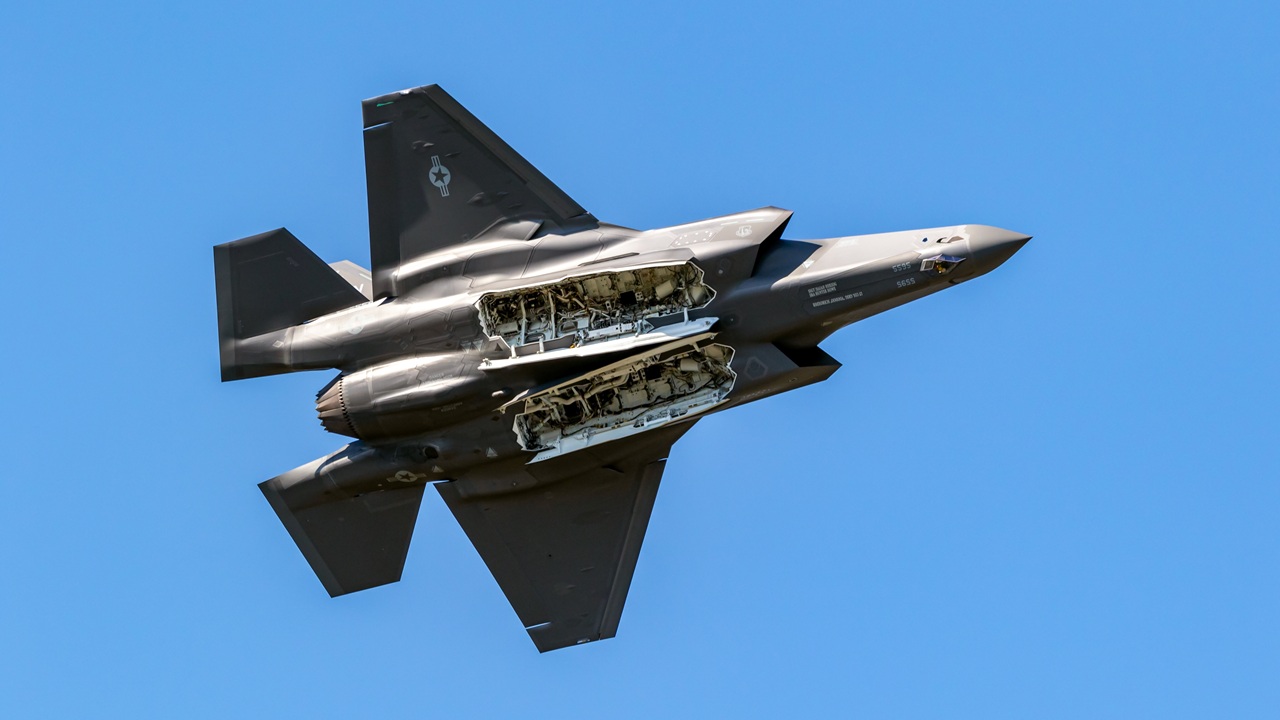
Internal bays are far harder to use than simple hardpoints—but can help to keep a stealth plane stealthy, while external weapons light up on enemy radar.
Modern combat aircraft increasingly carry weapons bays internally rather than on external pylons. Internal weapons bays are closely associated with reducing radar cross-sections (RCS), improving a plane’s stealth capabilities. However, the bays’ purpose is broader than radar evasion. While complex and in certain respects constraining, internal weapons bays are becoming an increasingly popular design choice for modern fifth- and sixth-generation aircraft.
Are Internal Weapons Bays Really Better than Hardpoints?
Early jet fighters and bombers relied entirely on external attachments—better known as “hardpoints”—which allowed for flexibility and greater payload. If a weapon could be attached securely to the underside of the plane, and the plane could take off with it, that weapon could be used—giving planes a great deal of flexibility in the ordnance they carried on strike missions.
Modern fighters’ internal weapons bays are more limited, but are aerodynamically clean. For strategic bombers, internal bays also reduce drag and improve range, which is of course valuable in a platform charged with traveling intercontinental distances. Stealth fighters gain the same advantage on a smaller scale.
External weapons dramatically increase a plane’s radar cross-section; corner reflectors, pylons, and exposed weapons effectively negate the stealth shaping found elsewhere. By contrast, internal bays allow aircraft to preserve low observability, which made them foundational to the design of fifth-generation aircraft. Today, multiple cutting-edge aircraft rely on internal bays. The F-22 Raptor is the world’s foremost air superiority fighter, with multiple dedicated bays. Similarly, the F-35 Lightning II has a single large internal bay on each side, optimized for the flexibility the multirole fighter needs. The B-2 Spirit has large internal bays, enabling the intercontinental strategic strike missions the platform was designed for. The forthcoming B-21 Raider will only feature internal weapons. And other nations are learning from the United States; China’s advanced J-20 fifth-gen fighter features internal bays, reflecting Beijing’s adoption of stealthy design principles. The aircraft developed in the future will more than likely also incorporate internal weapons bays.
Internal Weapons Bays Are Complicated to Operate
Hardpoints have a significant design advantage over internal bays: they are simple to operate. At the push of a button, a pilot can fire the weapon, which detaches from the hardpoint cleanly and goes on to its target.
By contrast, internal bays are very complicated. Bay doors must open and close rapidly to minimize radar exposure time. Weapons release often occurs in turbulent airflow, requiring precise timing and robust separation testing. Launchers and trapeze systems guide weapons into clean airflow. And internal bays limit weapon size, shape, and the aircraft’s maximum payload. In other words, aircraft with internal bays must be designed around bay volume from the outset. This adds weight, complexity, and maintenance burden—which is why, typically, external pylons are retained for use in permissive environments.
Tactically, fighters often fly “clean” in early phases of conflict, where radar evasion is still crucial. In these circumstances, internal weapons are used for first-day strikes and air superiority missions, during which air superiority may not have yet been achieved. Once the first strikes are executed, and air superiority is established, aircraft shift to external stores. Strategically, this approach reflects a broader shift—towards quality and survivability over raw payload capacity. In theory, the shift enables penetration of advanced IADS and A2/AD environments, which is central to US and Chinese air power concepts.
Internal Weapons Bays Will Only Grow over Time
In the future, internal weapons bays will likely grow larger, with modular bay configurations. New weapon shapes, too, will be designed for optimization for internal carriage. Sixth-generation aircraft will likely deepen the reliance on internal bays, perhaps including compatibility with hypersonic weapons.
Moving forward, internal weapons bays will not be optional features, but definitional features of aircraft architecture. They will impose certain constraints, but will also enable survivability in contested airspace. As air defenses continue to improve, keeping weapons inside the aircraft will be a prerequisite for operating within contested airspace.
About the Author: Harrison Kass
Harrison Kass is a senior defense and national security writer at The National Interest. Kass is an attorney and former political candidate who joined the US Air Force as a pilot trainee before being medically discharged. He focuses on military strategy, aerospace, and global security affairs. He holds a JD from the University of Oregon and a master’s in Global Journalism and International Relations from NYU.
Image: Shutterstock / VanderWolf Images.