Most of the US Army’s planes were spun off into the Air Force in 1947, but it continues to operate a handful of fixed-wing aircraft for logistics and ISR purposes.
The US Army is synonymous with helicopters—but the service also operates a modest fixed-wing fleet. These aircraft are not geared for air superiority or strike missions—the Army long ago relegated those tasks to the US Air Force, spun off from the Army in 1947—but instead support command, logistics, intelligence, and mobility. Indeed, in an Air Force-dominated fixed-wing ecosystem, the Army stubbornly clings to a small fleet.
Before 1947, the US Army Air Forces controlled most of America’s military aviation. The creation of the US Air Force separated roles, with the Air Force taking on combat air power and strategic lift and the Army keeping organic aviation for ground forces. The Army also retained a fleet of fixed-wing aircraft for missions the helicopter couldn’t efficiently perform.
Said succinctly, Army aircraft are tactical enablers, not independent combat assets—focused on supporting commanders on the ground, operating from austere or short runways, and facilitating rapid point-to-point movement. Specifically, the Army has utility and transport aircraft, (formerly) tactical airlift, and ISR aircraft.
What Aircraft Does the US Army Operate?
For utility and transport aircraft, the Army operates the C-12 Huron and the UC-35 Citation. The former is a militarized version of the Beechcraft King Air, with a primary role of personnel transport, liaison, and light cargo; the Huron is often used by senior commanders and staff. The Citation is a business-jet-based platform offering faster movement for time-sensitive missions; the platform is ideal for intra-theater travel.
For tactical airlift, the Army experimented with the C-27J Spartan. Designed for short takeoff and austere airfields, the Spartan was intended to give the Army organically tactical lift capabilities. The program ended amid inter service friction and budget pressures. The program illustrated the limits of Army fixed-wing ambitions.
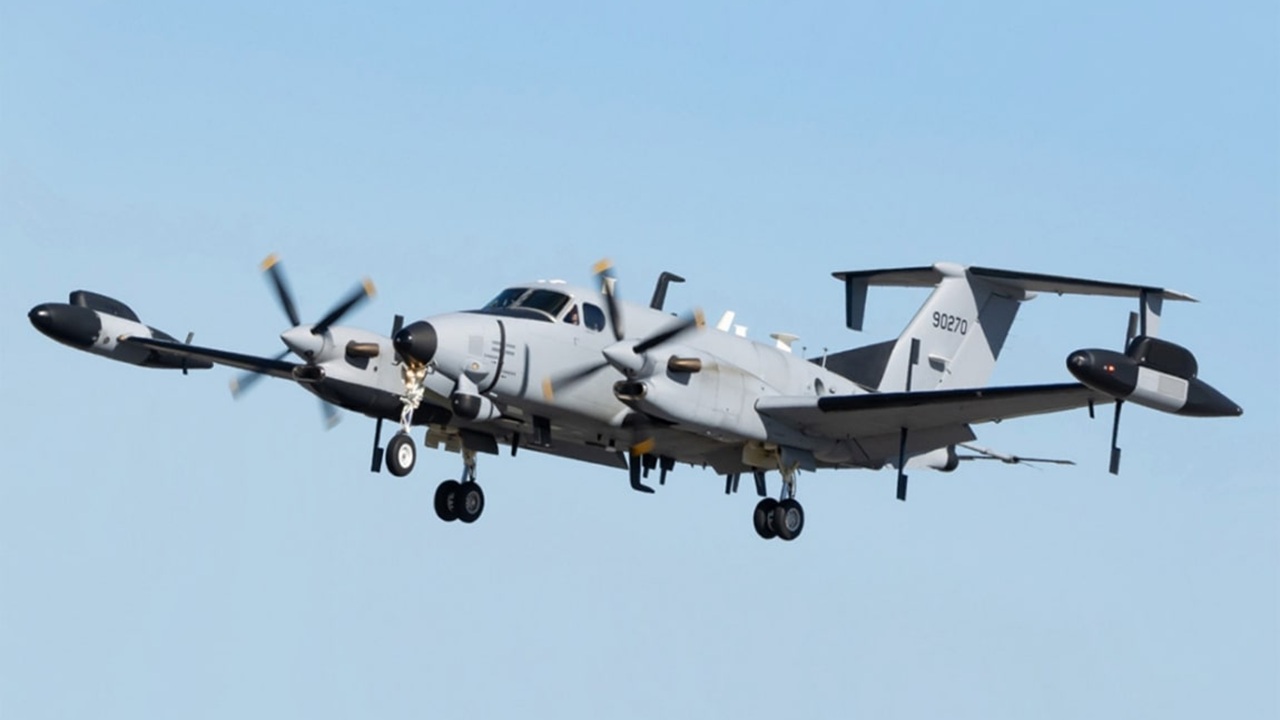
Army platforms also provide ISR. The RC-12 Guardrail is a SIGINT platform modified from the Beechcraft King Air, tasked with intercepting enemy comms and locating emitters. The EO-5C ARL is an Airborne Reconnaissance Low platform, modified from the De Havilland Dash 7, tasked with wide-area surveillance and communications and electronic intelligence. The Army also flies the MC-12W Liberty, derived from the Beechcraft King Air 350, for Multi-Int ISR.
Fixed-wing aircraft offer longer endurance than helicopters, with greater altitude and sensor coverage that is useful for battlefield surveillance, signals intelligence, and command support. These platforms are less visible than drones, but still valuable.
What Can Fixed-Wing Aircraft Do that Helicopters Can’t?
One might expect the Army to just use helicopters for these tasks. But fixed-wing aircraft do offer advantages over helicopters. Specifically, fixed-wing aircraft are faster over long distances, more fuel-efficient, and lower maintenance per mile flown. Helicopters dominate tactical lift but airplanes fill efficiency gaps.
Army aircraft do operate under restrictions, specifically from offensive strike missions and deep interdiction. The Army is careful to avoid duplication with Air Force roles, which is part of why the Army fixed-wing fleet remains deliberately small and specialized. Today, Army fixed-wing aircraft are most active in regional command support, training and logistics, and low-visibility ISR missions; they are often invisible to the public but heavily used internally. In the future, Army aviation will likely trend towards smaller, more efficient aircraft, an increased ISR specialization, possibly with an integration between manned-unmanned systems.
From a strategic perspective, the Army’s fixed-wing aircraft reflect a pragmatic approach, rather than grand ambitions. The fleet exists to support soldiers, not to project air power of any kind. As long as ground forces need speed, range, and persistence, the Army will likely keep flying fixed-wing aircraft quietly, in the background.
About the Author: Harrison Kass
Harrison Kass is a senior defense and national security writer at The National Interest. Kass is an attorney and former political candidate who joined the US Air Force as a pilot trainee before being medically discharged. He focuses on military strategy, aerospace, and global security affairs. He holds a JD from the University of Oregon and a master’s in Global Journalism and International Relations from NYU.
Image: Wikimedia Commons.