
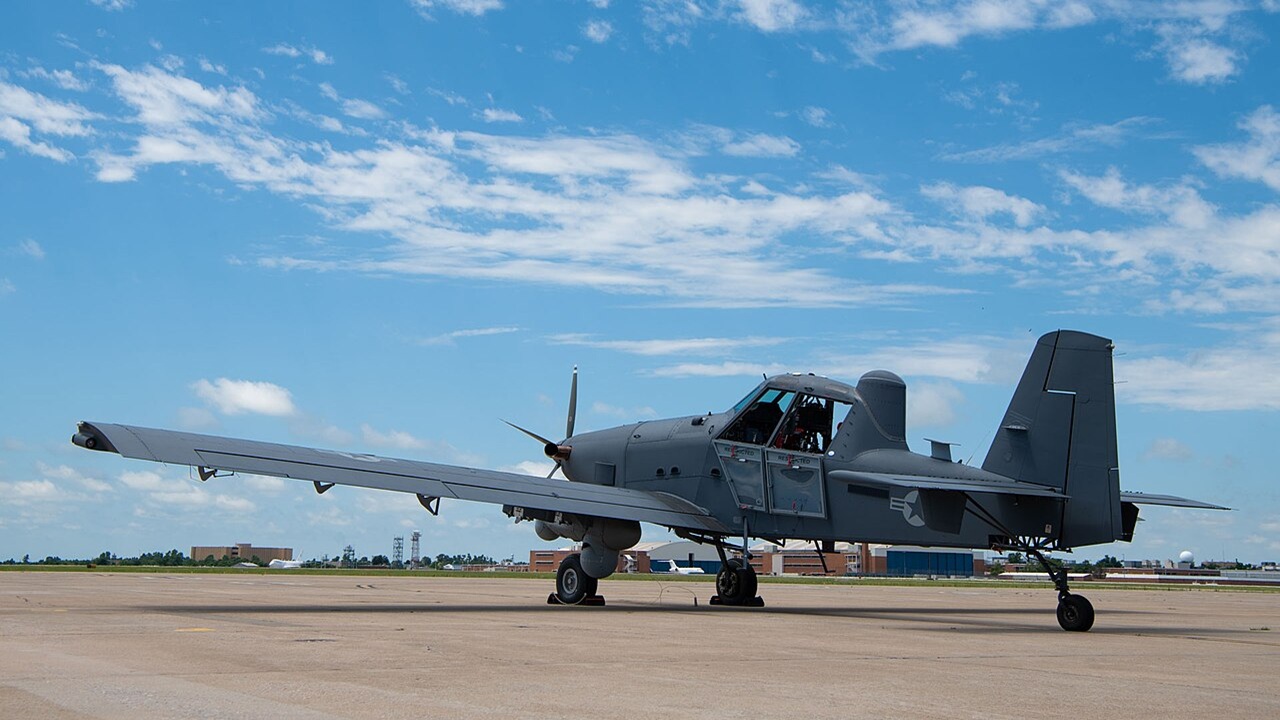
The Skyraider II is the first US Air Force plane since the Vietnam War to have a propeller instead of a jet engine—but there are good reasons for it.
The US Air Force is fielding a new attack aircraft—and, for the first time in more than a generation, the aircraft in question is powered by a propeller.
The OA-1K Skyraider II, seemingly an anachronism in a jet-dominated fleet, isn’t a throwback to the olden days of aircraft. Instead, it’s a strategic play for missions that don’t need speed or stealth—or billion-dollar aircraft.
About the OA-1K Skyraider II Propeller Plane
- Year Introduced: Mid-2020s
- Number Built: Unknown (75 ordered)
- Length: ~36 ft (11.0 m)
- Wingspan: ~59 ft (18.0 m)
- Weight (MTOW): ~16,000 lb (7,260 kg)
- Engine: One Pratt & Whitney PT6A turboprop
- Top Speed: ~300 mph (480 km/h)
- Max Speed (Mach): ~Mach 0.40 (~300 mph / ~480 km/h)
- Cruise Speed: ~230 mph (370 km/h)
- Endurance:
- Range: ~1,300 mi (2,100 km) / 6+ hours’ endurance (mission-dependent)
- Service Ceiling: ~35,000 ft (10,700 m)
- Crew: 2
The Skyraider name is a deliberate echo of the Vietnam-era A-1 Skyraider, the Air Force’s last turboprop attack aircraft (which later became the template for the A-10 Thunderbolt II, or “Warthog”). The reason for the throwback format: the Air Force has repeatedly struggled to field low-cost, permissive-environment aircraft. The Armed Overwatch program, which gave rise to the OA-1K, emerged after decades of overusing fast jets for slow wars. Incorporating lessons learned from Iraq and Afghanistan and various counter terror and support missions, the OA-1K is very much a modern platform—despite the propulsion system.
The OA-1K is a light attack, ISR, and armed overwatch platform. The OA-1K is not a platform for high-end peer-conflict. Rather, the aircraft was designed for permissive or semi-permissive airspace, not first-day-of-war missions. Basically, the OA-1K is an affordable complement, not a replacement or peer, of fighters and bombers.
The single-engine turboprop design is derived from a lineage of rugged agricultural aircraft. The reinforced airframe was built for low-altitude flight, rough environments and long endurance. Multiple hardpoints were included for sensors, weapons, and external fuel stores. The platform features modern avionics, sensors, and communications.
Isn’t a Propeller Anachronistic Today?
Surprisingly, the propeller grants the OA-1K several distinct benefits. The main advantage is fuel efficiency and better low-speed handling; loiter time is improved, allowing the aircraft to stay airborne for hours at a time at low cost. Speed control is improved, allowing the aircraft to fly slow enough to positively identify targets. Short-rough field operations are enabled, allowing the aircraft to operate closer to ground forces. And the thermal and acoustic signature is reduced relative to jets at altitude, which is useful for overwatch missions in an era of advanced ground-to-air missiles.
While jets excel at speed, penetration, and survivability in contested air space, the OA-1K excels at persistence, human-in-the-loop decision making, and cost-effective presence. The jet and the prop offer very different tools for very different war scenarios.
The US Air Force will use the OA-1K for armed overwatch of special operations forces, ISR, and strikes in counterterrorism missions, partner-nation support and training, border, maritime, and remote-area patrols, and missions where drones lack the requisite flexibility or ROE responsiveness. Strategically, the OA-1K frees up higher-value aircraft like the F-15 and F-35 for high-end deterrence.
The OA-1K exists because air dominance is not always contested and because cost matters over the course of long campaigns, where daily jet operations can start to become rather expensive. Still, the OA-1K is vulnerable to modern IADS and advanced SAMs, meaning air superiority will likely need to be established before the OA-1K is deployed.
In all likelihood, the OA-1K will only be adopted with a limited fleet, and will never become a force cornerstone. But the inclusion of the aircraft signals a broader Air Force acceptance of a “low-high mix,” recognition that the most cutting-edge aircraft aren’t needed for every single mission.
About the Author: Harrison Kass
Harrison Kass is a senior defense and national security writer at The National Interest. Kass is an attorney and former political candidate who joined the US Air Force as a pilot trainee before being medically discharged. He focuses on military strategy, aerospace, and global security affairs. He holds a JD from the University of Oregon and a master’s in Global Journalism and International Relations from NYU.
Image: Wikimedia Commons.















.jpg)