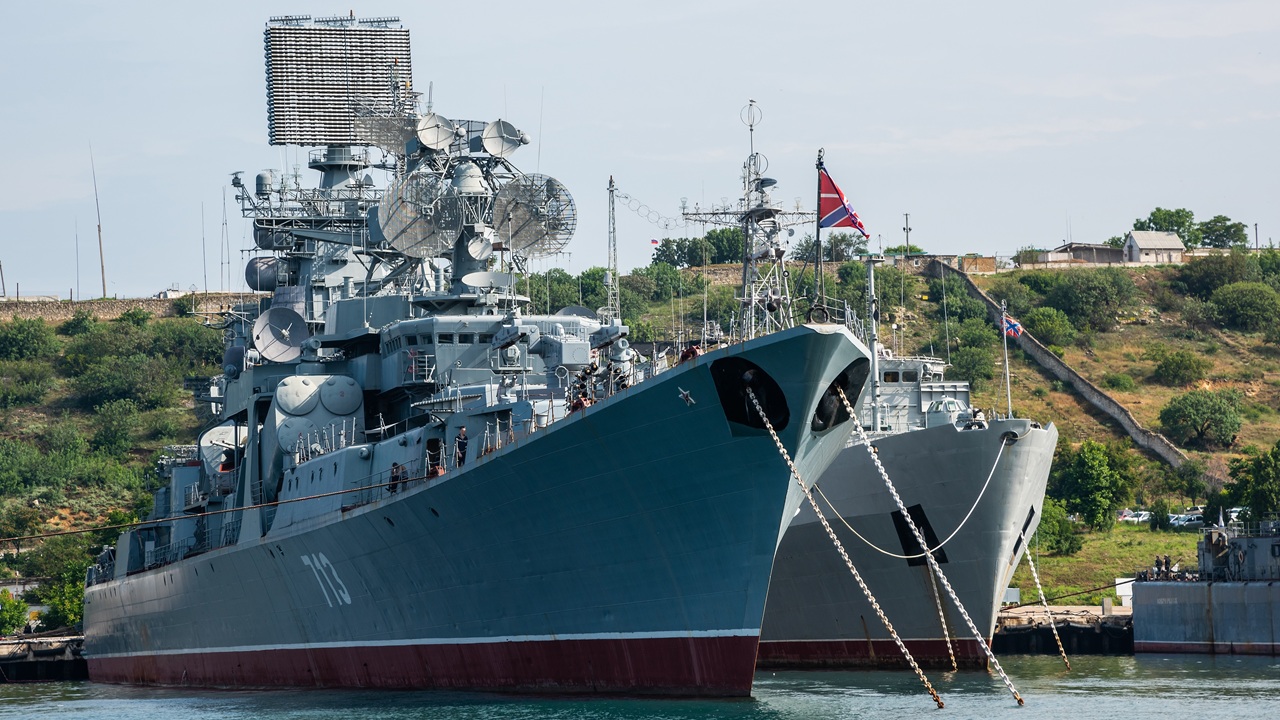
Following Ukraine’s string of high-profile drone attacks against Russia’s naval forces in the Black Sea, the Kremlin has attempted to retaliate in kind.
Since Russia’s large-scale invasion of Ukraine began in February 2022, the Ukrainian military and security services have displayed a remarkable ingenuity in inventing and perfecting ways to repel the Russian attackers. In particular, the Ukrainians have shown a great ability to develop unmanned systems that can wreak havoc on the Russian forces without putting their operators in danger—a capability that has helped keep them in the fight against Russian numerical superiority and long battlefield odds.
Time and again, the Ukrainians have used one-way attack drones, aerial and maritime, to inflict heavy blows on the Russian military. Only in December, the Ukrainian forces used Sea Baby unmanned underwater drones to severely damage a Russian Kilo-class submarine while it was berthed in port. And this was just the latest example of Ukrainian drones landing big strikes against Russian military and infrastructural targets.
But Moscow has not been sitting idle. Indeed, the Russian Ministry of Defense has been developing its own unmanned systems to balance the situation.
Russia Is Building Up Unmanned Surface Drones
In response to the Ukrainian military’s and security services’ advanced maritime drone capabilities, including underwater and surface drones, the Russian Navy is seeking to develop its unmanned surface vessel—as well as counter-drone capabilities to interdict the Ukrainian threat.
Earlier in January, a pro-Kremlin Telegram channel focused on the Russian Ministry of Defense posted footage showing a Russian Sirius 82 uncrewed surface vessel remotely deploying anchored surface mines in the Dnipro River, in Ukraine.
“The Russian Navy is seeking to develop its USV [uncrewed surface vessel] and counter-USV capabilities, attempting to close the gap with Ukraine’s more successful asymmetric maritime capabilities,” the British Ministry of Defence assessed in its latest intelligence update on the Ukrainian conflict.
The Russian Navy has been developing other maritime drones as well. In August, it notably used an unmanned surface system to attack the Ukrainian Navy’s reconnaissance ship Simferopol in the Danube River. The strike was successful, and the Ukrainian vessel was sunk. This was the first-ever reported use of a Russian surface drone against a Ukrainian warship or support vessel.
But there is something else special about the attack against the Ukrainian reconnaissance vessel. The Russian military used two drones, an aerial and a maritime, to conduct the operation—highlighting the promise of unmanned systems operating together.
“The targeting of the Simferopol was enabled by an overhead Russian reconnaissance Orion uncrewed aerial vehicle (UAV), demonstrating early interoperability and intent,” the British Ministry of Defence assessed.
The Ukraine War Is Increasingly a Drone Contest
The battlefield in Ukraine has highlighted the tremendous utility of drones in modern warfare—and the drones pioneered and refined there have been used in other conflicts, including in Africa. In the decades to come, drones will become even more of a mainstay for any army seeking to punch above its weight. Aerial, ground, or maritime unmanned vehicles provide modern militaries with vital kinetic strike, surveillance, and intelligence-gathering capabilities. Militaries are embracing the promise and flexibility that unmanned systems offer. And the lessons coming out of the Ukrainian conflict, as well as other battlefields around the world, are only encouraging about the utility of drones in modern warfare.
Thus far, the Ukrainian forces have had the upper hand in new and capable unmanned systems. But the Russian Ministry of Defense is catching up fast, taking advantage of the time Moscow’s attritional strategy is offering to develop new and better drones.
About the Author: Stavros Atlamazoglou
Stavros Atlamazoglou is a seasoned defense journalist specializing in special operations and a Hellenic Army veteran (national service with the 575th Marine Battalion and Army HQ). He holds a BA from the Johns Hopkins University and an MA from the Johns Hopkins’ School of Advanced International Studies (SAIS). His work has been featured in Business Insider, Sandboxx, and SOFREP.
Image: Shutterstock / Photo_Olivia.