
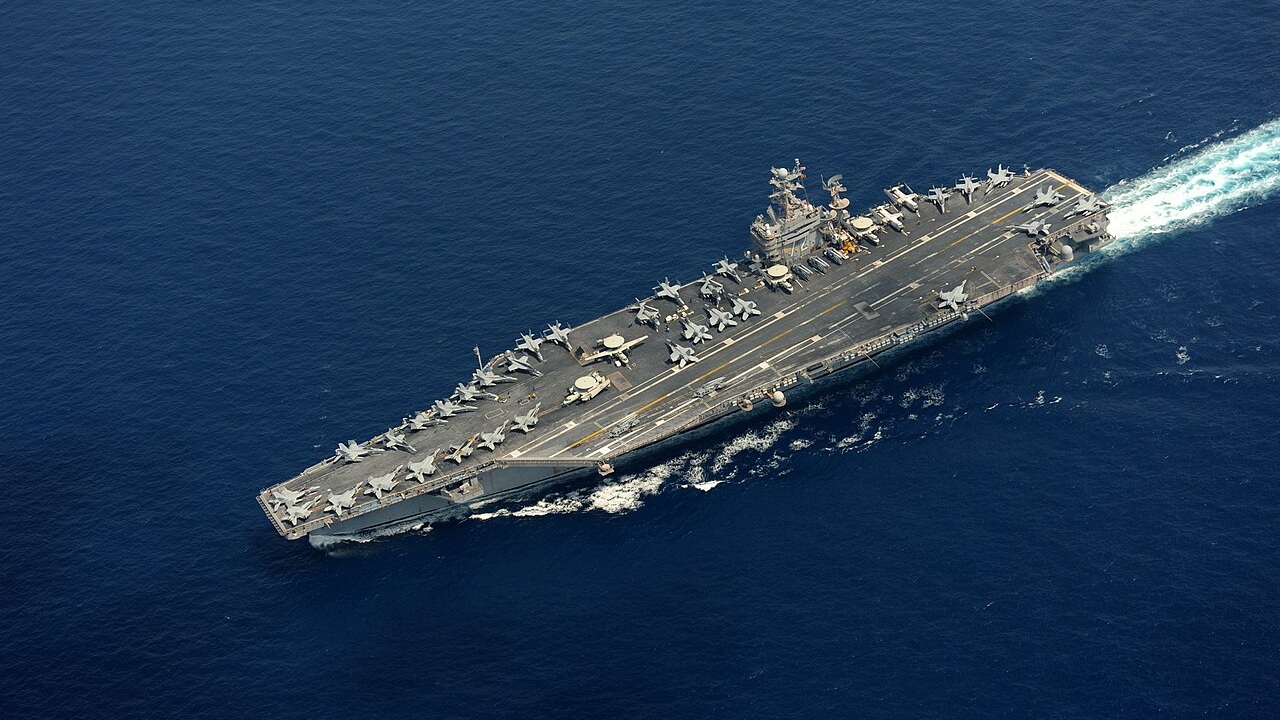
President Trump’s deployment of the USS Abraham Lincoln near Iran draws attention to the fact that the aircraft carrier isn’t just a tool of war, but a tool of high strategy. The aircraft carrier is not merely a combat platform, or a surface vessel, but a signal. And at this moment, that signal is being broadcast to Iran: take political steps to avert a crisis, or face the United States’ military might.
The USS Abraham Lincoln’s Specifications
- Year Commissioned: 1989
- Number Built: 1
- Length: 1,092 ft (332.8 m)
- Beam (Width): 252 ft (76.8 m)
- Displacement: 104,300 long tons (116,800 short tons)
- Engines: Two Westinghouse A4W nuclear reactors, four steam turbines, four shafts
- Top Speed: Over 30 knots
- Range: Unlimited distance; 20-25 years
- Armaments: Two Mk 57 Mod 3 Sea Sparrow, two RIM-116 Rolling Airframe Missile, two Phalanx CIWS; 90 fixed-wing aircraft and helicopters
- Crew: ~5,000–6,000
How Aircraft Carriers Help America Project Strength
The US has relied on aircraft carriers in the Middle East for decades. The advantages of the platform are obvious: they can be deployed without permission from any host nation, they provide immediate air power, and they can control escalation. In an Iran-related contingency, carriers would provide flexible pressure around or over Iranian waters and airspace, without committing to war or “boots on the ground” deployments.
The Abraham Lincoln is a nuclear-powered aircraft carrier commissioned in 1989—part of the Nimitz class, which has formed the backbone of US carrier aviation for half a century. The Lincoln was designed for sustained global operations, high sortie generation, and integration with joint and allied forces. The design emphasis was on endurance, redundancy, and survival. Nuclear propulsion enables virtually unlimited range and high sustained speeds while the large flight deck supports continuous air operations. Basically, the Lincoln provides persistence like no platform aside from a fixed air base.
The typical carrier air wing includes strike fighters, electronic warfare aircraft, airborne early warning, and helicopters for ASW and logistics. This medley of aircraft enables everything from precision strike to air defense to ISR to maritime control. But the carrier does not operate alone; instead, it serves as the centerpiece of a Carrier Strike Group (CSG), surrounded by escorts that provide air defense, missile defense, and ASW. This layered defensive system protects the carrier while also extending its reach and persistence.
How Would the Abraham Lincoln Be Used Against Iran?
In an Iran contingency, the Lincoln would likely be used for air defense against regional forces, strike operations against high-value targets, and ISR and maritime patrol missions. Carrier aviation would give the Trump administration a rapid response option, allowing for sustained pressure and scalable escalation. But the carrier would not be operating in isolation; it would be integrated with land-based aircraft, submarines, and long-range strike assets, i.e., the B-2 Spirit operating from bases in Missouri or Diego Garcia.
Tactically, the Lincoln offers flexibility—the ability to reposition rapidly, or to surge, or de-escalate, immediately. With the protection of escorts, the Lincoln is highly survivable. And because the aircraft carrier creates such a signal, its mere presence suggests seriousness without forcing the US into a commitment. Strategically, the carrier’s presence offers reassurance to regional allies and deters Iranian escalation. This preserves decision space for US leadership while keeping pressure on Iran without crossing any red lines.
In sum, the carrier is about optionality. Still, there are drawbacks to carrier deployment. Carriers are high-value assets. And Iran’s strategy emphasizes missiles, drones, and asymmetric attacks—all of which have made the carrier more vulnerable in recent years.
Regardless, the Lincoln changes the regional calculus, operating as a diplomatic instrument as much as a military instrument. The deployment creates options, not the inevitability of attack, shaping Iran’s decisions through mere presence.
About the Author: Harrison Kass
Harrison Kass is a senior defense and national security writer at The National Interest. Kass is an attorney and former political candidate who joined the US Air Force as a pilot trainee before being medically discharged. He focuses on military strategy, aerospace, and global security affairs. He holds a JD from the University of Oregon and a master’s in Global Journalism and International Relations from NYU.
Image: Wikimedia Commons.
















_transits_the_Indian_Ocean.jpg)