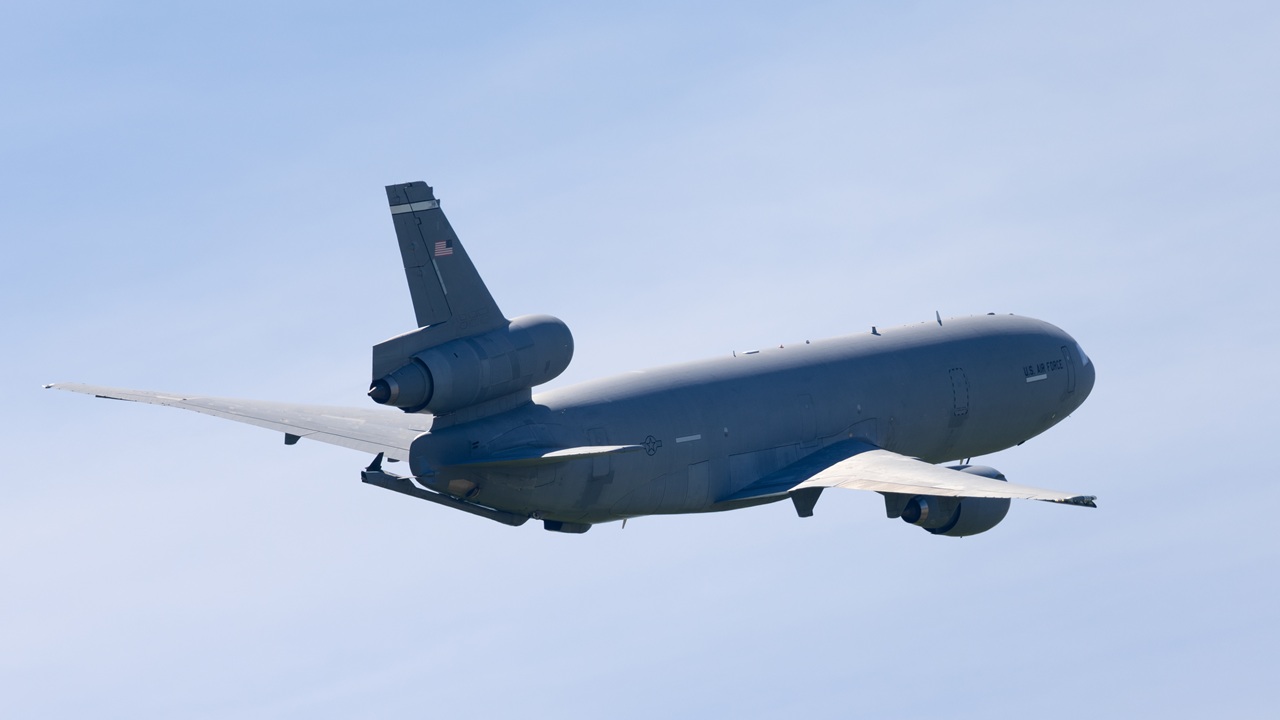
In spite of the KC-10’s admirable qualities, and its decades of valuable service, the Pentagon ultimately scrapped the program in 2024.
The KC-10 Extender is one of the most capable aerial refueling aircraft ever fielded. Rarely discussed, but essential to US global reach, the KC-10 was a combined tanker, transport, and logistical platform—all in a single airframe. Despite proving so effective, however, the KC-10 was retired in 2024, leading to immense controversy within the Pentagon and Congress.
The KC-10 Extender’s Specifications
- Year Introduced: 1981
- Number Built: 62 (KC-10 and KDC-10)
- Length: ~181 ft (55.0 m)
- Wingspan: ~165 ft (50.4 m)
- Weight(MTOW): ~590,000 lb (267,600 kg)
- Engines: 3× General Electric CF6-50C2 turbofans
- Top Speed: ~610 mph (~982 km/h) / ~Mach 0.90
- Range: ~4,400 mi (7,080 km)
- ServiceCeiling: ~42,000 ft (12,800 m)
- Loadout: No weapons; could carry up to 356,000 lb (161,480 kg) of fuel
- Aircrew: 4 (plus passengers, if applicable)
Why Did the US Air Force Want the KC-10?
After Vietnam, the US recognized that its air power was constrained by a shortage of aerial refueling tanker aircraft. To fix the problem as quickly as possible, the US transformed the DC-10 commercial airliner into the KC-10 military variant. Entering service in the early 1980s, the KC-10 was a complement—not a replacement—for the already-existing KC-135 Stratotanker.
The KC-10 is a wide body tail-jet design optimized for fuel volume and payload flexibility. Larger than the KC-135 but smaller than the C-5 Galaxy, the KC-10 was a civilian-derived structure, which simplified both logistics and maintenance. The design emphasis was on range and offload, not austere-field operations.
The defining feature of the KC-10 was its ability to carry vast amounts of fuel; the aircraft could offload significantly more fuel at long range than the KC-135. This enables fewer tanker sorties and longer fighter and bomber legs. This was especially valuable for Pacific and intercontinental operations.
The KC-10’s Technical Specifications
The KC-10 was equipped with dual-method refueling systems. For Air Force aircraft, the KC-10 featured the flying boom. For Navy, Marine Corps, and other allied aircraft, the KC-10 featured hose-and-drogue pods. This versatility allowed for the refueling of fighters, bombers, and transports. The result was a rare ability to support mixed formations in a single mission.
The aircraft’s refueling boom was advanced, with high fuel transfer rate and precision control. The boomer operator was positioned aft with direct visual and sensor cues. This enabled safe refueling at a wide range of speeds and altitudes.
Inside the KC-10 was a convertible interior, which allowed for a variety of configurations, including palletized cargo, troop transport, and aeromedical evacuation. The aircraft could carry up to 75,000 pounds of cargo. This rare ability made the KC-10 a true multi-mission logistics aircraft, rather than merely a tanker alone.
The cockpit was modernized over the service life of the aircraft. The civilian-style flight deck helped to reduce the training burden, keeping the pilot pipeline flowing. The aircraft did require long, well-prepared runways, however, just like a civilian airliner. So, the jet was optimized for strategic hubs—not forward bases.
The KC-10 Saw Decades of Service
Operationally, the KC-10 saw heavy use in Middle East operations, enabling long-range bomber missions. Often paired with fighters transiting inter-theater distances and ISR aircraft requiring long loiter times. The KC-10 functioned as a force multiplier rather than a visible combat asset.
Strengths of the platform included a massive fuel offload, dual refueling compatibility, and cargo flexibility. Limitations of the platform included the aging airframes, high maintenance costs, and limited survivability in contested air spaces. Limitations aside, the KC-10 still enabled the US’s global reach doctrine and reduced reliance on overseas basing; the KC-10 was critical in shaping modern expeditionary air operations.
However, due to an aging fleet and rising sustainment costs, the KC-10 has recently been retired. The KC-46 will serve to replace the KC-10, which will be remembered as one of the most efficient force multipliers ever fielded—demonstrating that tankers are not merely support aircraft, but strategic enablers as well.
About the Author: Harrison Kass
Harrison Kass is a senior defense and national security writer at The National Interest. Kass is an attorney and former political candidate who joined the US Air Force as a pilot trainee before being medically discharged. He focuses on military strategy, aerospace, and global security affairs. He holds a JD from the University of Oregon and a master’s in Global Journalism and International Relations from NYU.
Image: Shutterstock / ranchorunner.