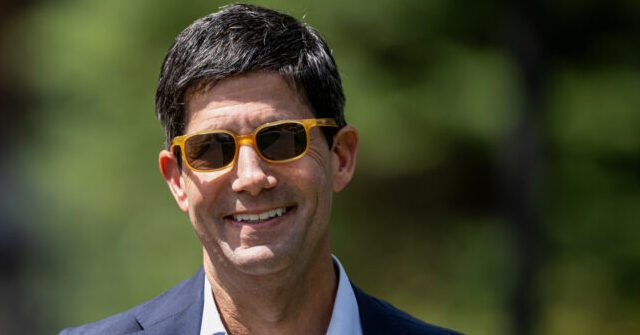
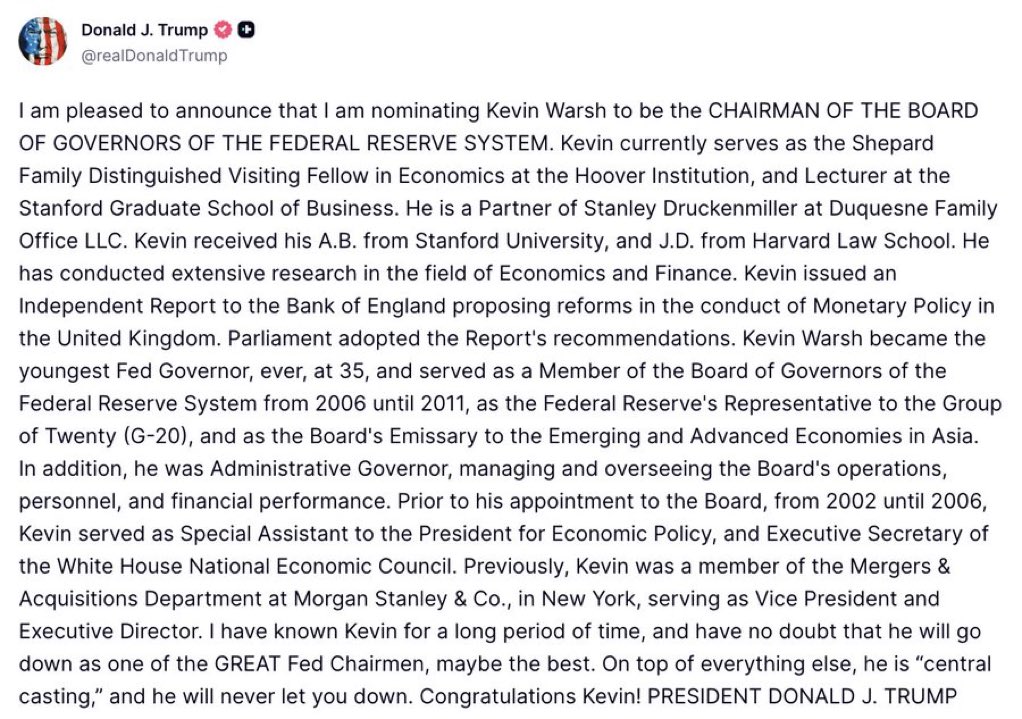
President Donald Trump said Friday he intends to nominate Kevin Warsh as the next chairman of the Federal Reserve, marking a comeback for the former Fed governor who was passed over for the top job in 2017.
“I have known Kevin for a long period of time, and have no doubt that he will go down as one of the GREAT Fed Chairmen, maybe the best,” Trump wrote on his Truth Social platform. “On top of everything else, he is ‘central casting,’ and he will never let you down.”
Warsh, 55, served on the Fed’s Board of Governors from 2006 to 2011 and has advised Trump on economic policy. He will succeed Jerome Powell when his term expires in May, pending Senate confirmation. Trained as a lawyer, Warsh would be the second attorney in a row to lead the central bank.
The selection caps years of public criticism by Warsh of Powell’s policies after leaving the Fed. It may reassure those worried about Fed independence. In a 2010 speech titled “Ode to Independence,” Warsh defended the central bank’s autonomy from political pressure, warning that governments would be “tempted to influence the central bank to keep monetary policy looser longer to finance the debt.”
From Crisis Manager to Outside Critic
Appointed by President George W. Bush in 2006 at age 35, Warsh was the youngest person ever to serve as a Fed governor. His experience and connections in financial markets proved crucial during the 2008 financial crisis, when he played a pivotal behind-the-scenes role in Washington’s rescue efforts.
According to the Wall Street Journal, during that period, Warsh became so indispensable to then-Fed Chair Ben Bernanke as a liaison with Wall Street executives and Republican lawmakers that Fed staffers coined a familiar refrain: “Have you run it by Warsh?”
Those connections with Wall Street and the Bush administration contribute to the idea that Warsh’s pick is extraordinary for a president steeped in populist economics.
Warsh resigned from the Fed in 2011 shortly after it embarked on a second round of bond purchases. In the years that followed, he became a persistent and high-profile critic of the Fed’s balance sheet expansion and prolonged low-interest rate policy. He warned in 2021 that the central bank was sowing the seeds of inflation by continuing to purchase large quantities of Treasurys and mortgage-backed securities—a warning that would later prove prescient.
“The Fed should declare victory over the crisis,” Warsh wrote in a 2021 Wall Street Journal op-ed, “and begin to unwind its extraordinary interventions before they sow the seeds of the next one.”
Warsh has placed a sweeping overhaul of the Fed’s $6.6 trillion asset portfolio at the heart of his monetary policy agenda. He has long argued that the Fed’s emergency measures—including quantitative easing (QE) and an expanded balance sheet—have outlived their usefulness and now distort financial markets.
He contends that by more aggressively reducing the size of the balance sheet, the Fed could gain room to lower interest rates while restoring a more neutral role in financial markets. He has called for a new accord with the Treasury Department to clarify the Fed’s footprint in money markets and reduce the risk of entanglement with fiscal authorities.
In recent television interviews, Warsh has invoked the example of former Fed Chairman Alan Greenspan, who refrained from tightening policy during the 1990s expansion while remaining watchful for financial excesses. Warsh has similarly argued that the Fed must be flexible but vigilant, resisting pressures to do too much or too little.
A Divided Central Bank
Warsh will take the throne of a Federal Open Market Committee divided over whether to ease policy further. The Fed cut interest rates three times in late 2025—in September, October, and December—but left them unchanged this week at a range of 3.5% to 3.75%.
Some policymakers remain uneasy about additional cuts with inflation still running above the Fed’s 2% target. Powell, for his part, had led the Fed to lower rates in 2025 amid signs of labor market fragility. Others argue that monetary easing risks fueling further asset price inflation, especially as firms continue to pass along tariff-driven cost increases.
Warsh has been skeptical of such divisions within the Fed. In a 2017 speech at the Hoover Institution, he criticized the central bank’s internal culture as prone to “groupthink of the guild” and urged reforms to foster more rigorous debate and independent thinking among policymakers.
He has also been critical of the Fed’s reliance on abstract models like the neutral interest rate (what economists calls “R-star”), writing in 2018 that “the fault lies in R-star and in ourselves” and cautioning against overreliance on unobservable variables in policy decisions.
Prescient Inflation Hawk
A central theme of Warsh’s post-Fed commentary has been the danger of inflation. In a 2021 op-ed titled “The Fed Is the Main Inflation Culprit,” he argued that inflation is not merely the result of supply shocks or temporary disruptions but the outcome of deliberate policy choices.
“Inflation is a choice,” Warsh wrote, urging the Fed to refocus on its core mandate of price stability. His early warnings gained credibility as consumer prices surged in 2022 and 2023, forcing the Fed into an aggressive tightening cycle.
While critical of the Fed’s recent direction, Warsh has also warned against politicizing the central bank. In multiple speeches, he has argued that the Fed undermines its own independence when it strays from its narrow mandate.
He has also voiced skepticism about the development of a retail central bank digital currency (CBDC). Warsh has suggested that any digital dollar should be limited to wholesale use among banks to avoid disrupting the traditional financial system or enabling excessive state surveillance.
Confirmation Fight Looms
Warsh’s confirmation may be complicated by a recently launched Department of Justice probe into the Fed. On Jan. 9, the central bank received subpoenas related to Powell’s 2025 congressional testimony about a renovation project. Powell responded with a videotaped statement defending the Fed, and several Republican lawmakers have vowed to block any new Fed appointments until the legal matter is resolved.
Senator Thom Till (R-NC) said Friday he will oppose Warsh’s confirmation until the Department of Justice drops its investigation into Chairman Powell.
Warsh emerged as Trump’s pick after beating out a shortlist that included Kevin Hassett, director of the White House National Economic Council; sitting Fed Governor Christopher Waller; and BlackRock executive Rick Rieder.
Warsh is married to Jane Lauder, granddaughter of cosmetics mogul Estée Lauder and daughter of Republican donor Ronald Lauder, a former Wharton classmate of Trump’s who gave $5 million in March to Trump’s MAGA Inc. super PAC.
Since leaving the Fed, Warsh has been a fellow at Stanford University’s Hoover Institution, served on the board of United Parcel Service, and advised hedge fund manager Stanley Druckenmiller. He has written and spoken extensively on monetary reform, inflation risks, and global financial stability.
In his new role, Warsh will confront 21st-century challenges with few precedents: navigating the inflationary effects of protectionist trade policy, evaluating how artificial intelligence may reshape productivity and employment, and responding to the rise of digital currencies.
Although the Fed chair wields tremendous influence, Warsh will have to forge consensus within the 12-member Federal Open Market Committee, composed of seven Fed governors and five regional bank presidents. His success may hinge on persuading a fractured committee to align behind a new strategic vision for monetary policy.