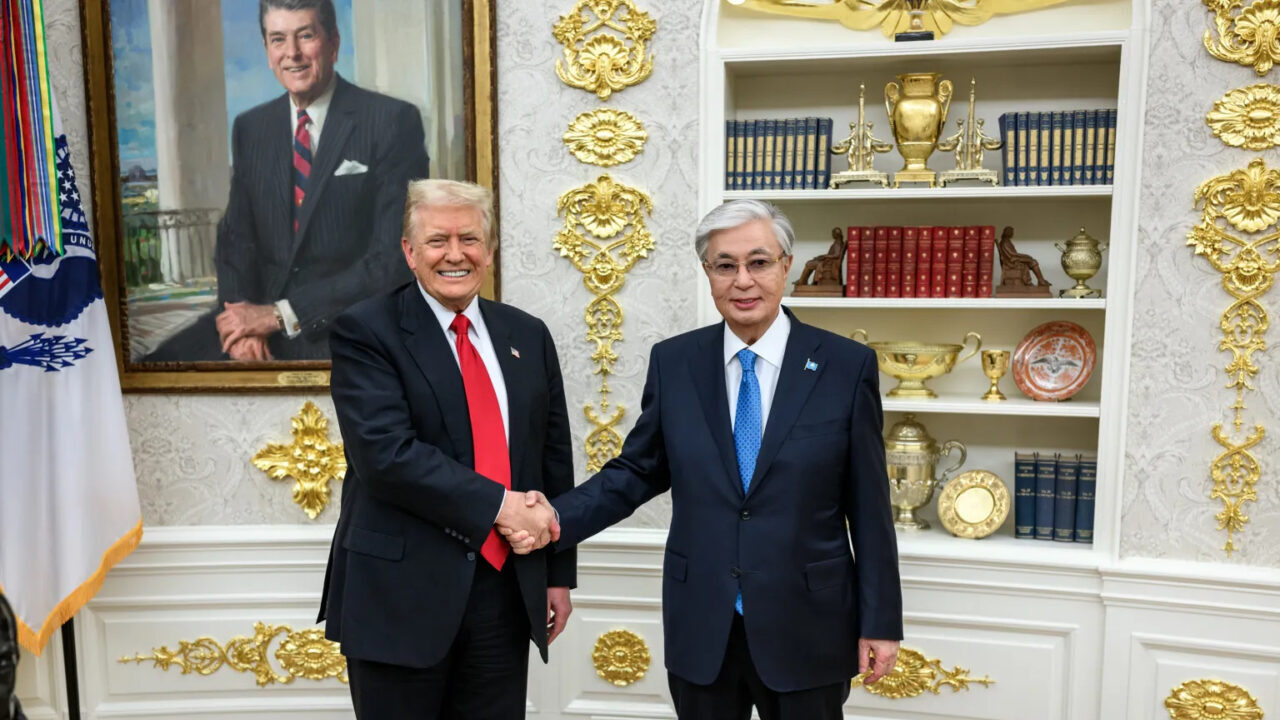
While the White House has paid more attention to Central Asia than past administrations, it is unclear where the region fits on the US priority list.
Central Asia, due to its vast energy and mineral resources, is of critical importance to China, Europe, Russia, and the United States. While geographically distant, the US government has made important strides in recent years to increase its engagement with Central Asia, including a high-profile 5+1 presidential meeting in Washington in late 2025. It would not just be symbolic, but also very important, if President Donald Trump visited a Central Asian country like Kazakhstan this year, one of the two Central Asian countries that joined Trump’s Board of Peace at the recent Davos conference.
No sitting United States president has ever visited Central Asia. That said, other senior US officials have traveled to the region. Vice President Dick Cheney memorably visited Astana, Kazakhstan’s capital, inMay 2006, 20 years ago, as part of a three-country tour, while the US military operation in Afghanistan was intensifying. Almost two decades later, Secretary of State Anthony Blinken visited both Kazakhstan and Uzbekistan in early 2023.
On the other hand, the Central Asian leaders have traveled to the United States to meet with the US president. The first-ever presidential C5+1 took place at the sidelines of the United Nations General Assembly in 2024, between US president Joe Biden and his Central Asian counterparts. Then, last November, a leader’s summit took place in Washington between President Trump and the five Central Asian leaders. Other initiatives were established to increase engagement, including the Critical Minerals Dialogue and the Business 5+1 initiative.
In other words, there has been positive momentum over the last two years, driven by administrations from both US political parties to engage Central Asia at the highest level. The next natural step is a visit by a US head of state to the region.
Kazakhstan is the most developed Central Asian nation: it has the largest volume of trade with Washington, and President Kassym-Jomart Tokayev has a generally forward-thinking mindset, including plans to increase digitalization nationwide by the end of the decade. Agencies like Kazakh Invest are tasked with bringing international investors, and diplomatic & trade delegations regularly visit Washington and other cities. Deputy Prime Minister and Minister of Economy Serik Zhumangarin and Deputy Minister of Foreign Affairs Alibek Kuantyrov led a delegation in New York in October, which included meetings with partners at the New York Stock Exchange.
Geography matters: while landlocked, Kazakhstan’s location is highly advantageous as a trade bridge. The country is also the leader of the Trans-Caspian International Trade Route. The Eurasian analyst Bruce Pannier said at a webinar by the Caspian Policy Center that “the Middle Corridor is the driver of regional cooperation nowadays,” and Astana is the cornerstone, as “every week someone is coming to Kazakhstan” to discuss this initiative. Similarly, when the Zangezur Corridor between Armenia and Azerbaijan becomes a reality, it could become another component of the Middle Corridor.
Astana understands US foreign policy interests and priorities nowadays. The trajectory of US-Central Asian relations in 2026 is determined by a shift from broad-based multilateralism to more focused, targeted bilateral agreements and engagement within a broader regional framework in which all sides share common goals.
There are undeniably strong diplomatic, trade and investment, defense, and people-to-people relationships between Central Asia and Moscow and Beijing. The Central Asian states are members of Eurasian blocs such as the Shanghai Cooperation Organization or the Eurasian Economic Union, or have otherwise strong bilateral relations with Beijing and Moscow.
These links cannot be realistically eliminated or broken. However, it is also true that countries like Kazakhstan see the rest of the world not as a threat but as an opportunity to gain new friends and partners. The Kazakhstani government’s famous multi-vector foreign policy is very much alive.
In this evolving, recalibrated Washington strategy for engaging the world, Kazakhstan is the natural center of gravity or cornerstone within Eurasia. The country has a wealth of resources, particularly rare earths and critical minerals that Washington covets, a young and skilled workforce, and a president who understands the delicate balance of global geopolitics, as well as the potential to serve as a bridge between the West and Eurasia. Amid global turbulence, Astana offers Washington a predictable and reliable partner in a complex neighborhood capable of moderating regional conflicts and ensuring energy security.
It is debatable whether President Trump will visit Central Asia in 2026, given his heavy foreign policy workload, including finding a solution to the war between Russia and Ukraine, the (unbelievable) tensions with Europe over Greenland, and the ongoing crisis in Iran. It is unclear where Central Asia falls within the White House’s current priorities.
Mixed messages are coming from the Trump administration. Both President Tokayev and Uzbek president Shavkat Mirziyoyev have joined Trump’s Board of Peace initiative (it is unclear if Astana or Tashkent will pay $1 billion for permanent membership). On the other hand, Kazakhstan, Kyrgyzstan, and Uzbekistan are three of the 75 countries included in the State Department’s pause on immigrant visas.
Access to the Central Asian market and critical resources can only occur by engaging Astana. Moreover, from a geopolitical perspective, Kazakhstan can help Washington prevent the region from being absorbed by Moscow or Beijing.
Similarly, the United States is the ideal counterweight to maintain the diversity and balance in Kazakhstan’s multi-vector diplomacy. There is much to be gained by the two countries through greater engagement with each other. At a personal level, Presidents Tokayev and Trump have met recently in Washington and Davos, as well as in a December 2025 phone call. The two presidents seem to get along well.
The next natural step for this friendship would be a visit by the sitting US president to Astana, which would include another leaders’ summit with Central Asian leaders in situ. This hypothetical, but strongly advisable, visit would be both symbolic and historic, marking the beginning of a new chapter in US-Kazakhstan and US-Central Asia relations.
About the Author: Wilder Alejandro Sánchez
Wilder Alejandro Sánchez is president of Second Floor Strategies, a consulting firm in Washington, DC. He covers geopolitical, defense, and trade issues in Central Asia, Eastern Europe, and the Western Hemisphere. He has written extensively about Eurasian environmental challenges, including a December 2025 presentation on “The Caspian Sea at the Regional Ecological Summit 2026” organized by George Washington University and Civitas University, and co-authored a report on water security issues in Central Asia, published by the Atlantic Council. Follow him on X via @W_Alex_Sanchez.
Image: White House / Public Domain.