
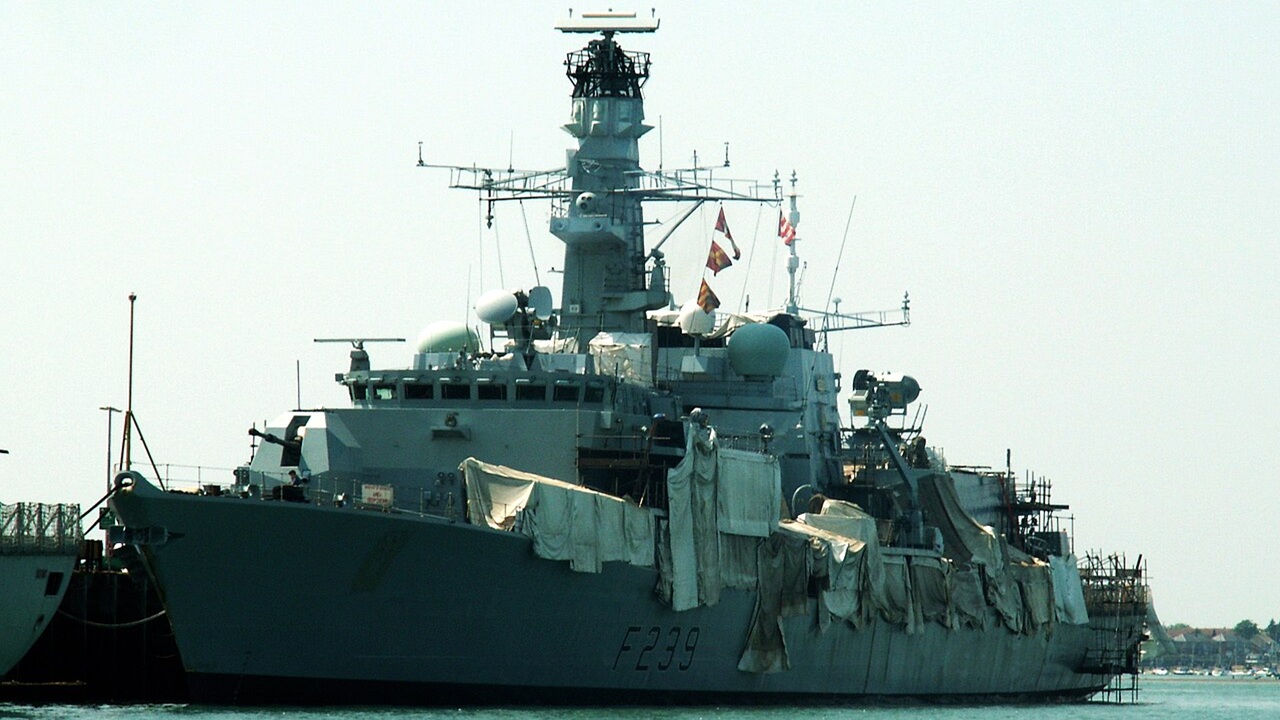
The Royal Navy recently invested in significant upgrades to the HMS Richmond—even with the knowledge that it would be decommissioned well before 2030.
The once mighty Royal Navy is truly a shell of its past glory, and is soon expected to become even smaller. The UK’s senior service announced this month that it will decommission the Type 23 Duke-class frigate HMS Richmond—leaving the Royal Navy with just six frigates, while their intended Type 26 and Type 31 replacements are still years away.
This shouldn’t be a complete surprise, as HMS Richmond first entered service in 1995 and has reached the end of its expected life. Moreover, the warship was the first of four Type 23 frigates to be outfitted with new engines as part of the Power Generation Machinery Upgrade (PGMU) program. Still, that update was meant to extend the service of HMS Richmond into the early 2030s—only for the Royal Navy to reverse course on the program after it was found to be far more complex than initially planned, even as it was partially successful. The powerplant is running smoothly, but the upgraded warships, which have remained in service far longer than expected, are facing other issues that cannot be as easily addressed.
“The frigates’ hulls, originally designed to last about 18 years, have become unrepairable after the rigours of 30 years of operations,” Navy Lookout explained.
Still, in what can only be described as throwing good money after bad, it was only last year that the frigate received the Naval Strike Missile upgrade and the Link 16 Crypto Modernised communication suite. Both enhanced the capabilities of a warship that is now set to be retired by the end of the year, raising serious questions about whether the upgrades were worth it.
The decision to decommission HMS Richmond follows the retirement of HMS Lancaster, leaving the Royal Navy with just six of an original 16 Type 23 frigates.
“No new frigates will become operational before late 2028, and it [has] not yet been confirmed, but frigate numbers may even decline to five this year,” Navy Lookout added.
The Type 23 Duke-Class Frigate’s Specifications
- Year Introduced: 1989, when HMS Norfolk was commissioned
- Number Built: 16 (6 in Royal Navy service)
- Displacement: 4,900 tonnes (5,400 tons)
- Length: 133 m (436 ft)
- Beam: 16.1 m (52.8 ft)
- Engines: Combined diesel-electric and gas (CODLAG), which includes two Rolls-Royce Spey gas turbines, two electric motors, and four diesel generators
- Speed: 28 knots (32.2 mph, 51.8 km/h)
- Range: 7,800 nautical miles (8,976 mi, 14,445 km) at 15 knots
- Armament:
- Guns: 4.5-inch Mk 8 Naval Gun, 30mm guns
- Missiles: Harpoon anti-ship missiles, Sea Ceptor (formerly Sea Wolf/Sea Dart) surface-to-air missiles
- Torpedoes: Sting Ray torpedoes (launched via Mk 32 tubes)
- CIWS: Phalanx Close-In Weapon System (on some)
- Aircraft: Hangar and flight deck for helicopters (Lynx, Merlin)
- Sensors: Artisan 3D radar (post-refit)
- Crew: ~185 officers and sailors
The Type 23 Duke-class frigate was initially developed at the end of the Cold War for anti-submarine warfare (ASW), but later evolved into a multi-purpose warship, including air defense, anti-surface warfare (ASuW), and general operations. A total of 16 were built for the Royal Navy, and the vessels will be replaced by the newer Type 26 City-class and Type 31 Inspiration-class frigates. However, there have been delays, and the newer warships are expected to enter service through the early 2030s, leaving the service spread thin in the meantime.
The Current Vessel Is the Seventh HMS Richmond
The Type 23 frigate set for retirement this year is the seventh Royal Navy warship to be named for the Dukedom of Richmond, where the title emerged under King Henry VIII as the Duke of Richmond and Somerset. The title went extinct for the first time upon the death of the first Duke, Henry FitzRoy, the king’s illegitimate son. The modern dukedom was created by King Charles II in 1675.
Interestingly, the first HMS Richmond, a 26-gun sloop, launched in 1655 as the HMS Wakefield, preceding the creation of the dukedom. It was renamed HMS Richmond five years later, upon its creation. Four other warships bearing the name were built and commissioned during the 17th, 18th, and early 19th centuries.
The last warship named for the dukedom was HMS Richmond (G88), the former US Navy destroyer USS Fairfax (DD-93), which was transferred to the Royal Navy as part of the 1940 Destroyer for Bases Agreement. That warship earned Battle Honours for actions in the Atlantic and Arctic, and later served with the Royal Canadian Navy and, later, the Soviet Navy during World War II. Renamed the Zhivuchi, she remained in service with the Soviet Navy until 1949, when she was retired and sold for scrap.
The current HMS Richmond also took part in combat operations during Operation Iraqi Freedom, providing naval gunfire support (NGS) during the 40 Commando’s amphibious assault on Iraq’s Al Faw peninsula. It would seem that the only battle she couldn’t win was with time.
About the Author: Peter Suciu
Peter Suciu has contributed over 3,200 published pieces to more than four dozen magazines and websites over a 30-year career in journalism. He regularly writes about military hardware, firearms history, cybersecurity, politics, and international affairs. Peter is also a contributing writer for Forbes and Clearance Jobs. He is based in Michigan. You can follow him on Twitter: @PeterSuciu. You can email the author: [email protected].
Image: Wikimedia Commons / AlfvanBeem.















,_Portsmouth,_UK.JPG)