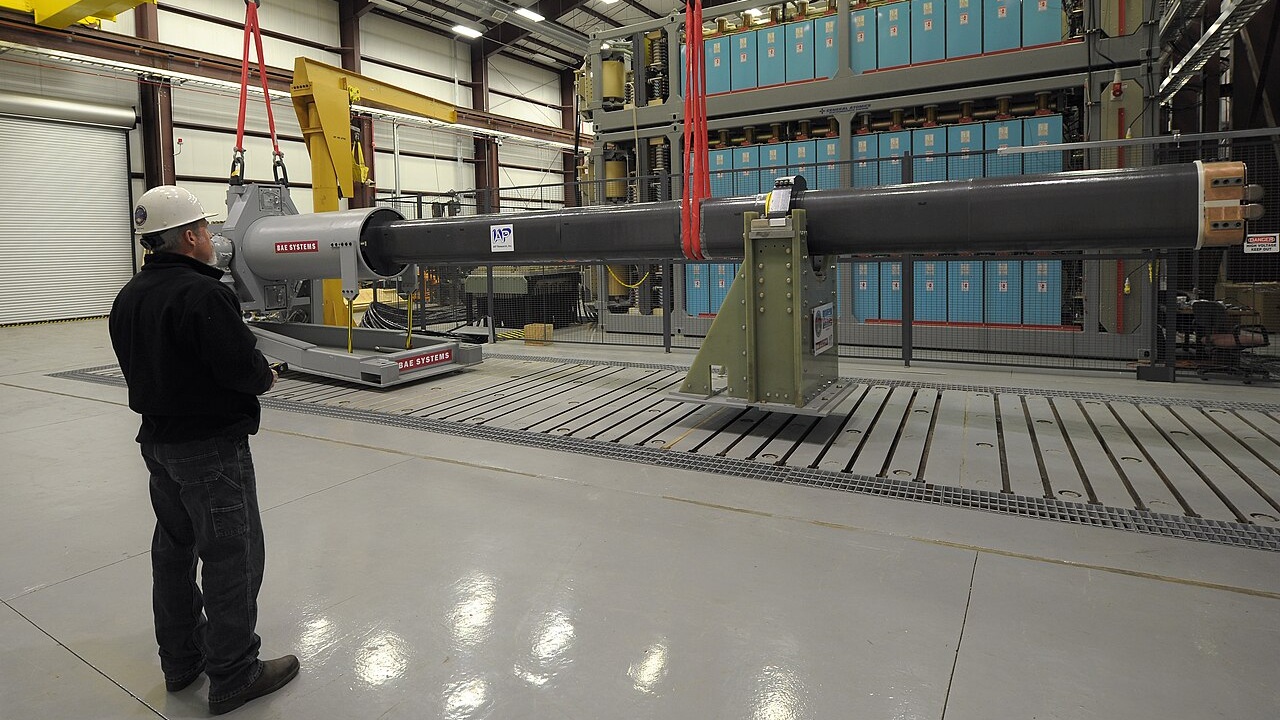
If Trump’s “Discombobulator” really worked as hinted at during the Maduro raid, it would be the first time in the Pentagon’s history that it successfully built a directed energy weapon.
Secretary of Defense Pete Hegseth recently went on his “Arsenal of Freedom” tour, checking out various factories and design hubs involved with the United States’ defense industrial base. As part of that coast-to-coast, whirlwind tour, Hegseth made some interesting comments about American military capabilities.
One of the things he claimed was that the US military possesses what he described as “directed-energy weapons.”
The “Discombobulator” Story in Venezuela
In light of the successful US military raid on Caracas, Venezuela, that led to the successful capture of President Nicolas Maduro and his wife, President Donald Trump claimed that some form of directed energy weapon, what he called the “Discombobulator,” was used.
As best as various media sources can tell, the so-called “Discombobulator”—if it is, in fact, real—was used to incapacitate Maduro’s mostly Cuban team of bodyguards. Others have implied this system was also used to take down the Chinese and Russian air defense systems that ringed Caracas just before US military helicopters entered Venezuela’s capital.
But it’s important to keep in mind that, whatever happened in Caracas in the early morning hours of January 3, the United States military had previously abandoned its directed energy weapon (DEW) projects. Having spent years and gobs of tax dollars, the US military’s known DEW projects failed to achieve even basic requirements.
Of course, there are differences between whatever system was deployed in Caracas and the DEWs that the United States military has been trying—and failing—to build. The Discombobulator is relatively small and directed at closer-range targets, at least according to the descriptions. But DEWs have been under development since the 1960s. Some major DEW programs that were canceled include the YAL-1 Airborne Laser and the Navy’s Electromagnetic Railgun (EMRG).
There are others, too. As with all of them, though, the commonality is that they could never overcome the technical hurdles that the design teams experienced. That’s an interesting turn of events, considering that the Japanese have proven that they can built DEWs that are effective and scalable. So too, incidentally, have the Chinese.
The Flying Laser That Never Flew in Combat
The YAL-1 Airborne Laser Test Bed was officially terminated in 2010—but not before the Boeing 747-based aircraft consumed upwards of $5 billion over 16 years.
That system was intended to shoot down incoming ballistic missiles, essentially frying the missiles as they entered the atmosphere and destroying them before those missiles could reach their targets. A byproduct of Cold War-era thinking and fears, it was assumed a DEW designed to destroy incoming Soviet missiles was a great form of a missile shield.
The sad reality is, though, it never worked as advertised. Designers ultimately concluded that the program was impractical, inefficient, and that the YAL-1 could not operate safely or efficiently in combat conditions. It ended up as a $5 billion boondoggle.
Railguns That Eat Themselves
As for the Electromagnetic Railgun, that system was canceled in 2021 after 15 long, hard years of development. This was a US Navy program that was supposed to create the next great defensive systems for US Navy warships. The only problems facing the Navy with the EMRG system was that it had low rates of firing, was a power hog, and the gun barrel on the weapon rapidly deteriorated after the railgun fired only a few rounds.
Meanwhile, the US Air Force abandoned their Airborne High Energy Laser (AHEL) in 2024. This program attempted to mount a high-energy laser weapon onto an AC-130J Ghostrider gunship. That project never went forward due to the immense technical challenges involved with mounting a high-energy laser weapon on an AC-130J Ghostrider.
Why Fighter Jets Will Never Be X-Wings
There was the Air Force project that tried to basically turn their warplanes into X-Wings from Star Wars. The Self-Protect High Energy Laser Demonstrator (SHiELD), endeavored to place laser pods on warplanes. Rather than firing missiles and bullets, the warplanes employing the SHiELD technology would be able to have basically limitless armaments onboard, because lasers were energy-produced and did not need rearming.
Like all the other DEW projects the American government tried, though, SHiELD saw little success and was abandoned.
What the Pentagon Actually Has
There were common reasons behind why all these innovative, next-world-sounding weapons failed to take hold. For example, engineers involved with these projects reported that there were serious complications that came with beam control, power scaling, and managing extreme heat generation—especially when the planes in question were moving.
All told, these programs suffered through what’s known as excessive optimism about the readiness of the laser technology. These larger systems simply never made it. Still, the shorter-range Laser Weapon System (LaWs) that the Navy is developing has, finally, shown promise. The smaller the technology, perhaps, the more successful it’ll be.
So, Pete Hegseth’s recent claims that America has DEWs, on some small-scale level, that is probably true. But does the United States have a reliable, large-scale DEW program? No. And there’s no reason to suspect, given all the technical complications, the United States will ever truly develop the technology to deploy DEWs as regularly as we utilize missiles or bullets.
Hegseth was likely telling a half-truth in his statements: trying to send a signal of toughness and resolve in the face of so many global threats that have successfully built DEWs for themselves.
About the Author: Brandon J. Weichert
Brandon J. Weichert is a senior national security editor at The National Interest. Recently, Weichert became the host of The National Security Hour on America Outloud News and iHeartRadio, where he discusses national security policy every Wednesday at 8pm Eastern. Weichert hosts a companion book talk series on Rumble entitled “National Security Talk.” He is also a contributor at Popular Mechanics and has consulted regularly with various government institutions and private organizations on geopolitical issues. Weichert’s writings have appeared in multiple publications, including The Washington Times, National Review, The American Spectator, MSN, and the Asia Times. His books include Winning Space: How America Remains a Superpower, Biohacked: China’s Race to Control Life, and The Shadow War: Iran’s Quest for Supremacy. His newest book, A Disaster of Our Own Making: How the West Lost Ukraine is available for purchase wherever books are sold. He can be followed via Twitter @WeTheBrandon.
Image: Wikimedia Commons.