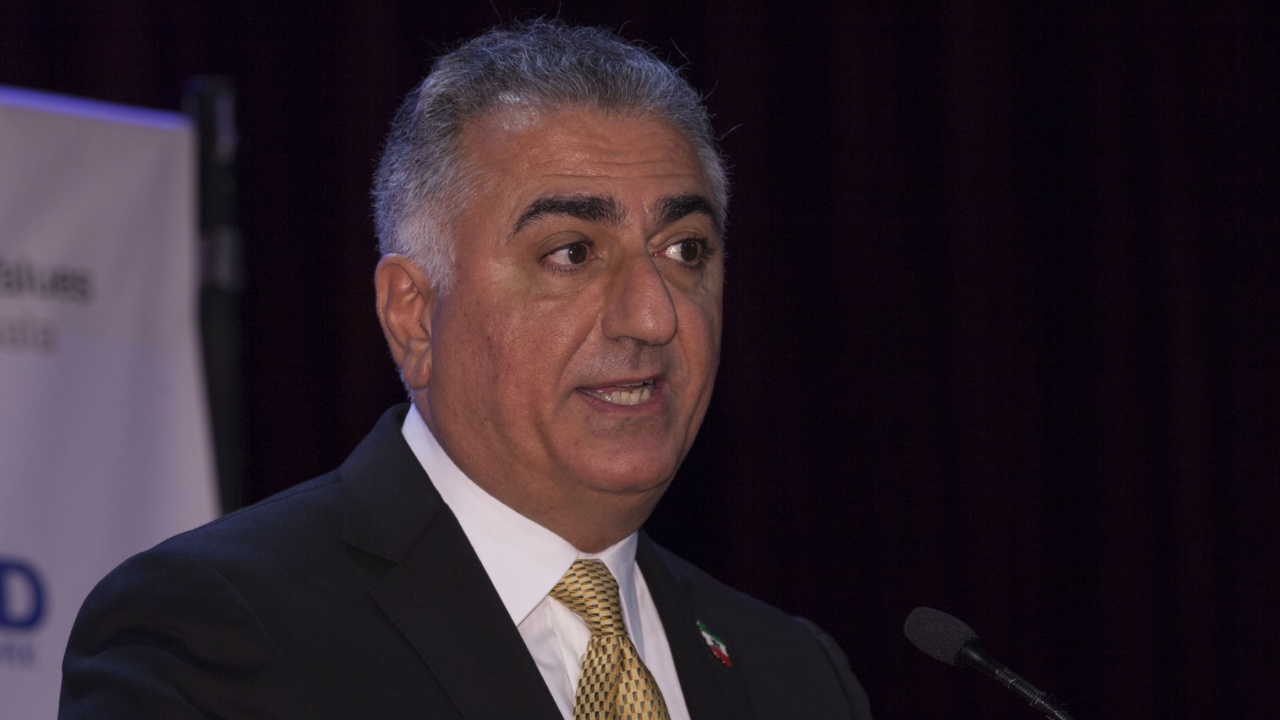
This month’s mass protests in Iran demonstrated the growing homegrown appeal for the return of the country’s long-exiled crown prince.
“Javid shah” (Long live the king), “Reza, Reza Pahlavi, this is the national slogan,” and “This is the last battle, Pahlavi will return.” These are just a few of the chants heard on the streets of Iranian cities during this month’s massive protests, 47 years after Iran’s tragic 1979 revolution forced the Pahlavi monarchy into exile.
A Western observer looking at Iran’s recent round of labor strikes and protests might be surprised by the growing frequency with which demonstrators chant the name of Crown Prince Reza Pahlavi. For an audience with liberal or historical skepticism toward hereditary rule, the situation in Iran could be perplexing: Why are Iranians calling for a prince instead of republican alternatives?
Some might assume chants for Reza Pahlavi represent reactionary nostalgia or a regression to further authoritarian tendencies at a time of pressing socio-economic upheaval and ongoing protests against the Islamic Republic. Yet these chants are emerging from a broad sector of Iran’s society, including laborers, oil workers, teachers, truckers, and students who have already experienced an authoritarian regime and paid its full price.
These groups are not demanding another authoritarian, but a transition rooted in competence and order. Their chanting of Pahlavi reflects their exhaustion with authoritarian incompetence. Even Iran’s traditionally conservative and pro-clerical Bazaar chants for Pahlavi’s return, signaling a broad consensus for the role of the crown prince.
A National Reassessment of Reza Pahlavi
The Islamic Republic’s failures have triggered a reassessment of the Pahlavi era. The chants for Crown Prince Reza Pahlavi are not regressive nostalgia, but a demand for a “return” to rational politics and common-sense governance. For many Iranians today, the Pahlavi era is an era of political competence. While the US dollar exchange rate is more than 20,000 times what it was in 1979, and 60 percent of the population lives below the poverty line, the regime prioritizes sending hundreds of millions of dollars to Hezbollah.
The chants in support of Pahlavi are the answer to a practical question for the ordinary Iranian citizen: Who can credibly garner national opposition to the clerical regime, achieve political transition, and maintain post-regime order in a country where the rulers have systematically destroyed trust in institutions?
This question cannot be adequately answered with sentimentalism or nostalgia for the late Shah. If Iranians are chanting “Reza Pahlavi” in the streets, it is because they are making a strategic judgment. They are chanting the name of a figure they believe can unify, coordinate, and manage the risks of transition after the downfall of the Islamic Republic.
1. Reza Pahlavi Represents an “Experienced Future” for Iranians
Many Iranians believe Crown Prince Reza Pahlavi can lead the transition to a future they have experienced in the past. The appeal of the pre-1979 era stems from a successful socio-economic track record under the Pahlavi monarchy. Many Iranians now believe that Iran was moving in the right direction before 1979. Economic growth, state-building, expanded education, women’s suffrage, and religious freedom are all associated in the minds of Iranians with the Shah era. Iran maintained normal relations with its neighbors and had amiable ties with other nations, including the United States, Israel, the Soviet Union, and China.
By the late 1970s, political openings were incomplete but visible, progressing rather than worsening as they would under the clerical regime. Reza Pahlavi symbolizes this legacy. People chant his name not necessarily to restore the past as it once was, but to use it as a framework for a prosperous future Iran. As the political theorist Leo Strauss argued in Progress or Return, sometimes the future requires repentance from the present and a return to the past as an act of correction.
2. Reza Pahlavi Reduces Coordination Costs and Facilitates Collective Action
As seen in his recent video message to Iranians, Reza Pahlavi’s name serves as a focal point for coordination in a space where opposition is fragmented, and citizens’ trust in other opposition players is low. In political science lingo, the crown prince’s presence lowers the transaction costs of coordinating across disparate actors. Rather than expending scarce political capital on ideological gatekeeping, identity claims, or claims of leadership supremacy, political actors can coordinate around a figure who is nationally recognized and trusted more than everyone else. This is an achievement that the fragmented opposition has always failed to achieve.
3. Iran’s Exhaustion with Radical Politics
Iranians are tired of revolutionary politics. Yet they also understand that dismantling a regime that deploys executions, imprisonment, torture, and live fire to quell dissent cannot be achieved through gradual reforms or symbolic and soft dissent. The challenge for Iranian citizens is how to achieve regime change without pushing the country into cycles of violence or even civil war. This requires a very delicate approach that combines adherence to democratic norms with revolutionary thrust and seriousness.
Reza Pahlavi is committed to both. He has a commitment to democratic norms, stressing time and again that the future of Iran’s form of government and other fundamental political matters will be decided through elections. Yet he also understands that pressure on the regime must be sustained and credible. His campaign to register defectors from the military and security apparatus of the Islamic Republic via a secure platform and QR Code reflects a level of practical political measure that is unheard of in the history of Iranian opposition groups.
4. Reza Pahlavi’s Consistent Messaging on the Islamic Republic
In Iran’s opposition politics, few figures have survived the test of time like the crown prince. After almost five decades in exile, Reza Pahlavi has consistently endured regime propaganda without losing his restraint and composure. As the Islamic Republic has cycled through its phases, from Akbar Hashemi Rafsanjani’s “reconstruction,” to Mahmoud Ahmadinejad’s rhetoric of “justice and equity,” to Hassan Rouhani’s claims that the system could be reformed from within, the crown prince has been steadfast in his messaging: There is no exit from Iran’s crisis unless the regime is toppled. For Iranians, this long record of consistency is a strong sign of his reliability as a leader of transition.
5. Monarchy Is a Unifying Force in a Divided Opposition
The crown prince is in no way connected to ethnic factionalism, extreme ideological tendencies, or opportunist exile ecosystems seeking economic or political incentives from foreign governments. Furthermore, much of Iran’s diaspora opposition is descended from the revolutionary forces of 1979 who deposed the Shah, only to be later eliminated by the very regime they helped establish. A prime example is the Mojahedin-e Khalq Organization (MEK), which not only lacks credibility inside Iran but is widely viewed with outright hostility by the Iranian public. For many Iranians, this distance is precisely the source of his legitimacy, in that he represents a clean break from a failed revolutionary past and is free from profit-seeking projects.
6. Reza Pahlavi: A Transitional Leader for Iran
One reason people trust Pahlavi is that he does not insist on serving the nation without holding power. He has repeatedly stated that he is not a candidate for the presidency or the premiership, positioning himself as a transitional leader. The crown prince has repeatedly stated that he seeks to lead Iran during the transition period to a democratic system. In a society traumatized by two “supreme leaders” who seized power in the name of the people and never relinquished it, this is an important posture. For many Iranians, the crown prince’s position reduces fears of authoritarian relapse.
7. Reza Pahlavi’s Appeal to the Iranian Working Class
Support for Crown Prince Reza Pahlavi is not limited to upper-class diaspora or older pro-monarchy migrants in California. Actually, the pattern in Iran is often the opposite. Chants for Pahlavi are increasingly heard in smaller towns and cities, and among blue-collar workers and middle-class citizens. Groups of citizens, such as teachers, nurses, drivers, oil workers, and truckers, who have been hit the hardest by the Islamic Republic’s incompetence leading to inflation, and subsequent state repression, are on the front lines of supporting the crown prince.
The wide-ranging support reflects the Iranian people’s lived experience under the clerical regime and a desire to return to the better times of the Shah-era, when sound economic policy was the norm of governance. For many in these classes, the Pahlavi brand has become associated with such competence.
8. The Reza Pahlavi Transition Plan
Finally, unlike much of Iran’s exile opposition, the crown prince has moved beyond slogans to transitional planning. His Emergency Phase booklet lays out a modern procedural framework for democratic transition and stabilizing the country after regime collapse. The booklet is evidence that Pahlavi believes legitimacy will come from the people, and every major institutional choice and constitutional process, including Iran’s future democratic regime type, will be decided through the ballot box and popular will. This emphasis on procedure over his own personality reiterates his role as a facilitator of an orderly and democratic transition.
About the Authors: Saeed Ghasseminejad and Mahdi Amiri
Saeed Ghasseminejad is a senior Iran and financial economics advisor at the Foundation for Defense of Democracies (FDD), specializing in Iran’s economy and financial markets, sanctions, and illicit finance. Saeed’s work has been published in The Wall Street Journal, CNBC, Fox News, Foreign Policy, The Hill, Business Insider, The Weekly Standard, The National Interest, National Post (Canada), Hurriyet (Turkey), Arab News, and The Jerusalem Post.
Mahdi Amiri holds a PhD in Political Science from the University of North Texas, an MA in Political Science from the University of Texas at Arlington, and an MA in comparative Western and Islamic political thought from Tarbiat Modares University in Tehran. He serves as a political and research consultant for Manoto TV.
Image: Lev Radin / Shutterstock.com.