Though Iran’s various exile-based opposition movements share a hatred of the Islamic Republic, their own internal differences have stymied efforts to form a united front against it.
This month, the Iranian people once again took to the streets to protest for a better life against the Islamic Republic. In the early days of the protests—before a violent government crackdown killed thousands, if not tens of thousands, of demonstrators—one often heard the refrain among observers and commentators that the regime’s “endgame” was at hand, and that Iran was on the cusp of freedom.
As the scale of the massacre inside Iran becomes clearer, it is apparent that the present authorities in Iran have lost all legitimacy, relying solely on brute force and intimidation to remain in control. But in the midst of the chaos, one question that has remained unanswered is what alternatives to the Islamic Republic actually exist. After the fall of Khamenei and the IRGC, who will govern the “free” Iran? Indeed, the central fact of the clerical dictatorship’s longevity is not merely its willingness to engage in mass slaughter to remain in power, but the inability of Iran’s divided opposition to meaningfully challenge it.
The vast majority of Iranians—both inside the country and in the diaspora—oppose the Iranian regime. But “anti-regime” sentiment comes in many flavors. Iranians opposed to Khamenei are divided by identity, history, borders, language, religion, class, and even what the word “Iran” should mean.
Many Iranians Are Suspicious of Reza Pahlavi
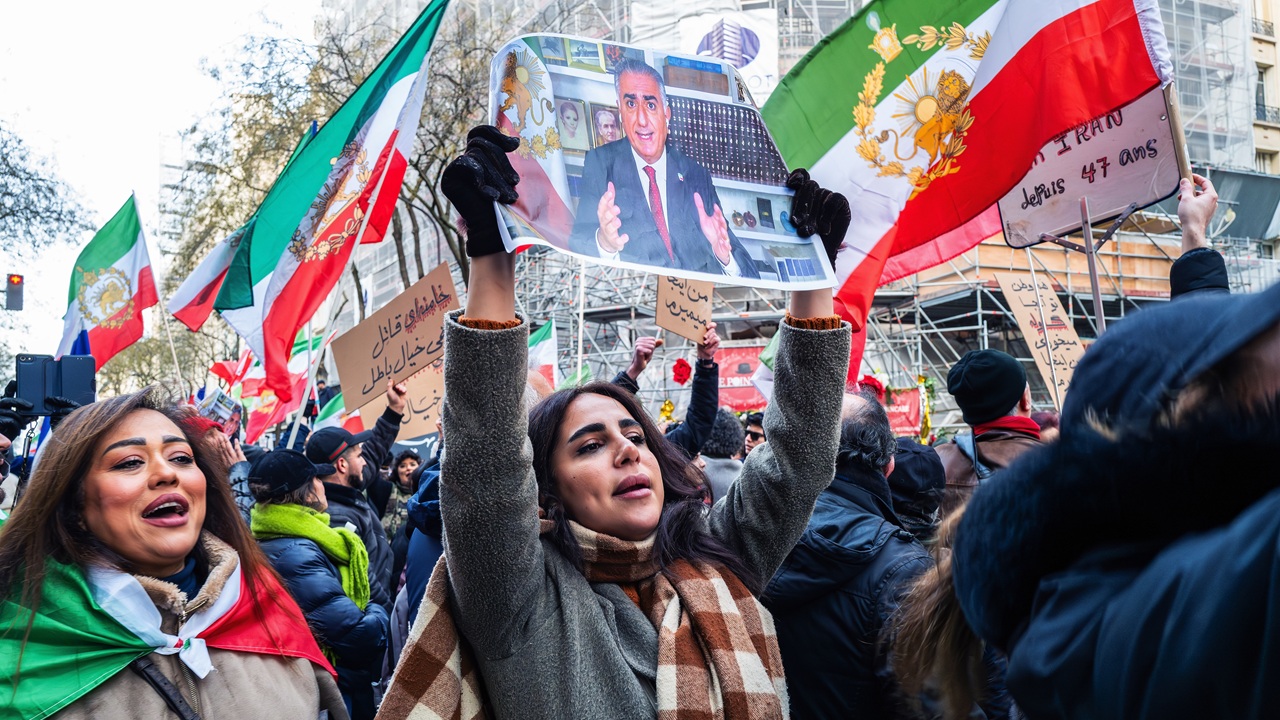
Start with Iran’s monarchists—the supporters of Reza Pahlavi, the son of Shah Mohammed Reza Pahlavi, who fell from power in 1979. Pahlavi leads one of the staunchest and most widespread opposition movements to the Islamic Republic, and there is clear evidence that he has some support within Iran; chants of “Javid Shah” (“Long Live the Shah”) were a mainstay of the recent protests. Of course, the shah-in-waiting has spent nearly all of his adult life in the United States, and his qualifications to rule a nation of 90 million are far from certain. Still, Pahlavi is perhaps the most obvious choice for a successor to the clerical government, and has expressed his willingness to be a temporary leader during a transition to democracy. In that sense, he could serve as the leader of a united front.
The main obstacle to the creation of such a front is the loud pro-monarchist ecosystem surrounding Pahlavi, which behaves in a way that is deeply offensive to some who might otherwise support him. Pahlavi has spoken about the need for democracy, and stressed that if he were to return as Iran’s monarch, it would be of a constitutional monarchy. Yet his most strident supporters have made it clear that they envision his rule as a restoration of Iran’s pre-1979 absolute monarchy (and, opponents presume, its various human rights abuses). Pahlavi’s refusal to distance himself from the advocates of these positions is a major red flag. His camp is also notorious for picking fights with other members of the opposition; it regards Iranian dissidents who refuse to support Pahlavi as traitors, regime agents, or obstacles to liberation. In doing so, it undermines any effort to form a broader coalition with them.
This behavior can be widely seen online. For instance, Iranian women’s rights activist Masih Alinejad has been a prominent voice against the Islamic Republic for many years, and has been targeted by serious threats and assassination plots linked to the regime. Yet diaspora politics is so toxic that supporters of Pahlavi have harassed and defamed her—calling her corrupt, foreign-controlled, or “not real opposition.” The same pattern emerged after Narges Mohammadi, a longtime human rights activist and political prisoner inside Iran, won the Nobel Peace Prize in 2023. Mohammadi is widely seen as a symbol of civil resistance inside Iran. Even so, Iranian opposition social media, particularly pro-Pahlavi monarchists, condemned her Nobel win, accusing her of complicity with the regime and calling her a “reformist” intent on leaving the Islamic Republic intact rather than overthrowing it. With allies like these, who needs enemies?
This is why non-monarchist Iranians often fear the monarchist current as an authoritarian movement cloaked in anti-regime trappings. If monarchists treat anyone opposing their views as traitors while in exile today, how would they treat federalists, leftists, Kurds, Baluchis, Arabs, or religious minorities inside Iran if they were ever to come back into power?
The MEK Has Too Many Skeletons in Its Closet
The other major Iranian opposition exile movement is the Mujahedin-e Khalq (MEK), better known in the West as the National Council of Resistance of Iran (NCRI). It, too, is unpalatable to a majority of Iranians.
The MEK began as a movement of Iranian leftists with Islamist ideas. Under the leadership of student leader Massoud Rajavi, it carried out bombings inside Iran, first against the Shah and later against Khomeini. After the group was banned inside Iran in 1981, it struck an alliance with Saddam Hussein during the Iran-Iraq War and established military bases in Iraq that it used to launch attacks on Iranian troops. The MEK has gone to great lengths to stress that it never actually fought alongside Saddam’s forces—yet its members still fought against their own countrymen during a war for national survival, giving them a status within today’s Iran akin to that of Benedict Arnold in the United States.
For this reason, the MEK has virtually no chance to build a mass movement inside Iran. Outside Iran, the organization has gained some measure of influence, hosting prominent Western politicians at its conferences and gaining US congressional support for its “10-point plan” for a post-Islamic Republic government. However, it has also faced persistent criticism over its cult-like structure and practices. For instance, it requires that its members remain celibate, and insists that Rajavi—who has not been seen since 2003—is still alive and in hiding. (His wife, Maryam Rajavi, leads the group in his absence.) The group also carries the stigma of having been listed as a Foreign Terrorist Organization in the United States until 2012.
Owing to these controversies, the MEK has few friends across the broader opposition universe, which regards it as compromised and untrustworthy. In turn, the MEK tends to treat other opposition currents as unserious or irrelevant, proffering its own structure and messaging discipline as the only credible alternatives to the Islamic Republic. These tendencies make it virtually impossible for the group to unify with any other opposition movements—and given the MEK’s baggage, it is unclear if such unity would even be helpful to the anti-regime cause.
Ethnic Separatism Is Extremely Controversial in Iran
Then come the separatists—more precisely, the spectrum that ranges from decentralization advocates to federalists to independence movements among non-Persian ethnic groups on Iran’s periphery. Activists within Iran’s Azeri, Arab, Kurdish, Baluchi, and other minority communities have argued that the modern Iranian state, both under the Shah and the Islamic Republic, has been built on their forced assimilation.
Iran is a state of many ethnicities, and Western policymakers have a tendency to default to a Persian-centric view of the country, viewing “Iran” as one territorial unit. Minority activists have argued that this tendency treats Iranian territorial unity as more important than the needs of the minority communities within its borders. They contend that Iran’s modern identity project—suppression of local languages, cultural hierarchy, and centralized control—is not only harmful to the country’s minority communities, but also far older than the Islamic Republic and unlikely to be solved by its overthrow. Instead, they suggest that the only long-term solution is the creation of independent territories inside Iran in line with its ethnicities.
Whether one agrees with this camp of opposition or not, it reflects a political reality within Iran: many non-Persian communities do not regard the Islamic Republic’s oppression as a new phenomenon, but merely as the latest iteration of a central state that has always treated them as subjects rather than partners. Unsurprisingly, these opposition groups find themselves in contestation not only with the clerical government, but with both the monarchists and the MEK—each of which has stressed the importance of maintaining Iran’s territorial integrity and quashing peripheral separatism.
If Khamenei Fell, None of These Factions Could Replace Him
With these huge divisions facing the opponents of the Islamic Republic, the real crisis becomes clear: if the regime collapses, which faction actually has the legitimacy to fill the vacuum? The honest answer is that in the current situation, no one does. If a post-regime transition were to take place, and the vacuum were filled by one of these exile-heavy camps alone, Iran would almost immediately fall victim to instability.
It is vital to understand that the existing Iranian diaspora groups are not mere political factions, but also wounded identity projects. Monarchists are fighting for a lost “golden age” that has little chance of returning—and, in truth, was never all that golden to begin with. The MEK claims to be fighting for a democratic transition in a country that overwhelmingly regards it as a Quisling movement and would never hand it power through the ballot box. Separatist factions are fighting for ethnic independence that most Iranians do not support. None of these contradictions would be resolved if the regime were simply to collapse. If anything, the fall of the Islamic Republic and the ensuing power vacuum would only inflame them.
Many policy experts in the West have therefore voiced concerns that post-Islamic Republic Iran would turn into an “Iraq scenario” or an “Afghanistan scenario” if the regime collapses. That fear is understandable. A transition handing power to a single exile group, be it monarchist or MEK, would very likely plunge Iran into crisis, as large parts of the country would see it as a foreign takeover rather than liberation. The international dimension would further exacerbate this, as exiled opposition groups excluded from power through nonviolent means might subsequently attempt to claim it by force.
A Better Alternative: Organic Opposition Inside Iran
None of this should be taken to suggest that Iranians are inherently averse to democracy, or that the current ruling authorities should remain in place. But popular legitimacy to succeed them does not come from recording videos and appearing in the media abroad, as many opposition leaders do now. Legitimacy comes from lived trust within the country, from local networks that have been the loudest in opposition to the regime, and from leadership that Iranians know and trust due to their shared experience on the streets. For this reason, any serious post-Islamic Republic vision must be centered on the real opposition inside Iran—with a transitional arrangement shaped by internal forces, built around safeguards against revenge killings, protections for minorities, and a clear plan to prevent armed factions, both based inside Iran and outside it, from hijacking the moment.
In short, the vital question Iranians must answer is not only whether protests can topple the Islamic Republic, but what kind of political culture will replace it. One thing is clear, though: if Iran is to remain intact and politically stable after the fall of the clerical regime, it will not remain so through the denial of political differences, but through real pluralism and rules that protect political opponents from predatory state behavior. Otherwise, the vacuum will not be filled; the violence will endure; and the people of Iran will continue to suffer long after the Islamic Republic is gone.
About the Authors: Natiq Malikzada and Trevor Filseth
Natiq Malikzada is a journalist and human rights advocate from Afghanistan. He holds an MA in International Relations and an LLM in International Human Rights Law from the University of Essex, which he attended as a Chevening Scholar. Since 2013, he has focused on countering religious extremism and promoting democracy and pluralism. In 2020, he co-founded Better Afghanistan, an organization dedicated to fighting extremism, supporting education, documenting human rights violations, and empowering civil society. The organization also provides a platform for Afghan women’s rights activists to mobilize, engage in dialogue, and advocate for freedom and justice under increasingly repressive conditions.
Trevor Filseth is the defense and national security managing editor at The National Interest. His work has also appeared in 19FortyFive, The Diplomat, Al-Hurra TV, and the Gulf International Forum.
Image: Shutterstock / Pierre Laborde.