
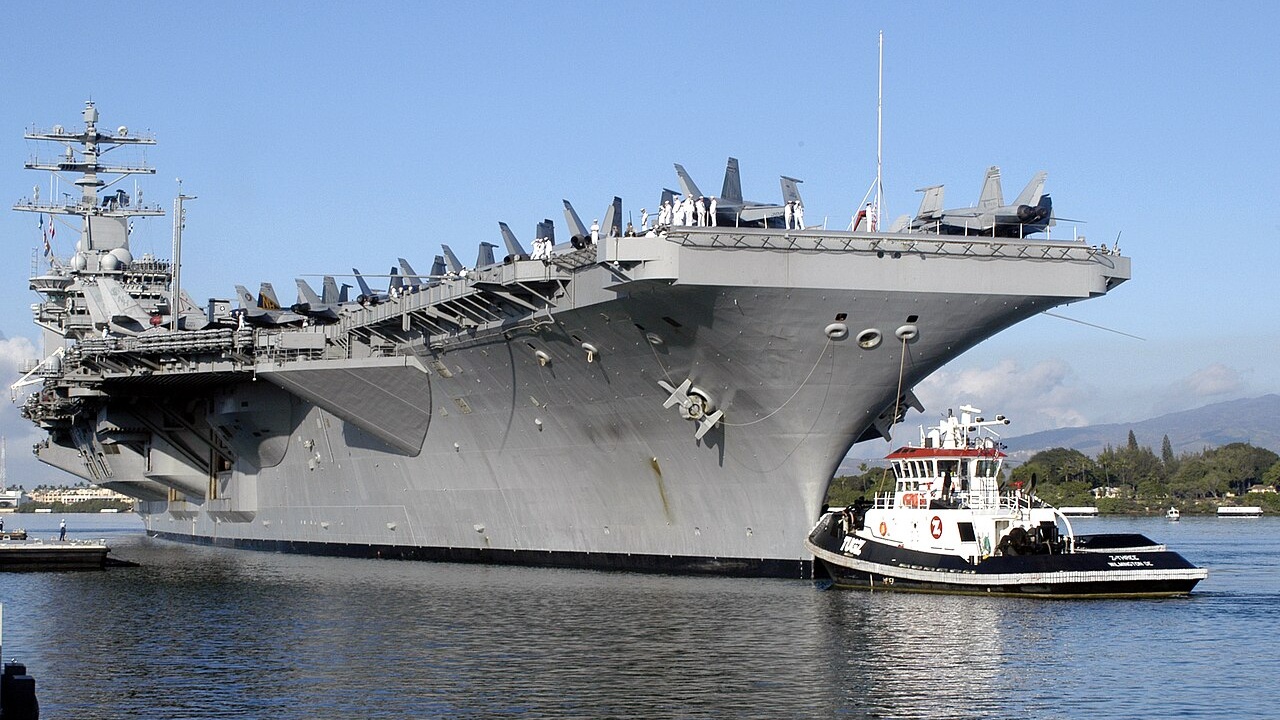
With simultaneous crises emerging in the Middle East and Asia, the United States has too few aircraft carriers for its global demands.
President Donald Trump appears to be seriously contemplating a massive strike against the wildly unpopular regime ruling the Islamic Republic of Iran.
Of course, whether the 47th president ultimately pulls the trigger or not remains uncertain. There are some speculations online that Trump might try to replicate his successful, limited tactical raid that captured Nicolas Maduro after a months-long naval buildup along the Venezuelan coast.
Regardless of whether Trump replicates the airstrikes from last year in Iran or if he attempts to kidnap Supreme Leader Ali Khamenei, the operational patterns emerging across the US military moving around the Middle East suggest that the Trump administration is preparing the option of comprehensive, sustained, and sweeping airstrikes—likely launched from a strike force of aircraft carriers.
Understanding America’s Middle East Carrier Surge
At present, the USS Abraham Lincoln and its attendant strike group are already in-theater. It is possible that the USS George H.W. Bush—now sailing in the western Atlantic—may soon travel to the region as well. Meanwhile, the USS Theodore Roosevelt, which recently departed San Diego for the Indo-Pacific, is widely believed to be a candidate for eventual redeployment to the Middle East.
Taken together, these movements point toward a developing strike window beginning January 25. From that point forward, the president would possess the naval aviation mass necessary to order large-scale carrier-based air operations against Iranian targets.
What far too few analysts are acknowledging, however, is the magnitude of the Iranian counterstrike that would inevitably follow.
Israeli Prime Minister Benjamin Netanyahu has casually declared—while operating from a secure location in Crete, it should be noted—that Israel could absorb upwards of 700 Iranian missile strikes if it meant the collapse of the Iranian regime. This is a breathtakingly glib assessment. America’s Arab partners, particularly Saudi Arabia and the Gulf states, are far less sanguine. They understand that Iran’s response would almost certainly involve large salvos of long-range ballistic missiles, emerging hypersonic weapons, and swarms of drones aimed at critical oil infrastructure, ports, desalination plants, and power generation facilities.
Then there is Tehran’s standing threat to close the Strait of Hormuz.
Yes, the US Navy has spent decades planning for precisely such a scenario. And yes, American naval power would almost certainly—eventually—be able to defeat Iran’s modest maritime forces. Any opening US strike package would undoubtedly target Iranian naval bases and missile sites near the Strait as a priority.
But planning and execution are not the same thing. Even a temporary disruption of traffic through the Strait of Hormuz would send global energy prices soaring, hammer financial markets, and impose real economic pain on America’s allies—and on Americans at home.
In short, a war with Iran would not be a contained, regional event. It would be an economic and strategic shock with global consequences.
America Might Need to Bring the Nimitz Back from the Scrapyard
There is another underappreciated danger, too. With American warships heavily committed in the Middle East and the Caribbean, any crisis in the Indo-Pacific—particularly involving China and Taiwan—could find the United States dangerously short of available carrier strike groups.
In such a scenario, the Pentagon might be forced to consider an extraordinary measure: returning the USS Nimitz to operational service.
The venerable Nimitz completed its final deployment in December 2025 and currently sits in Bremerton, Washington, awaiting the start of its decommissioning process. In May, the ship is expected to sail to its final destination, the scrapyard in Newport News, Virginia. Once there, its nuclear reactors will be removed, and the rest of the ship will be carefully broken up and recycled for scrap.
In other words, the decommissioning process of the Nimitz has not yet begun—and won’t for another four months. What’s more, before decommissioning, the Navy must begin a lengthy “inactivation” phase. So, even with inactivation set to commence in May, there will be a long time before it is fully decommissioned. Until then, the Nimitz is basically in hibernation.
While this is going on, the Nimitz’ roughly 3,000 crewmembers are not slated to fully transfer to new assignments until mid-April. In three months, the crew will be reassigned to Newport News, Virginia. Until that point, though, the ship could still be staffed if a real geopolitical emergency occurred between now and April/May.
This is the strange and precarious moment the US Navy now inhabits.
The US Navy Has a Shrinking Margin for Error
By law, America is required to maintain a fleet of at least 11 aircraft carriers. With the Nimitz slated for retirement and her replacement—the Ford-class USS John F. Kennedy—still under construction, the Navy is already flirting with dropping below that threshold. That is likely one of the reasons why the Navy isn’t rushing to render the Nimitz inactive and then decommission her.
If a major war occurs in the next few months in the Middle East while tensions simultaneously spike in the Pacific, the Nimitz may become an unlikely but key stopgap in any contingency.
About the Author: Brandon J. Weichert
Brandon J. Weichert is a senior national security editor at The National Interest. Recently, Weichert became the host of The National Security Hour on America Outloud News and iHeartRadio, where he discusses national security policy every Wednesday at 8pm Eastern. Weichert hosts a companion book talk series on Rumble entitled “National Security Talk.” He is also a contributor at Popular Mechanics and has consulted regularly with various government institutions and private organizations on geopolitical issues. Weichert’s writings have appeared in multiple publications, including The Washington Times, National Review, The American Spectator, MSN, and the Asia Times. His books include Winning Space: How America Remains a Superpower, Biohacked: China’s Race to Control Life, and The Shadow War: Iran’s Quest for Supremacy. His newest book, A Disaster of Our Own Making: How the West Lost Ukraine is available for purchase wherever books are sold. He can be followed via Twitter @WeTheBrandon.
Image: Wikimedia Commons.
















,_makes_a_port_visit_in_Pearl_Harbor_before_continuing_on_her_scheduled_deployment.jpg)