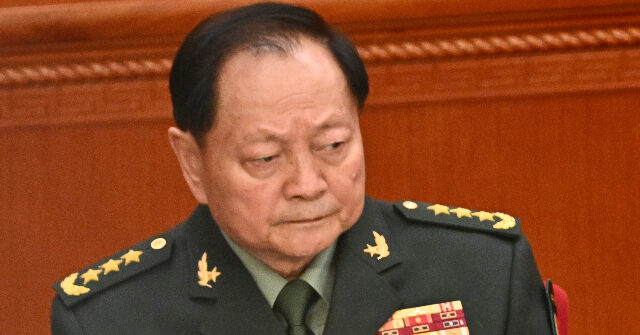
Gen. Zhang Youxia, the top-ranked vice chairman of China’s Central Military Commission (CMC), was abruptly removed from his position and placed under investigation for “severe violations of party discipline and state laws” over the weekend.
His ouster sent shockwaves through the Chinese Communist Party, since he was not only a top-tier member of the Politburo, but also a close personal ally of dictator Xi Jinping.
Another high-ranking member of the CMC, Gen. Liu Zhenli, met a similar fate over the weekend, leaving the People’s Liberation Army (PLA) with only one supreme military commander beside Xi himself: Gen. Zhang Shengmin, who was ranked below Zhang and was in charge of disciplinary affairs. Zhang Shengmin gained his seat on the CMC only this past October, when vice chair He Weidong and eight other top generals were purged.
Zhang and Liu were also among the few top Chinese military officers who had actual combat experience, thanks to the China-Vietnam border conflict of 1979. That experience will not be easy for Xi to replace and it could lead to morale problems among PLA troops.
The Chinese Defense Ministry did not offer specifics of the charges against Zhang when it announced his removal on Sunday, but the Wall Street Journal (WSJ) claimed, citing anonymous rumors, that Zhang has been accused of “leaking information about the country’s nuclear-weapons program to the U.S. and accepting bribes for official acts.”
According to the WSJ’s “sources familiar,” Zhang’s breach of security was revealed during the investigation of Gu Jun, formerly general manager of the China National Nuclear Corporation, the state-owned enterprise that oversees both civilian and military nuclear research in China. The probe of Gu allegedly discovered a nuclear security breach, which Zhang was somehow connected to.
Zhang has also reportedly been accused of “forming political cliques” that could undermine Xi’s power and accepting bribes to influence military procurement decisions.
Former CIA analyst Jonathan Czin of the Brookings Institution told Reuters that Zhang’s “shocking” removal “means that truly nobody in the leadership is safe now.”
Xi frequently conducts political purges of the PLA, usually justified as anti-corruption crusades, but no one so close to Xi has been targeted before. Xi even persuaded Zhang, now 75 years old, to put off retirement in 2022 so he could serve another term on the CMC. Zhang Youxia’s father, Zhang Zongxun, was one of the founding generals of the People’s Republic of China (PRC), and Xi Jinping’s father served alongside him.
Some observers took Zhang’s stature and personal closeness to Xi as evidence that his offenses must have been serious indeed for Xi to act against him. The Chinese dictator frequently expresses his frustration with corruption in the military, especially in procurement contracts. He placed a large number of handpicked loyalists into key military positions about fifteen years ago, to get a handle on corruption, but seems to have concluded many of his agents have themselves become corrupted by the system.
There are different schools of thought about what Zhang’s shocking purge means for China’s military planning. Some analysts believe Xi has been working so hard to iron out corruption because he wants a reliable, efficient PLA standing by to carry out his commands if he decides to move against Taiwan before leaving office. Others say the sacking of Zhang and Liu will leave the PLA unprepared for such a massive undertaking for years to come.