The phrase “everything is bigger in Texas” certainly applies to the state’s publicly funded stadiums and arenas. Now that Texas’s major cities are betting big on tourism, it will soon apply even more to its convention centers.
Eight Texas cities and counties—Houston, Dallas, Fort Worth, San Antonio, Austin, Corpus Christi, East Montgomery County, and College Station—are building, renovating, or planning convention centers. All come with glossy economic projections, drafted by consultants paid for such work.
Finally, a reason to check your email.
Sign up for our free newsletter today.
Ask a local official why cities in such close proximity are investing in such outdated projects, and you’ll hear the consultant-inspired refrain: “they pay for themselves.” But if history is any guide, convention centers are more likely to become massive money pits, with taxpayers left on the hook long after the politicians who approved them are gone.
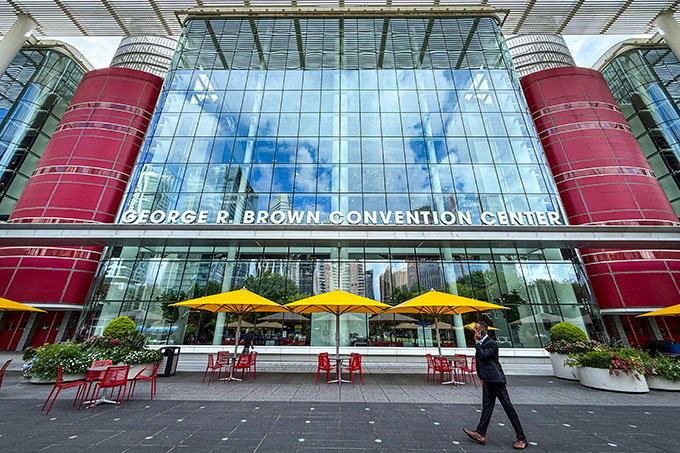
Of all the cities and counties, Houston probably has the best case for an upgraded convention center. This year, the Bayou City is slated to host seven FIFA World Cup matches, the World Baseball Classic, and the first of a three-year run of NCA All-Star Nationals (the nation’s largest cheerleading competition). The Republican National Convention will roll through in 2028, and the city hopes to host another Super Bowl in 2029. Notably, though, Houston secured these events without having completed its $2 billion, 700,000-square-foot convention center upgrade.
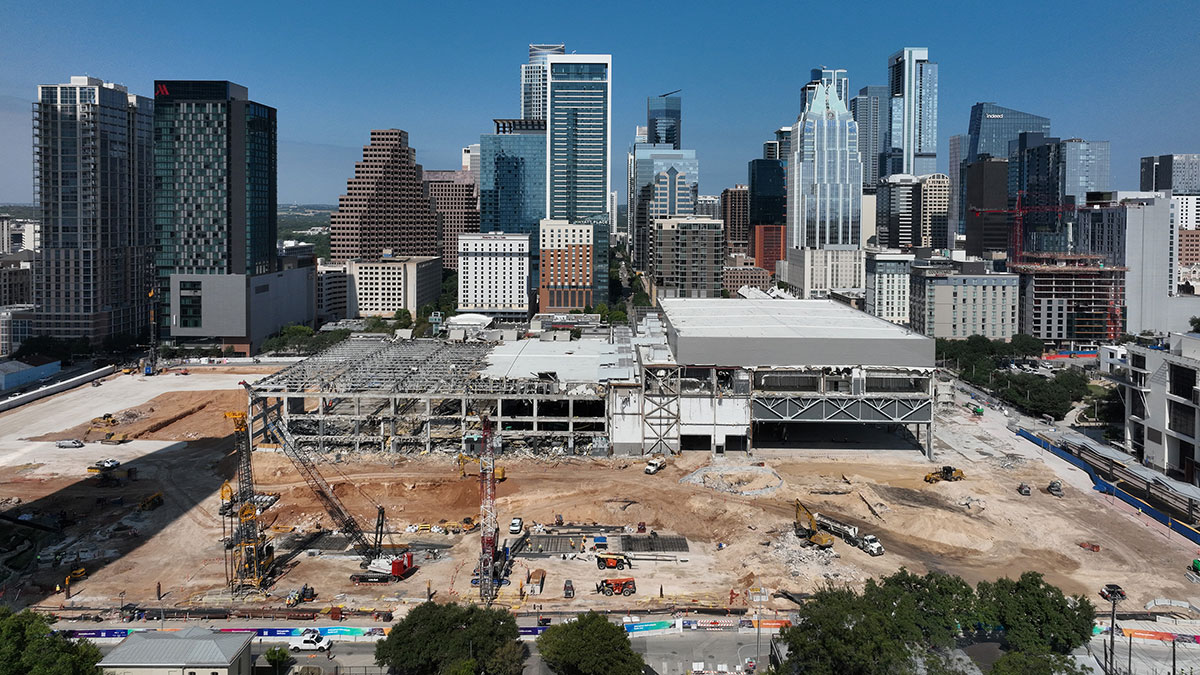
Other metros’ plans are similarly pricey. Austin is pursuing Unconventional-ATX, a $1.6 billion rebuild of its convention center that will double the venue’s size. Dallas’s Kay Bailey Hutchison Convention Center is getting a $3.5 billion rebuild, while neighboring Fort Worth’s convention center received a $700 million facelift as part of a $2 billion downtown redevelopment.
San Antonio is further expanding its Henry B. González Convention Center, planning an expansion running between $750 million and $900 million as part of its multibillion-dollar downtown redevelopment project. Corpus Christi just designated a Project Financing Zone (PFZ) around the American Bank Center Complex and expects to generate $70 million for critical upgrades. East Montgomery County, just north of Houston, is building the seventh-largest convention center in the state. College Station has its eye on a $500 million multipurpose convention and event center.
One would expect so many centers, so close together, to cannibalize each other’s markets. That’s not how the consultants see it.
Unconventional-ATX projects an added $285 million in spending and $13 million in new tax revenue every year. Houston’s projections are the boldest: $20.6 billion in new spending, $6 billion in new earnings and payroll, and $740 million in new tax revenue.
Consultants offer these rosy estimates despite a 2018 Texas comptroller’s office report finding that most convention centers “do not cover their operating costs, and competition among them has risen sharply.”
“Convention centers are highly expensive operations, and most don’t make a profit,” the report adds, “particularly when considering the debt service payments involved in their construction.”
Even without intense intrastate competition, convention centers almost never prove profitable. Two-thirds never cover direct operating costs, and more than half contribute nothing to debt service. Texas’s cities have seemingly adopted an arms-race logic: because our peers are building bigger, we must also build bigger, without considering whether enough demand exists to justify the venture.
Most convention center projects use one of two funding sources: local hotel-occupancy taxes and PFZs. Hotel-occupancy taxes are a revenue stream that must be used to encourage tourism, which cities are given broad discretion to define. When a PFZ is applied and approved by the state, a city continues to collect its local hotel-occupancy tax but is allowed, through the PFZ, to keep the state’s portion of the hotel-occupancy tax as well. The city also gets to keep revenue from the state sales tax and state mixed-beverage tax within a three-mile radius of convention centers, multipurpose arenas, or related infrastructure projects for up to 30 years.
But while visitors directly pay the taxes to fund these ventures, local taxpayers face real risk. If tourism underperforms and revenues come in below projections, Texas cities often use local tax dollars to cover convention center debt (and have faced credit downgrades because of it).
Unfortunately for taxpayers, the truth is that convention centers have not delivered economic boons; their real function is to provide a way for public officials to leave a symbol of their tenure. That’s a costly habit to maintain—and an even costlier one to remove.
Top Photo: The demolition of the Austin Convention Center in September 2025 (Jay Janner/The Austin American-Statesman via Getty Images)
City Journal is a publication of the Manhattan Institute for Policy Research (MI), a leading free-market think tank. Are you interested in supporting the magazine? As a 501(c)(3) nonprofit, donations in support of MI and City Journal are fully tax-deductible as provided by law (EIN #13-2912529).
Source link