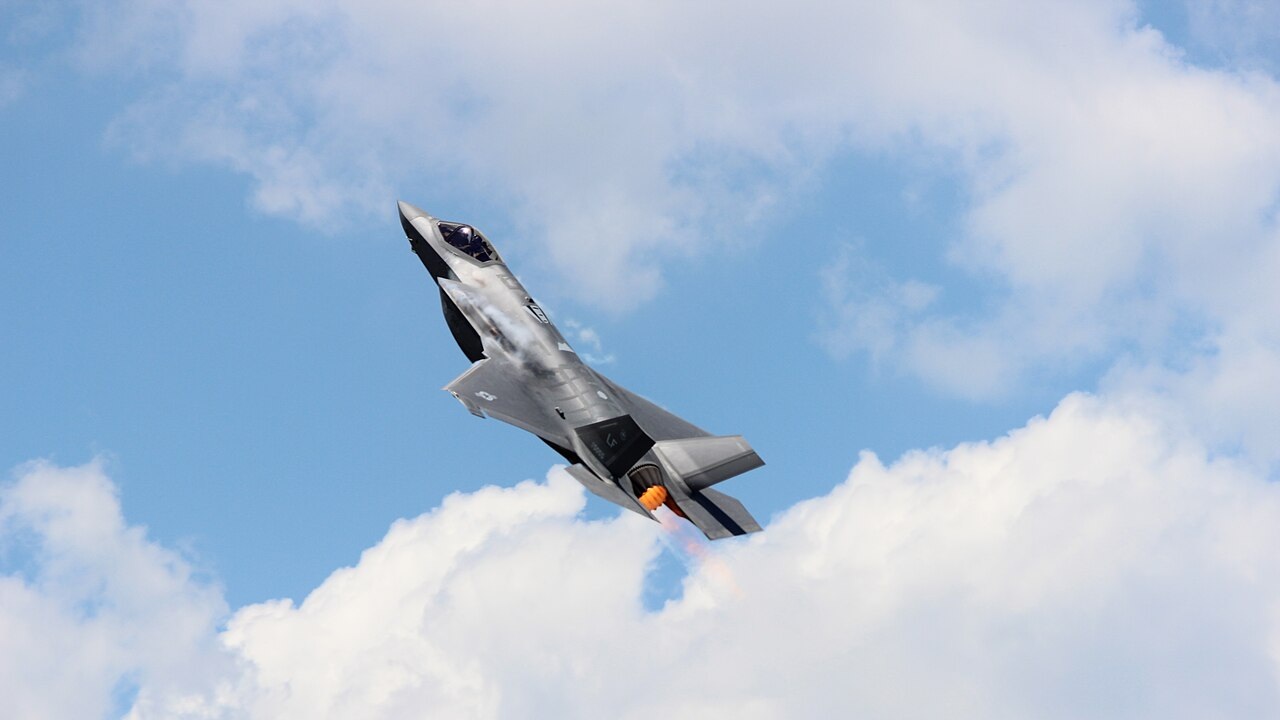
The F-35 was not built to win dogfights, but to operate smoothly at long ranges and over long periods of time.
The F-35 is often compared to the F-16 or the F-22, nimble aircraft with world-class handling characteristics, against which the F-35 falls short. But the comparison misses the point. The F-35’s handling characteristics are deliberately engineered, and are closely tied to the platform’s mission.
The F-35 was not designed to out-turn opponents, but rather to control space and survive first contact with an adversary. The handling, which in many respects has been de-emphasized, reflects the platform’s role, priorities, and the future of air combat.
The F-35 Lightning II’s (F-35A) Specifications
- Year Introduced: 2015
- Number Built: 1,000+, all variants (A, B, and C)
- Length: 51 ft 4 in (15.7 m)
- Height: 14 ft 4 in (4.36 m)
- Wingspan: 35 ft (10.7 m)
- Weight (MTOW): 70,000 lb (31,800 kg)
- Engines: One Pratt & Whitney F135-PW-100 afterburning turbofan
- Top Speed: ~1,200 mph (1,930 km/h) / Mach 1.6
- Range: ~1,380 mi (2,220 km) with internal fuel
- Service Ceiling: 50,000 ft (15,240 m)
- Loadout:
- 1 × GAU-22/A 25 mm rotary cannon (internal on F-35A only)
- Internal bays: Up to 4 × AIM-120 AMRAAMs or 2 bombs + 2 AMRAAMs
- External hardpoints: Up to 18,000 lb (8,160 kg) of ordnance (compromises stealth)
- Aircrew: 1
The F-35’s Basic Handling Profile
The F-35 is inherently stable—a stark contrast from the relaxed-stability designs of the F-16 and F-22. Why is this?
Essentially, the F-35 was designed with smooth handling in mind. Stability reduces pilot workload, allowing the plane’s operator to focus his or her efforts elsewhere. This prioritization—predictability over raw agility—means that the F-35 resists departure or abrupt energy loss. The result is an aircraft that is easy to fly and hard to mishandle, even under the stress of combat.
This does not mean that the F-35 is not maneuverable. Indeed, it can sustain a high angle of attack, with a flight control system that actively limits departure. But there is no thrust vectoring. Instead, the F-35 relies on control surfaces and software. In a post-stall envelope, the F-35 is stable and controlled, designed to recover safely and to allow the pilot to maintain situational awareness. The high AoA capabilities are used defensively for nose pointing and missile employment—not for prolonged post-stall maneuvering. As such, the F-35 has de-emphasized spectacle, especially relevant to peer fifth-generation fighters like the F-22 and the Su-57.
The Secret to the F-35: Control over Excitement
The F-35 enjoys an adequate—but not extreme—roll rate. Its pitch response is smooth and damped. The yaw is highly controlled. Fly-by-wire filters pilot input and prevents over-control. The system is calibrated to facilitate weapons employment and sensor alignment, not pure yanking and banking. In effect, the aircraft flies like a precision instrument, rather than a knife-edge dogfighter (akin to the F-22). The emphasis is still on lethality, but without aerobatic mastery.
The plane’s relative lack of maneuverability is the consequence of conscious design choices. The F-35 has a high internal fuel load, which adds weight. The wing was designed with a broad surface to improve lift and reduce wing loading penalty. The tradeoff is that its sustain turn rate is only modest. Accordingly, the F-35 prefers once-circle engagements and vertical maneuvering with altitude. Energy retention is software-managed; the jet protects the pilot from bleeding energy unnecessarily, which aligns with the BVR-first doctrine.
The jet’s handling characteristics reveal an intent to fight with sensors first, while minimizing pilot workload to allow for focus on the battlespace. The handling supports missile employment and high off-foresight shots while avoiding extended turning fights. The aircraft positions, engages and exits with a handling profile that prioritizes survivability and information over agility.
In short, the F-35 is never going to win any airshow competitions. But that has never been the point, and the plane’s customers understand that. Instead, the point is to enable the pilot’s information-centric mission—and the aircraft excels in that role.
The F-35’s handling characteristics reflect a shift in doctrine. Air combat has become networked and data-driven. The pilot is a manager of effects, not a stick jockey. The jet assumes that the fight is decided in BVR, and that should a dogfight develop, control and safety matter more than pure flair. These are intentional decisions that reveal a stark contrast with fighter doctrine of the late Cold War.
About the Author: Harrison Kass
Harrison Kass is a senior defense and national security writer at The National Interest. Kass is an attorney and former political candidate who joined the US Air Force as a pilot trainee before being medically discharged. He focuses on military strategy, aerospace, and global security affairs. He holds a JD from the University of Oregon and a master’s in Global Journalism and International Relations from NYU.
Image: Wikimedia Commons.