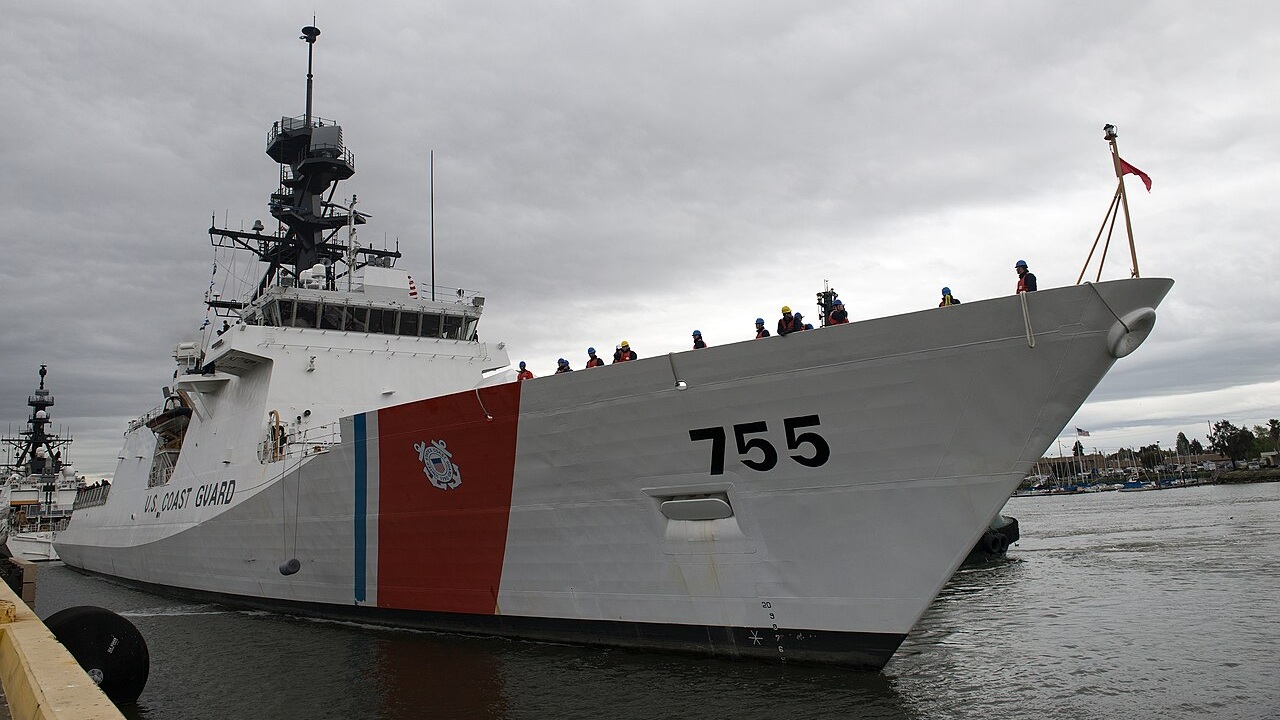
The FF(X) program could fill in for the ill-fated Constellation class, which saw cancellation last year after producing only two of the frigates.
The US Navy is confident that its new frigate will be operational in two years, according to senior Navy officials.
The FF(X) frigate is the Navy’s newest light warship, and the service wants a lot of ships and fast to bridge the gap with its Chinese adversary.
The FF(X) Frigate in Detail
What makes it more likely that the Navy will actually meet its timeline with the FF(X) is that the new frigate already has a proven design. Indeed, the Navy will be using the Coast Guard’s Legend-class cutter as the hull for the new frigate. The service has already agreed with Huntington Ingalls Industries’ (HII) Shipbuilding division, the manufacturer of the Legend-class cutter, for the work on the FF(X).
“Everybody keeps asking me, what about this? What about that? My answer back is, I care about getting this ship into production, learning, adapting and figuring out what this ship needs to grow into,” Chris Miller, the Naval Sea Systems Command’s executive director, said at the Surface Navy Association’s annual conference last week.
To facilitate the faster acquisition and operational fielding of the FF(X), the Navy is pursuing a gradual approach with regard to the development and subsequent capabilities of the new frigate. Under this approach, the service will first procure the necessary material to build and equip the maiden ship of the class before the Navy fully develops the FF(X)’s operational capabilities.
“We’ve also learned lessons on manning this ship. It will be designed to be maintained by sailors, and to have a right crew size to actually do what we have to get done, both in terms of maintenance and making sure the quality of life is what it needs to be,” the senior Navy officer added.
“I’m going to have a ship in the water by 2028 and it’s exciting, and I can’t wait, and it’s fast, and that’s okay,” Rear Admiral Brian Metcalf, program executive officer for ships, stated.
The Navy has been looking for a new frigate for some time. In November, the service decided to cut off the Constellation-class program at a very early stage, with only two ships under construction. Navy leadership cited extensive delays and cost overruns as the main reason for cancelling the program.
About the FF(X) Frigate
According to the unclassified information shared by the Navy, the FF(X) will have the following specifications:
- Year Introduced: Not yet introduced (expected 2028)
- Number Built: TBD (between 50 and 64)
- Length: 421 feet
- Beam (Width): 54 feet
- Displacement: 4,750 tonnes
- Engines: TBD
- Top Speed: 28 knots
- Range: 12,000 nautical miles (13,800 miles)
- Armaments: Up to 16 Naval Strike Missiles (NSM) or 48 cell AGM-114 Hellfire counter-unmanned aerial system missiles, 1×21 cell Mk 49 RAM air defense launcher, 1x57mm gun, 1x30mm gun
- Crew: 148
Aside from the corvette, the frigate has historically been the smallest surface combatant. In the age of sail, navies used frigates to transport important messages, scout ahead of the main fleet, and support coastal raids.
Today, navies rely on frigates for a number of mission sets, including anti-submarine warfare, anti-surface warfare, and air defense. Although technology and displacement values have changed significantly over the past century—indeed, a frigate today could be larger than a pre-World War I battlecruiser—the frigate is still considered a capable warship but with specific capabilities.
About the Author: Stavros Atlamazoglou
Stavros Atlamazoglou is a seasoned defense journalist specializing in special operations and a Hellenic Army veteran (national service with the 575th Marine Battalion and Army HQ). He holds a BA from the Johns Hopkins University and an MA from the Johns Hopkins’ School of Advanced International Studies (SAIS). His work has been featured in Business Insider, Sandboxx, and SOFREP.
Image: Wikimedia Commons.