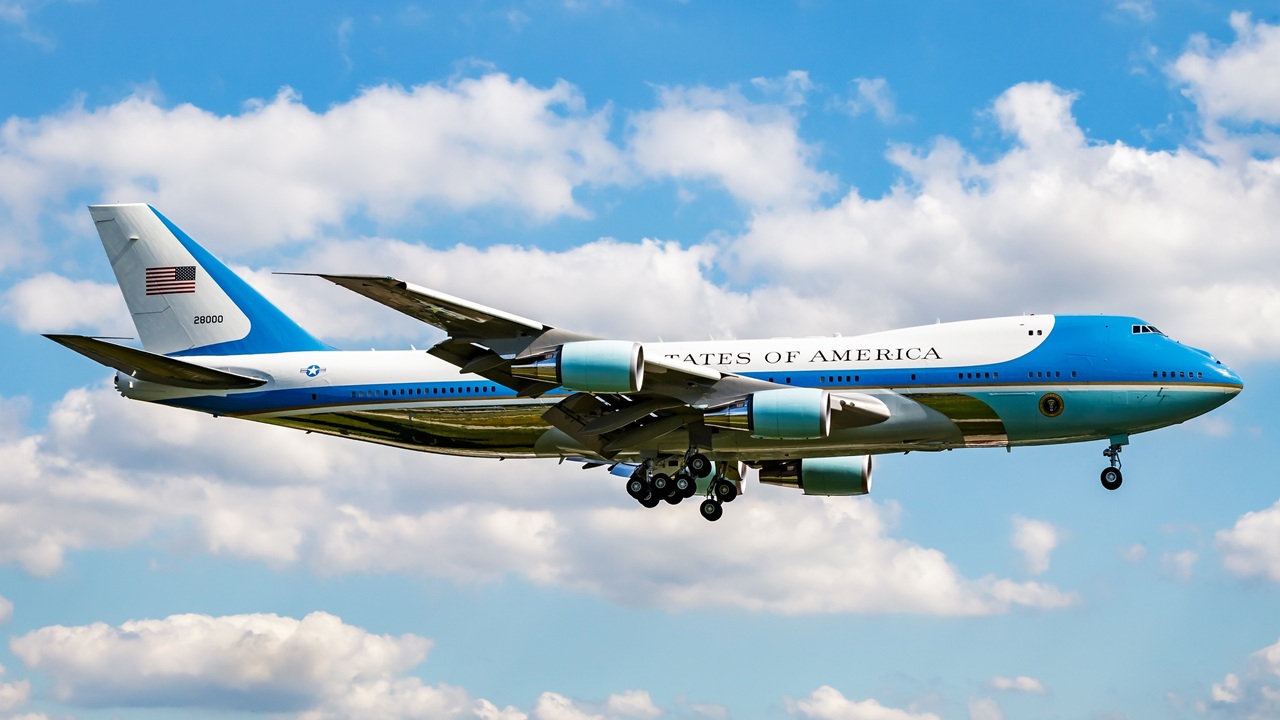
Air Force One was forced to turn back on its way to Davos, Switzerland—forcing President Donald Trump to use the vice presidential aircraft instead.
President Donald Trump didn’t make quite his planned triumphant arrival to Davos, Switzerland, earlier this week. The president arrived at the World Economic Forum about an hour later than expected after Air Force One was forced to abort its flight due to an electrical issue. Instead of arriving in the commonly used Boeing 747-200B, Trump was forced to travel on the smaller Air Force C-32, a modified Boeing 757.
“This has to be one of the best maintained planes in the world,” explained Mary Schiavo, CNN transportation analyst. “But there are things on every aircraft where when that warning light comes on you have to turn around and go back and address it.”
The C-32, which has a narrower body and is shorter, is usually used as the key VIP transport for the vice president and for the president when traveling to smaller airports. (For security reasons, the president and the vice president can never travel on the same plane, even when traveling to the same destination.)
There has been speculation on social media about whether the aborted flight affected Trump’s mood. Trump had previously criticized the current aircraft that serve as Air Force One, and this latest incident isn’t likely to endear the president to the aging planes.
The particular Boeing 747-200B was introduced in 1991, but despite its age, it has been maintained far better than any commercial airliner. The two new VC-25Bs, the military version of the 747, being modified to replace the existing 747-200Bs now in service, continue to run behind schedule—and likely won’t be ready until sometime in 2027 or 2028. That has further irked the president.
Minor Problems on Air Force One Are Taken Very Seriously
To date, there has been no serious incident involving an aircraft carrying the president of the United States. Experts note that technical problems are rare, mainly due to the meticulous maintenance and comprehensive checks performed on the aircraft. It wouldn’t be hyperbole to say that the military aircraft that carry the president are among the best-maintained in the world.
However, issues do occur.
According to a report from The Guardian, “In 2006 the primary Air Force One suffered a mechanical malfunction while on the tarmac in Ho Chi Minh City, Vietnam, forcing George W Bush to board the backup aircraft, a Boeing 757, to fly to his next destination in Indonesia.”
Beyond the maintenance, by law, Air Force One, which is any aircraft carrying the president, receives air traffic priority. Its crews are also described as “top-tier” and are trained to handle tricky landings and conditions.
Finally, although the president flies more than almost any business traveler in the world, the aircraft that serve as Air Force One are kept in reserve for his personal use—and, as a result, simply don’t log the same number of miles as commercial aircraft, and usually have fewer maintenance issues as a result.
Qatar’s Donated 747 Is Back in the Spotlight
Following the electrical issue this week, there is growing speculation that efforts may be rushed to allow Trump to use the Boeing 747-8 donated by the Qatari government last year.
Defense contractor L3Harris Technologies was contracted to overhaul and modify the donated jet, which was delivered to the Qatar Amiri Flight, a VVIP airline owned and operated by the Qatari government, in April 2012. The ruling Al-Thani family of Qatar had previously used the aircraft for flights to the United States and Europe.
Although described as a “flying palace” with a main bedroom, two full bathrooms, a guest bedroom, and multiple lounges, the aircraft must be stripped down and rebuilt to serve as Air Force One. Current independent estimates suggest that work on the gifted aircraft would cost up to $1 billion.
Efforts are underway to prepare the plane for use, which could be as early as this summer.
It remains unclear how the work can be completed on the donated aircraft, whereas it took years to complete on the two purchased by the US Air Force in 2015.
About the Author: Peter Suciu
Peter Suciu has contributed over 3,200 published pieces to more than four dozen magazines and websites over a 30-year career in journalism. He regularly writes about military hardware, firearms history, cybersecurity, politics, and international affairs. Peter is also a contributing writer for Forbes and Clearance Jobs. He is based in Michigan. You can follow him on Twitter: @PeterSuciu. You can email the author: [email protected].
Image: Shutterstock / Soos Jozsef.